Organized by our researchers Francesco Avanzi and Francesca Munerol, these seminars aim at raising awareness among high school students about the importance of a sustainable use of water resources and the associated challenges in a warming climate
With the new year, new seminars dedicated to high school students will start, beginning with a pilot at the Institute of Higher Secondary Education of Loano (Savona). These seminars are organized by our researchers Francesco Avanzi, of the Hydrology and Hydraulics Department, and Francesca Munerol, of the Planning and Procedures Department and legal specialist at CIMA Research Foundation. These seminars aim at introducing next generations to a resource of which some aspects are still little known: water! Our researchers will not follow the traditional, lecture-style approach; rather, they will base on a participatory, laboratory-based method.
We all know how important water is for life on our planet. And yet, there are many aspects of water supply that we don’t consider in our daily lives, or we even underestimate, with the consequence of fueling political, social, and economic conflicts and tensions. Our researchers will help students finding answers to questions like: what does it mean to manage water resources? How do human activities affect it? What are the expected impacts of climate change and the associated solutions for sustainable development in a warmer world? Starting from these questions, our researchers have developed three educational modules for high schools, each lasting one hour, to address some of the most topical and yet lesser-known issues surrounding this fundamental resource.
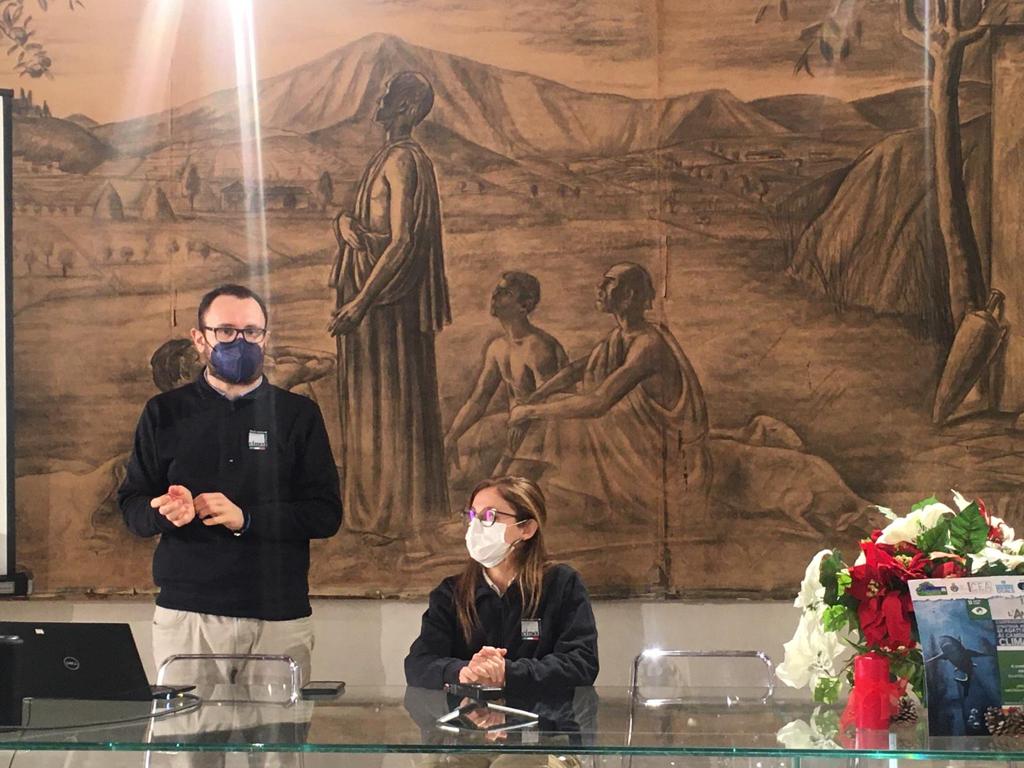
The first module of these seminars is dedicated to understand the water cycle – a cycle that will be “rewritten” with the students themselves based on their own experience and knowledge. The goal is to show how the same term “water resource” has many different meanings, sometimes even in conflict with each other. The second module will be dedicated to language, more precisely to sharpen students’ understanding of the most common and recurring terms and expressions surrounding the issue of water resources and climate change: an opportunity to confer a more precise meaning to words, names and expressions like the Paris Agreement, drought, water conflict, Next Generation EU, which are used almost daily in the media but that are not always easy to place in the overall picture. With this second step, the researchers want to help students acquire awareness of language and the phenomena it describes, as well as to get students ready to play an active role in finding solutions.
The third module, finally, represents a synthesis of the previous ones and focuses on the still little known theme of water conflicts and how they are increasingly fuelled by the effects of climate change. The socio-political, juridical, and technical characteristics of some of these conflicts will be illustrated, so as to reflect with students on possible solutions – even presenting some of those already implemented.
“We designed this course to prepare next generations to play a key role in solving the most pressing challenges of the 21st century, the century of water”, Francesco Avanzi comments. “Water is indeed an extremely topical subject, whose challenges will fall mostly on future generations. These generations must be as aware as possible of the implications, ramifications, and possible solutions that can be put in place ». According to Francesca Munerol, “Precisely because of the importance of the topics covered, we chose to start this group of seminars with high school students, but we have designed it in a way that it is flexible and adaptable to other targets. Our goal is o make scientific knowledge accessible to all.”