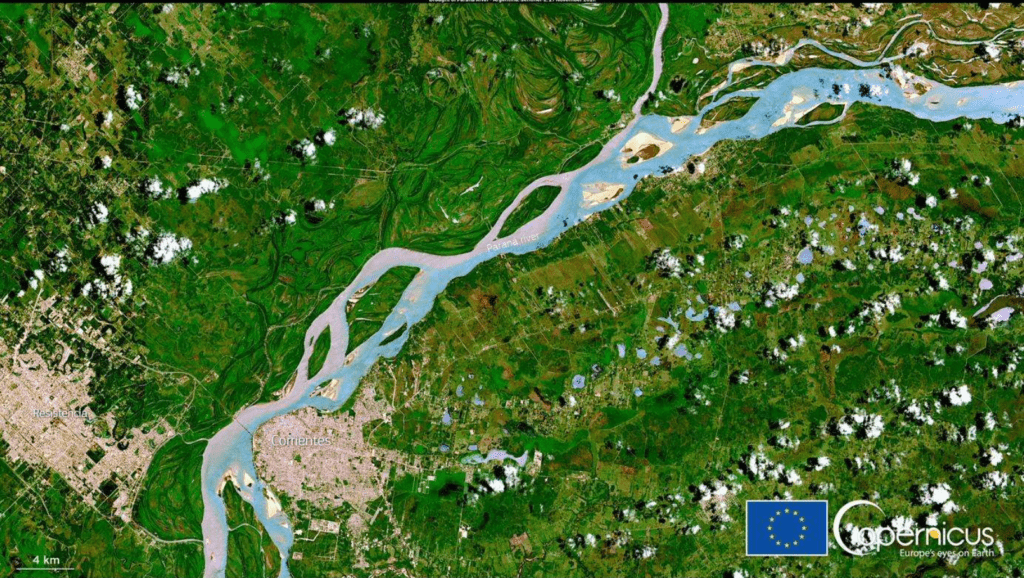
The European Union’s Joint Research Centre (JRC) has published a technical report to update about the drought situation that has been affecting the Parana-La Plata basin in South America for four years now. This is a vast area involving five countries (Argentina, Brazil, Paraguay, Uruguay, Bolivia), for which the impacts have been significant in environmental, energy and economic terms. CIMA Research Foundation, which has been involved in various projects in South America for years, contributed to the report
We have spoken several times about the drought that affected Italy during 2022. However, Italy is certainly not the only country that has recently suffered from drought, for which it is estimated that frequency and intensity will increase in many areas of the world due to climate change. The Parana-La Plata basin, which stretches across Argentina, Brazil, Paraguay, Uruguay and Bolivia is currently suffering from the greatest drought in the region for more than eighty years. A recent report by the EU Joint Research Centre, contributed by CIMA Research Foundation, brings together what we know about the characteristics of the event, the impacts on the area, and monitoring and response efforts.
Drought: various causes
The Parana River is the second longest in South America after the Amazon, and thus plays a vital role in the basin it feeds. Unfortunately, however, its water levels are now the lowest they have been since 1944, and several factors seem to contribute to explaining this phenomenon. A reason for the water shortage can be attributed to La Niña, a periodic oceanic phenomenon in the equatorial Pacific Ocean, whose temperature alterations affect atmospheric conditions in different areas of the world. “The mechanisms by which La Niña modifies weather conditions in different areas of the world are complex. Very briefly we can say that they determine, in the Parana-La Plata basin, a decrease in precipitation,” says Gustavo Naumann, former researcher at CIMA Research Foundation and now at the European Research Executive Agency of the European Commission, and one of the authors of the report. “Being known, the La Niña phenomenon and its “warm counterpart” El Niño, which together with their related changes in atmospheric circulation are known as the El Niño Southern Oscillation (ENSO), can support weather forecasting: that is, knowing that the phenomenon is ongoing, we can predict a shortage or excess of rain in areas where the the effect of this perturbation .”
Begun in 2020, La Niña may be partially responsible for the drought but, the report’s authors point out, changes in land use, combined with the presence of concomitant extreme events such as the heat waves of 2020 and 2021 (which also have favoured numerous fires in the region) play a role. The report does not focus on the dynamics that contributed to this prolonged drought but, rather, on its characteristics; however, “It is worth pointing out that, although the issue is still debated and the mechanisms are not fully known, deforestation could in fact influence drought events because moisture brought by plants is lost,” says Dr Naumann.
The JRC report is an update of the first technical report, published in 2021. Drought conditions, in fact, were already observable in mid-June 2019: at that time, rainfall was not particularly low, but the situation worsened over time, persisting until May 2022. As a result, soil moisture was also reduced over time, and in turn this led to vegetation stress, albeit with different responses depending on the type of soil in the area under consideration, plant species, topography, and various other factors that may influence plant response.
“We could say this is a classic study-case drought, because it started as an upstream precipitation anomaly (roughly in the São Paulo area in Brazil), and thus a meteorological drought, which over time led to a reduction in the flow of the rivers fed by the Parana-and thus a hydrological drought,” Dr Naumann adds.
From impacts to monitoring
One of the most important focuses of the report concerns the analysis of the impacts this long drought is having in the affected South American countries. “We have to consider that there are several aspects that distinguish them from the Italian and, more generally, European economies,” explains Lauro Rossi, director of the Impact-based Early Warning Systems o Climate Threats Program at CIMA Research Foundation, who is also among the authors of the report. “For example, water shortage in the rivers has raised the concern of possible power rationing given the grid dependence on hydroelectric plants in the region. According to the Argentinian National Water Institute, this situation has led countries to turn to less sustainable energy sources such as thermoelectric, which utilizes fossil fuels”. Again, a significant effect has been observed in terms of transportation, because the rivers in this vast region are an important communication route for the countries they bathe (Argentina, for example, exports about 80 percent of its agricultural products along the Parana waterway) but in some places were no longer navigable during this event.
In addition various effects on ecosystems, both direct and indirect, were observed: for example, water scarcity led to the concentration of pollutants in some areas, which in turn led to the uncontrolled growth of toxin-producing cyanobacteria, affecting the entire river biotic component. In turn, this affected fishing and various other activities that had to be banned during the summers of 2020 and 2021. In 2022, the Argentine Ministry of Health also issued a health alert for certain bacteria causing gastroenteritis and nasal congestion. In addition, the drought has contributed to the spread of fires in the region-triggered, in part, by the agricultural techniques employed and often much discussed-that have also affected protected areas.
The report closes with an analysis of monitoring systems in the different countries that include the Parana-La Plata basin. Among them is the National Monitoring System of Bolivia implemented by CIMA Research Foundation in 2019-2020. “Accurate monitoring, carried out with an organized chain and valid indicators, is a key tool to support adaptation to drought and mitigation of its impacts,” Dr Naumann says. “However, the basin area is very large, and the drought has affected several nations (Argentina, Brazil, Paraguay, Uruguay, Bolivia): the crucial point, therefore, is to have shared information, and this implies the need to encourage dialogue between different national agencies. This is not an easy task, because we must also consider that different entities are involved in the different nations. One attempt to incentivize this dialogue, as highlighted in the report, is represented by the Sistema de Información sobre Sequías para el sur de Sudamérica (SISSA), which began in 2019: it is a collaboration between six nations that develops and disseminates drought monitoring products derived from in situ and satellite data and, above all, works for the improvement of drought management by acting on institutional capacity, governance and planning.”
“CIMA Research Foundation has been working for many years in South America and the Caribbean, developing Early Warning systems for floods, fires, droughts. Our task is to provide state-of-the-art tools that can be used in real time to predict impacts and implement countermeasures to protect goods and people. In addition to the national drought monitoring system in Bolivia, the study of the Andean glaciers as a source of water resource of the downstream cities, the monitoring and forecasting systems of floods (Bolivia, Guyana, Belize) and wildfires (Paraguay, Bolivia), the development of a multi-sensor precipitation product (merging satellite, radar, in situ stations) in the Caribbean with high spatio-temporal resolution are just a few examples of our commitment in the region to improve monitoring and forecasting capabilities and develop Early Warning Systems for all», concludes Dr. Rossi.
Crediti immagine: Naumann, G.,Podestá, G., Marengo, J., Luterbacher, J., Bavera D., Acosta Navarro, J., Arias Muñoz, C., Barbosa, P., Cammalleri, C., Cuartas, A., de Estrada, M., de Felice M., de Jager, A., Escobar, C., Fioravanti, G., Giordano, Harst Essenfelder, A., L., Hidalgo, C., Leal de Moraes, O.., Maetens, W., Magni, D., Masante, D., Mazzeschi, Osman, M., Rossi L., M., Seluchi, M., Skansi, M. M., Spennemann, P., Spinoni, J., Toreti., A, Vera, C., Extreme and long-term drought in the La Plata Basin: event evolution and impact assessment until September 2022, Publications Office of the European Union, Luxembourg, 2022, doi:10.2760/62557, JRC132245. License: CC BY 4.0