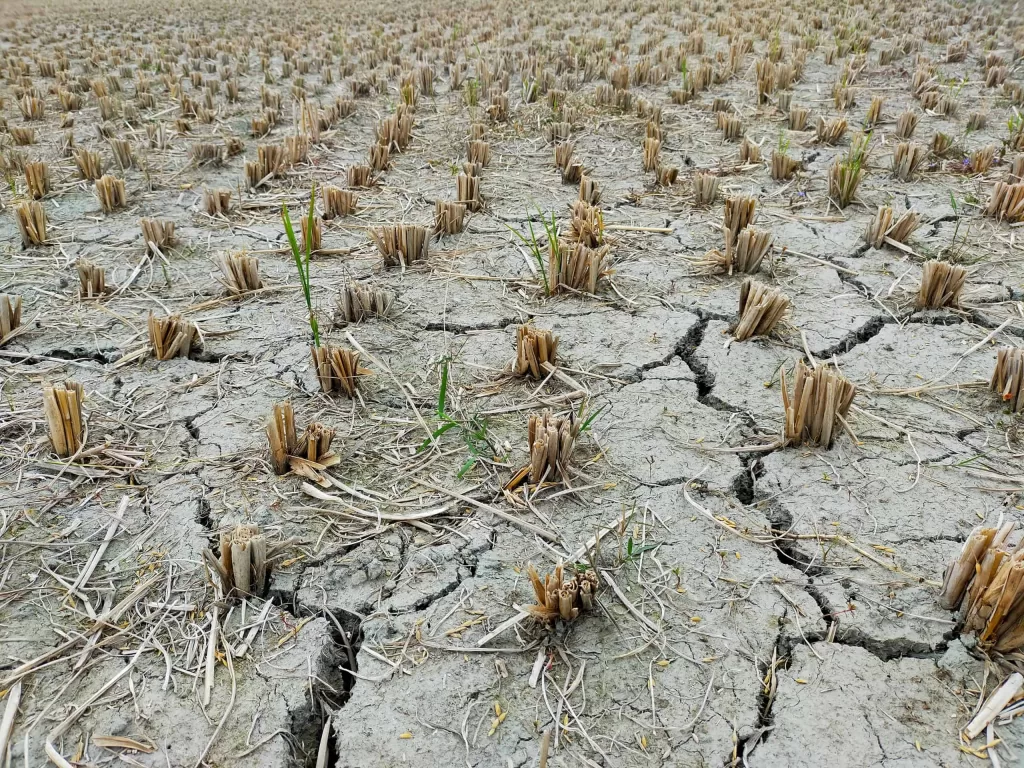
The technical report analyzing the data on the drought that is affecting the north of the country has just been published. CIMA Research Foundation has contributed to the document, focusing on Snow Water Equivalent, that is, water available in the mountains in the form of snow, which this year is 40% of the median of the last 12 years
The Global Drought Observatory (GDO) of the JRC has just published a technical report dedicated to the drought currently affecting Northern Italy. The document, to which the CIMA Research Foundation has contributed, presents the data available on the situation, including the impacts that this period of drought has had so far.
As we have already reported, Italy (as well as other European countries) is being affected by a period of drought that our researchers are analyzing. The GDO regularly monitors droughts, and every month releases analytical reports on the situation. Moreover, when an event is likely to have a major impact, GDO produces a specific in-depth report. This is the case of the report that was just released, in which the different parameters and elements characterizing the current drought are analyzed.
Among the different parameters analyzed, CIMA Research Foundation’s contribution focused on the so-called Snow Water Equivalent, which can be described, in short, as how much water is available in the form of snow. “Data collected for the Italian Alps in recent months indicate that, after a November with average snow accumulation, the subsequent dry period resulted in 40% of the 2009-2021 median conditions currently being accumulated across the Italian Alps. This deficit is particularly marked in the northwestern Alps,” explains Francesco Avanzi, researcher in the Hydrology and Hydraulics Department who contributed to the report. “The relevance of this snow shortage lies in the fact that snow represents the most important spring water reservoir for various activities, from energy production to agriculture. In other words, snow deficit may not pose an immediate problem, but this shortage may become evident in the next months: it is between March and April, indeed, when the increase in temperature determines the melting of snow, which, in the form of water, can be employed for irrigation and other activities, including ecosystem conservation.”
This is already a concern for some crops. For rice, for example, irrigation starts right in April. According to the JRC report, as of today, vegetation in northern Italy is still in normal conditions, but water availability is and will be lower than normal as it will unlikely be able to fill up with the spring snowmelt (the Po River and its tributaries, are already observing very low flows). “In addition, we are already observing a negative effect on hydropower generation systems: for many Italian reservoirs, the current levels are even lower than minima reached between 1970 and 2019,” says Gustavo Naumann, also researcher in the Hydrology and Hydraulics Department involved in the report.
Nevertheless, even if precipitation were to be plentiful in the coming months, the problem would not be completely solved: “When we talk about snow, for example, we are in fact referring to a water reservoir. This means that a shortage of snow is a shortage of ‘spare water’ that cannot be filled later,” the researcher explains. “And although the problem regards especially crops relying on irrigation, others may also be affected: in fact, in the absence of water, even crops that can normally rely on precipitation might need to be irrigated.”
Even taking into account that long-term forecasts are subject to uncertainty, seasonal forecasts for the period from March to May are not helping: in fact, forecast models suggest a drier-than-normal period for Piedmont and the southern part of Veneto, as well as for much of Italy, with some hotspots in Sardinia, Provence and Corsica.