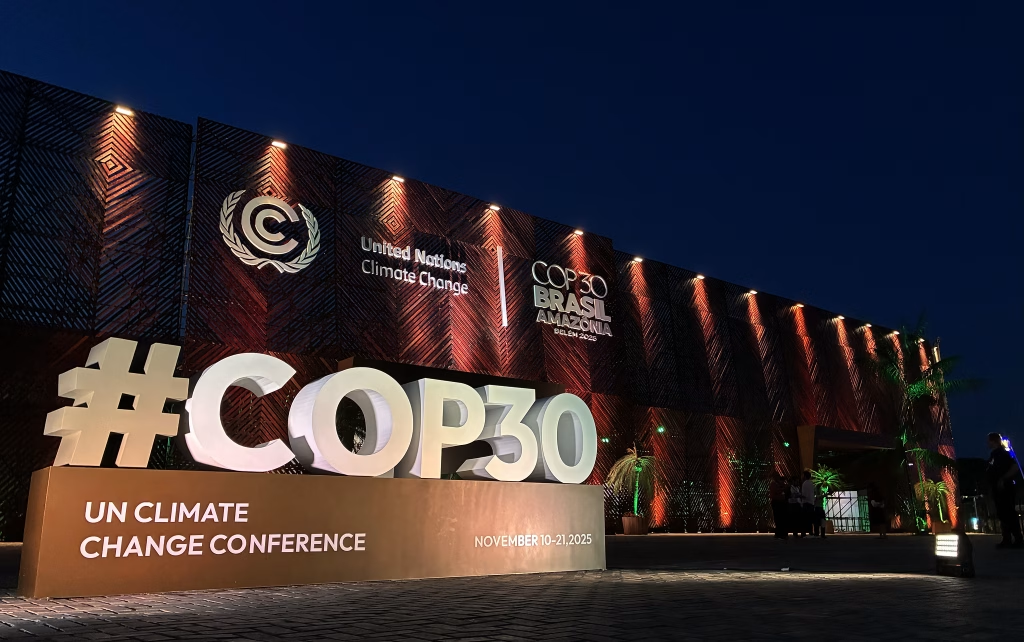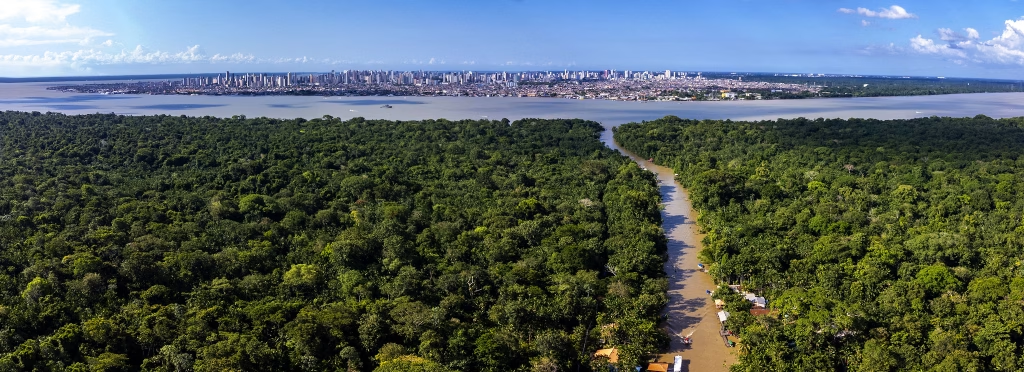
In Belém, in the heart of the Amazon, COP30 brings together governments, organizations, and the scientific community to redefine global climate action. This is where the human dimension of climate change—warning systems, migration, forced displacement, loss of land and livelihoods—forcefully enters the political and scientific agenda.
From early warning to climate mobility, from risk modelling to transcontinental cooperation, the presence of CIMA Research Foundation at COP30 represents a continuous thread connecting research, training, and risk governance. In a world where climate change is redefining the boundaries of the possible, science becomes a shared language to build trust, cohesion, and adaptive capacity — and, above all, to act together.
Cooperation for early action: Mozambique and AMHEWAS
CIMA Research Foundation takes part in two high-level events that broaden the perspective of scientific cooperation for early action.
At the high-level side event “Building Resilience in Africa: Mozambique”, held at the Italian Pavilion, President Luca Ferraris joins representatives of the Government of Mozambique, the African Union Commission (AUC), the Italian Ministry of Foreign Affairs and International Cooperation (MAECI), the Italian Agency for Development Cooperation (AICS), the United Nations Office for Disaster Risk Reduction (UNDRR), and the Food and Agriculture Organization of the United Nations (FAO).
The event is framed within the Mattei Plan for Africa and highlights the contribution of the Italian cooperation system — of which CIMA Research Foundation is an active part, together with MAECI and AICS — in strengthening early warning systems and integrating them into urban and territorial planning. Mozambique provides a concrete example through the National Emergency Operations Center (CENOE) in Maputo, which recently inaugurated its new Situation Room as part of the AMHEWAS network.
The initiative is grounded in close collaboration with Mozambican institutions — in particular the Instituto Nacional de Gestão e Redução do Risco de Desastres (INGD), the Instituto Nacional de Meteorologia (INAM), and the Direção Nacional de Gestão de Recursos Hídricos (DNGRH) — which lead the strengthening of the national early warning system and its integration into the continental AMHEWAS network.
The theme of early warning system enhancement is also central to the event “Sustainable Financing for the AMHEWAS Programme: Bridging the Gap between Early Warning and Anticipatory Action”, promoted by the AUC, the Government of Mozambique, and UNDRR. On this occasion, CIMA Research Foundation contributes to the discussion on strategies to consolidate the continental multi-hazard early warning network, providing its technical and scientific expertise in developing methodologies for system interoperability — through hydrometeorological models and multi-hazard forecasting platforms that support decision-making and the timeliness of response actions — alongside the strengthening of local capacities.

A Memorandum for scientific cooperation between CIMA and IOM
For years, CIMA Research Foundation has developed a dedicated line of research on disaster risk displacement, analysing the relationship between climate change, disasters, and human mobility. The objective is to understand how environmental, social, and climatic factors intertwine in driving population movements, translating scientific evidence into planning and adaptation tools. These analyses rely on quantitative approaches and integrated risk models that combine climatic, demographic, and socio-economic data to assess the likelihood and intensity of displacement over time.
Within this framework, the Memorandum of Understanding between CIMA Research Foundation and the International Organization for Migration (IOM) marks a step forward in a collaboration aimed at merging scientific and operational expertise to address the challenges of climate mobility. The agreement defines a shared framework for the development of analytical models and tools, the integration of nature-based solutions into risk reduction strategies, and joint scientific dissemination and training activities.
This partnership strengthens the role of research as the foundation for informed decision-making and evidence-based adaptation policies.
At COP30 to address climate mobility
This collaboration takes shape through two joint events with IOM and scientific partners — the United Nations University – Institute for Environment and Human Security (UNU-EHS), ETH Zurich, and the Internal Displacement Monitoring Centre (IDMC).
In the side event “Quantifying Climate- and Disaster-Related Displacement for Loss and Damage: From Modelling to Action”, CIMA Research Foundation contributes to the presentation of the Global Disaster Displacement Risk Model, a tool that projects internal displacement risk for multiple natural hazards and climate scenarios up to mid- and end-century. The model translates complex risk information into operational insights for adaptation planning, particularly in fragile and conflict-affected contexts, as illustrated by the case study on Somalia.
Within the Climate Mobility Pavilion, the interactive initiative “Climate Mobility Data and Literacy – Projecting Climate Migration and Displacement” invites participants to explore data and displacement projections through a hands-on experience, fostering dialogue among science, policy, and society.
Both events aim to make scientific knowledge accessible and actionable, encouraging shared reflection on how data can guide adaptation and Loss and Damage responses.
Special Mention
The Italian Society for Climate Sciences (SISC), in its role as Designated Contact Point, has appointed Francesca Munerol, researcher at CIMA Research Foundation, as one of its delegated observers to the United Nations Climate Change Conference in Belém.
Observers take part in the Conference proceedings to contribute – on behalf of the scientific community – to the international dialogue on climate research, policies, and action.
This appointment highlights the active role of CIMA Research Foundation in advancing scientific cooperation in support of global decision-making on climate change.
Knowledge, cooperation, action
From understanding the risks that drive human mobility to building increasingly effective early warning systems, the work of CIMA Research Foundation at COP30 reflects a single vision: transforming knowledge into cooperation.
Through its partnership with IOM and its technical-scientific contribution to African programmes such as AMHEWAS, the Foundation strengthens the link between research, data, and decision-making, promoting a global approach to resilience.
In a rapidly changing world, the science of risk thus becomes a science of shared responsibility — connecting people, territories, and institutions in building a safer and more informed future.