We describe the activities carried out by CIMA Research Foundation within the Horizon 2020 TRIGGER project, which started in 2022
The climate crisis alters our environment and causes phenomena like floods and droughts, but it also poses a significant threat to our health , involving complex dynamics and connections that research has increasingly brought to light over the years.
The link between the climate crisis and human health is at the heart of the Horizon 2020 TRIGGER project, which brings together 22 international partners, including CIMA Research Foundation. We share our activities in the project by discussing them with our researchers.
Climate and health
Floods, extreme rainfall, droughts, fires: these are all phenomena on which CIMA Research Foundation has been working for years, also exploring how climate change alters their frequency and intensity. That they can be directly responsible for deaths and injuries is evident; less direct, sometimes, is the link with other aspects of our health. Yet, it is a strong link, and it will become even more pronounced if we fail to mitigate the climate crisis. There are, for example, risks related to malnutrition and food insecurity due to damage to agriculture in case of drought and ecosystem changes. There are cardiovascular risks related to heat waves, and also those of certain vector-borne infectious diseases (such as ticks and mosquitoes), which change their distribution and periods of activity in response to rising temperatures. The list could go on, and unfortunately, as the World Health Organization reports, it should be noted that some groups of people, such as the elderly, the young, or the poor, are often more vulnerable.
“The aim of the TRIGGER project is to identify, quantify, and monitor the impacts of environmental risks related to climate change on human health through the direct collection of health, weather-climate, environmental, and socio-economic data using user-friendly tools,” say Riccardo Biondi and Antonio Parodi, respectively a researcher in Meteorology and Climate Department and the program director at CIMA Research Foundation. “One of the first objectives is therefore to select suitable environmental indices and calculate them on a very small spatial scale, thus very precisely.”
A selection for health
It is not a trivial objective, because there are various environmental parameters that can be analyzed to study their conditions, and for each, there are often several indices available that report the measure, with slightly different characteristics. This was the task for CIMA Research Foundation within the project.
“We analyzed the available scientific literature identifying all the indices that can have an impact on human health,” explain Dr Biondi and Dr Parodi. “Then we grouped them into different categories: for example, some are directly linked to temperatures, others to precipitation or humidity. Some of the identified indices have a direct impact on health: these are, in particular, air pollution indicators (such as the concentration of carbon monoxide or particulate matter). In addition, we also conducted a historical selection of climatological data related to these indices and the tools that allow monitoring them.”
It was then necessary to select the identified indices, choosing those that have the most significant impact on human health. Environmental parameters can indeed have very different effects depending on how they “associate” with each other: high temperature, for example, poses a greater risk of overheating if associated with high humidity levels because the sweat by which the human body disperses heat cannot evaporate quickly. Among the selected indicators, many refer to interconnected phenomena. For example, the Heavy Precipitation Index is related to rain, but this in turn influences the risk of fires, which in turn affect air quality because they are responsible for releasing various compounds (such as hydrocarbons, carbon monoxide, and dioxide, etc.) into the atmosphere.
“The selection of the most suitable indices was carried out by the Augsburg University (Germany), a project partner with greater health expertise,” says Dr Biondi and Dr Parodi. “One of the interesting aspects of the project – and increasingly characterizes scientific research – is indeed the multidisciplinary approach: the medical research world and the weather-climate research world find themselves closely collaborating to create synergies between their knowledge.”
Data collection and analysis will be carried out in five Climate-Health Connection (CHC) Labs, in Augsburg (Germany), Bologna (Italy), Geneva (Switzerland), Heraklion (Greece), and Oulu (Finland), which also serve as focal points for citizen science activities and stakeholder engagement. “CIMA Research Foundation is still involved on various fronts. At the moment, however, our main task is to provide climatological datasets, with runs of the WRF meteorological model at very small spatial scales, in the order of 2-3 kilometers,” conclude Dr Biondi and Dr Parodi. “These datasets are important for historical analysis, and therefore also for future projections and medium-term forecasts of climate change-related hazards.”
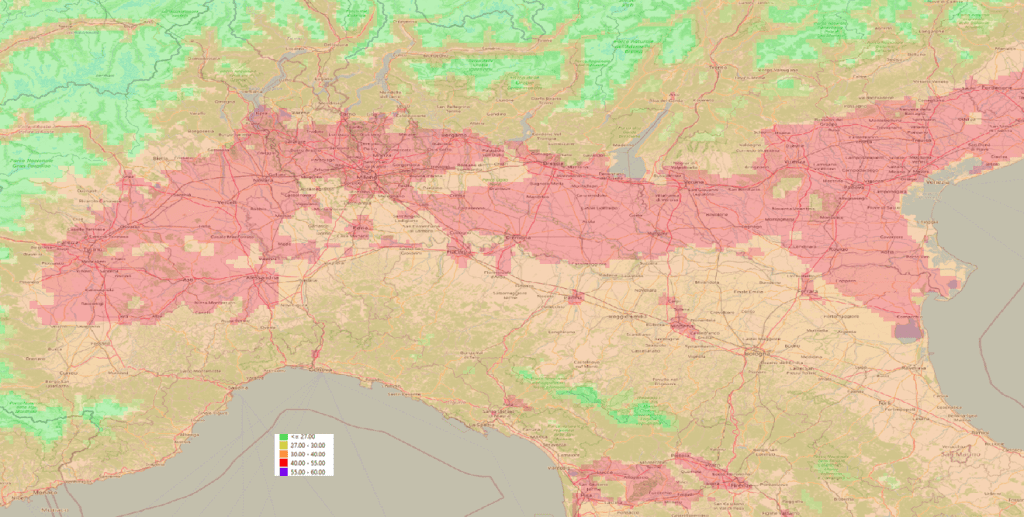
In the cover image: the Humidex index forecast by WRF OL for 08/22/2023, 00UTC run. The map forecast is for 12UTC the next day (08/23), with a resolution of 1.5 km, highlighting the heatwave that particularly affected the Po Valley. The scale represents the danger levels.