As in the past years, CIMA Research Foundation participates to the Genoa Science Festival, which takes place from October 20 to November 1: thirteen days of exhibitions, lectures and workshops. Here are all our appointments!
This fall, as every year, the Genoa Science Festival returns: thirteen days of exhibitions, events, conferences and workshops entirely dedicated to introducing the public to the world of research, the discoveries and problems it is facing and will have to face in the near future. In this 20th edition, the Festival is dedicated to the theme of languages: technical and scientific ones, but also as a reference to communication that is sometimes inaccurate and can become disorienting, and the importance of making it effective.
CIMA Research Foundation, as in past years, brings its scientific expertise to tell young people and adults about the natural hazards that our planet and the Ligurian territory has (and will have to) to face. What are they and how can we learn more about them? What can each of us do to protect ourselves and help monitor them?
The fil rouge that accompanies these issues is the climate crisis, which unfortunately plays an important role in influencing natural hazards. But how much we really know about this role, how much we can attribute to climate change some of the phenomena that have occurred recently (such as the drought that has been affecting Italy since the beginning of the year) is not always made clear, nor is it always evident…
Water and drought will be the protagonists of the conference that our researchers, together with colleagues from ARPAL, University of Turin and the Functional Center of the Autonomous Region of Val d’Aosta, will hold on Nov. 1 at 3 pm, at the University Library of Genoa. Water: the blue gold is a meeting dedicated to the challenges of water resource management in our century. Challenges that are also becoming increasingly evident at the national level, as shown by the drought that affected Italy (as well as several other European nations) during 2022: have these kind of events happened before? With what causes and consequences? What is the burden of the climate crisis and what can we expect for the future? These are the questions that will accompany speakers in their analysis of the recent drought, retracing the monitoring activities conducted by CIMA Research Foundation on Italian glaciers, highlighting the valuable role of snow and ice as increasingly at-risk water reservoirs and explaining the implications that water scarcity brings to us and ecosystems. A multi-voice discussion to tell and explain to the public how much we know about droughts, past and future, and the adaptation and mitigation strategies we can and should put in place.
Again, we believe in the importance of engaging younger people on scientific issues. So here is where the I-CHANGE laboratory (Oct. 20-Nov. 1, at the Giacomo Doria Museum of Natural History) aims to make young participants witnesses to the changing world. I-CHANGE is a European project that aims to engage citizenship to achieve real change toward environmental sustainability, through a multidisciplinary and participatory approach: thus, the workshop proposed within the Genoa Science Festival allows boys and girls to know and understand how weather-climatological data monitoring tools work, leading them to gain awareness of how climate study takes place. Weather stations, data-tracking apps, sensors that can be installed on various means of transportation, from cars to boats, are all tools that allow us to know and track our climate, gathering valuable information to verify its dynamics and identify strategies for mitigating the climate crisis. Knowing them and their use can make each of us, even the youngest, a participant in these processes and in the scientific method: and all the data and information collected during the project will converge in the I-CHANGE Environmental Impact Hub (EIH), which will return the information to citizens.
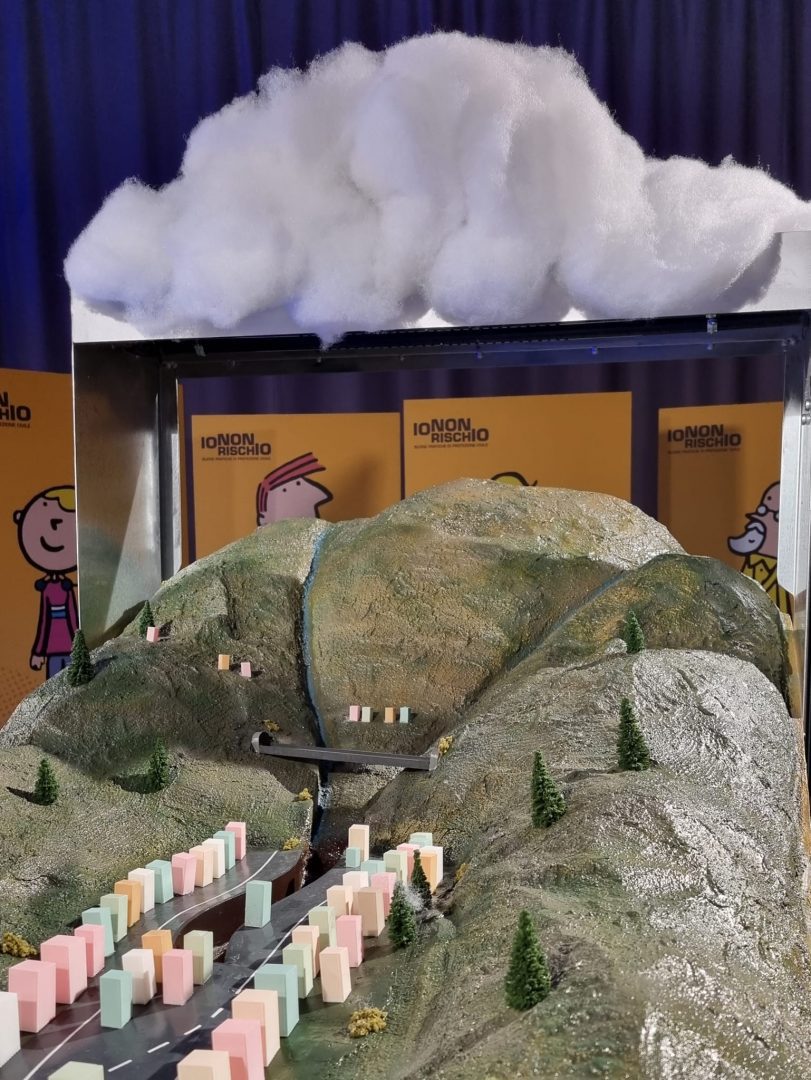
Talking about climate change also means talking about the risks it brings. Natural hazards and civil protection have been at the heart of CIMA Research Foundation’s activities since its inception. This does not only mean studying their dynamics, developing increasingly accurate forecasting tools and analysis: it also means knowing how to communicate with the community, making it aware of the risks, raising awareness of the critical issues in the area. For this reason, we support and participate in the Italian Civil Protection Department’s annual Io Non Rischio (I Do Not Risk) campaign, held this year on October 15 and 16 but “returning” at the Science Festival with an exhibition at the Doge’s Palace that will allow all people attending the Genoa Science Festival to learn about it and explore its themes. And it will also be an opportunity to acquaint the public with our model, already presented at the Io Non Rischio live event, which reconstructs a flood event in a typical Mediterranean basin, to make people understand how a flood can be born and develops!