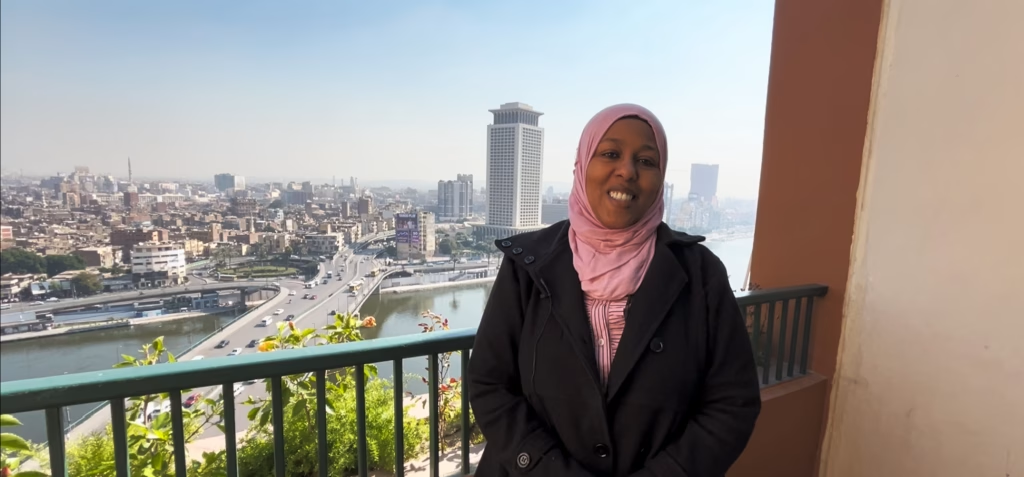
The climate crisis and the ongoing conflict in Sudan are severely testing local populations. Yet, the APIS project, supported by CIMA Research Foundation, is helping the country establish an early warning system, enhancing its ability to respond to climate-related emergencies. Dalal Homoudi, a meteorologist and a key figure in the project, shares her perspective on the daily challenges and her hopes for a safer future.
“Since the outbreak of the conflict, the challenges have grown immensely, but we have found ways to persevere and continue building a system that protects people.”
These words from Dalal Babikier Mohammed Homoudi, meteorologist at the Sudan Meteorological Authority, encapsulate the crisis Sudan is facing. A country plagued by water scarcity, droughts, floods, and the devastating consequences of conflict is now part of the APIS project. This initiative aims to strengthen Sudan’s Early Warning System (EWS) to address extreme climate events. Forecasting and early warning are no longer distant aspirations but are becoming tangible realities, improving the lives of vulnerable communities, even amidst a challenging context.
Since the conflict began in April 2023, the challenges have exponentially increased. Civil protection operations have become even more critical, and the need for rapid and accurate responses is more urgent than ever. Initiated in 2021 by CIMA Research Foundation and funded by the Italian Agency for Development Cooperation (AICS), the APIS project laid the groundwork for long-term resilience. It seeks to bolster local capacities in preventing and responding to disasters such as floods and droughts.
This story is not just about numbers and implemented technologies; it is also about the people whose lives are deeply affected by extreme events and the professionals working tirelessly to manage these impacts. Scientists and forecasters continue their work on the ground, striving to fulfill their mission in the face of adversity.
APIS: bridging knowledge and prevention
“Over the years, close collaboration with local institutions has enabled us to collect crucial hydrological risk data and take a significant step towards adopting advanced technological solutions,” explains Nicola Testa, a researcher at CIMA Research Foundation and the project coordinator. “The results of these efforts have led to the development of high-resolution forecasting models, improving the ability to respond to extreme events.” Dalal adds, “I believe the innovation of this project is that it brought together all institutions working on disaster risk management and flood and drought forecasting in one room.”
Beyond data, the project emphasizes technology and training. The Sudanese warning system has been integrated with advanced tools such as the myDEWETRA.world platform, which monitors and analyzes meteorological and hydrological data. This platform has become a critical asset for emergency management, decision support, and sharing sector-specific risk data, enabling the creation and dissemination of alert bulletins.
“We have established a network linking Sudan to regional centers, which allows us to keep the warning system operational even during a crisis,” explains Testa. “Despite significant challenges, we have managed to maintain continuity in monitoring and forecasting operations. This is essential to ensure that people are prepared and can respond effectively to extreme events.”
Prevention to protect: Dalal Homoudi’s story
For Dalal Homoudi, daily work is not just about data and forecasts; it is a mission to save lives. In a country like Sudan, where climate emergencies intertwine with social and political crises, every timely warning makes a difference.
Dalal describes how the APIS project has brought about a fundamental shift in addressing risks—not just focusing on weather forecasts but on the concrete impacts of weather events. ” We focused on what the weather will do rather than just what the weather will be,” she explains, highlighting the importance of bulletins that integrate risk, exposure, and vulnerability analyses. “After the conflict, we succeeded in enhancing the bulletin, now produced in collaboration with the Climate Prediction Center and colleagues from various institutions. A team of forecasters, with the help of early warning units, worked on impact-based forecasts and threshold analyses.”
One significant example of this transformation was during recent floods in northern and eastern Sudan, where the warning system quickly reached the most vulnerable communities, mitigating the consequences. “Our work has become more multisectoral, involving contributions from agriculture, health, and livestock sectors. This approach proved invaluable during an exceptionally intense rainy season that caused flash floods in northern and eastern Sudan. Our forecasts and messages to decision-makers enabled effective on-the-ground action, demonstrating the severe impact of extreme rainfall and flooding on communities,” Dalal emphasizes, underscoring the importance of collaboration across institutions and sectors.
The project’s scope extends beyond institutional and technical levels. Efforts have been made to make information accessible to local communities. Those directly affected by emergencies can now rely on precise guidance and support through a collaborative network of national and international organizations. Dalal expresses her pride in this achievement, as even in a challenging context like Sudan—marked by conflict and limited resources—the impact-based system has become a resilience tool.
The final technical workshop: future prospects
The final technical workshop of the project was held in Cairo from November 26 to 28, bringing together Sudanese experts and international partners. This event served as a crucial opportunity to consolidate progress, discuss challenges, and review best practices in managing the rainy season and implementing operational tools. A key focus was the operational use of the myDEWETRA.world platform, a fundamental resource for weather condition monitoring and alert bulletin dissemination. The platform will continue to support civil protection operations in Sudan. “Initially, the bulletin was automatically generated by models, but through collaboration between local and international teams, it has been refined to include analyses of risks, exposure, and vulnerabilities, delivering clear messages to decision-makers for timely interventions”.

Despite these successes, significant hurdles remain. Logistical difficulties and fragile infrastructure in many parts of Sudan require sustained efforts to ensure the warning system’s long-term sustainability. The conflict has weakened the operational capacity of national institutions yet strengthened collaborations with regional and international partners are maintaining focus on climate change and community protection. “Despite challenges such as conflicts and climate change, our role is to provide accessible information to communities, supported by partnerships with national and international organizations. This experience has been invaluable, and I am grateful to be part of this important project. I hope we can continue our work, gaining insights into floods, flash floods, and droughts, while supporting all sectors and communities in Sudan,” Dalal concludes.
Nicola Testa adds, “The challenges are many, but the results are tangible. The warning system must continuously evolve to adapt to a rapidly changing context. The goal for the future is to consolidate these advancements and ensure that Sudan operates its warning system autonomously, fostering high-level collaborations that have concrete impacts on national authorities and the Sudanese population.”