At the top: mountains on the front line of a changing climate
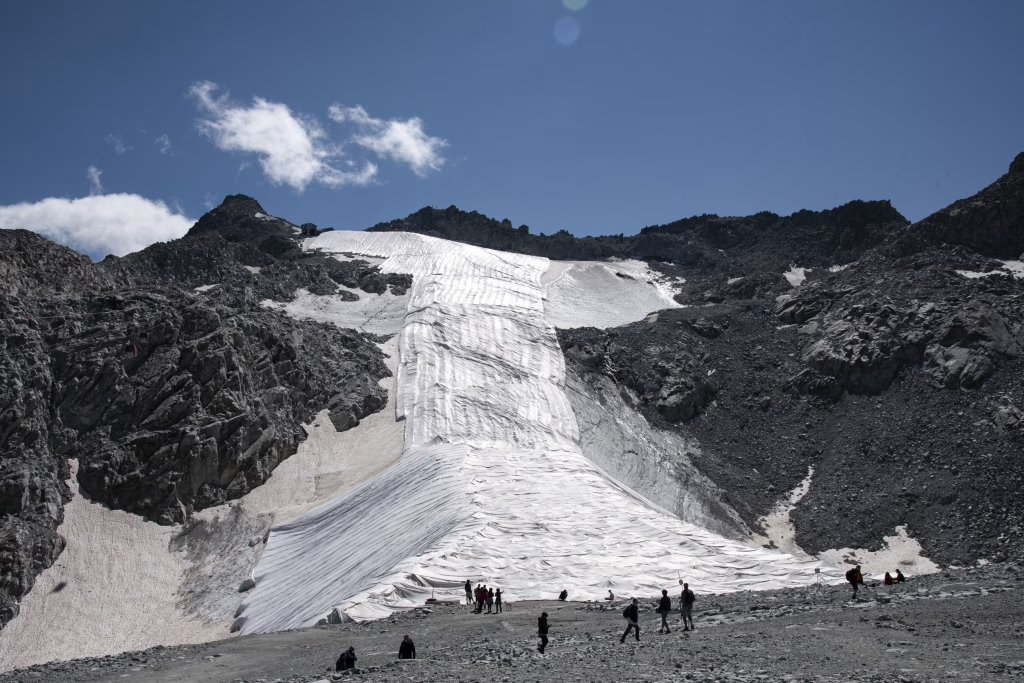
Mountains are among the first environments where climate change becomes visible. Not because they are “more fragile” in any absolute sense, but because at high elevations physical and ecological processes respond in an amplified way: global warming translates here into elevation-dependent warming, spatially heterogeneous and capable of reshaping, over short timescales, the boundaries of snow, ice, and habitats. It is as if high mountains shorten the distance between cause and effect, making legible what elsewhere unfolds more slowly.
Water, the Critical Zone, and the diversity of a changing mountain environment
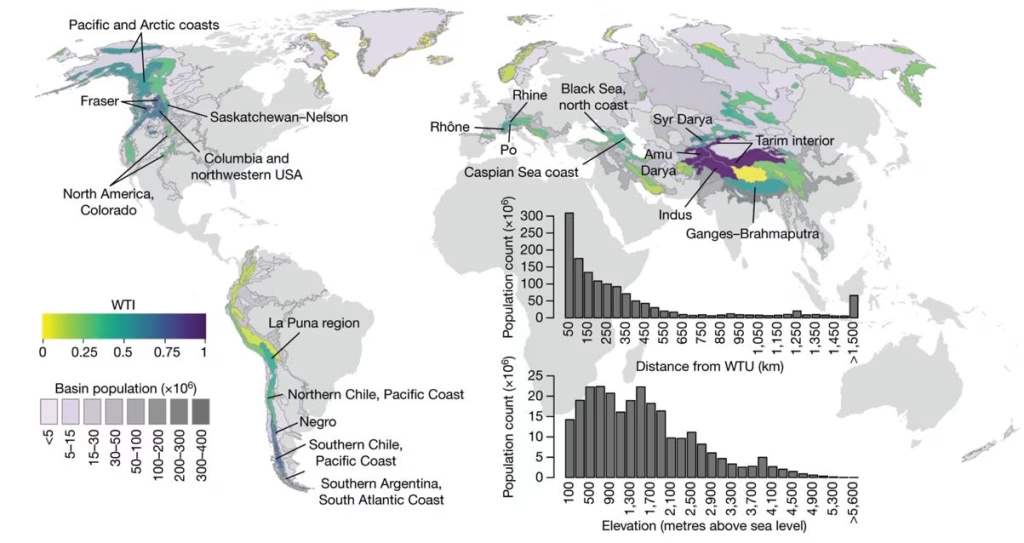
This acceleration affects the functional core of Alpine systems. Mountains are water reservoirs: they store resources as snow and ice and release them downstream, but the recent sequence of droughts and strong interannual variability are making water management increasingly complex. At the same time, the balance of the Critical Zone is shifting—the thin layer where “rock meets life” and where the processes that sustain terrestrial ecosystems take place. Here, carbon and water fluxes intertwine, together with the function of wetlands and Alpine peatlands, and the response of biological communities.
Biodiversity—understood as the diversity of species, habitats, and individuals—does not move on its own: alongside it emerges geodiversity, the diversity of mineralogical, geological, geomorphological, hydrological, and pedological features that form the physical basis of ecosystems, a “silent companion” that helps shape their resilience. This backdrop also includes the rise in wildfires, not only in summer but also in winter, signalling a new risk regime in mountain environments.
A view across disciplines
For researchers today, all this means something simple and difficult at once: mountains can no longer be observed “in fragments,” as Martina Leone, a PhD candidate at the University of Genoa based at CIMA Research Foundation, explains. Having taken part in the Student 4 Student Summer School, what struck her most in the exchange with other early-career scientists was “interdisciplinarity… a way of studying mountains that is increasingly relevant—no longer in fragments or niches, but through cross-over approaches, as if there were an intersection and overlap of knowledge from one topic to another.” Within this perspective, even seemingly specific phenomena—such as snow droughts and their consequences for summer streamflow and glacier melt in the Italian Alps—become pieces of a larger picture that brings together climate physics, hydrology, ecology, and territorial management.
Giulia Blandini, a researcher in Hydrology and Hydraulics at CIMA Research Foundation, adds a second, complementary viewpoint: she stresses how necessary it is to hold together the natural and human dimensions, because talking about mountains also means talking about tourism, economics, and the impacts of human activities on high-elevation ecosystems. This openness helped her “broaden my view of the mountain system as a whole,” grasping connections that often remain at the margins of day-to-day work.
This lesson also resonates strongly with the reflections shared by Antonello Provenzale at the “Montagne che cambiano. Natura e parchi alla prova del clima” meeting organised by CIPRA: mountains as water reservoirs and climate archives, but also as early indicators of what is changing across the planet and within our living systems. The voices of Giulia and Martina—shaped also by the international scientific exchange they experienced last September at the International Mountain Conference—remind us that mountain research is not only the measurement of phenomena, but the construction of perspectives able to traverse disciplines and scales. Because it is up there, in the highlands, that the future takes shape first.
To learn more about the processes that are changing natural hazards in mountain areas, below are some recent publications by authors from the CIMA Research Foundation.