Snow does not disappear suddenly. It retreats, thins, changes its form and timing. And today, for the first time, we can see, at the scale of the entire country, where and how much this is likely to happen.
For the first time in Italy, it has been possible to produce a spatial representation of the percentage variation of Snow Water Equivalent (SWE) across the entire national territory, projected up to 2070. This is not a local analysis: it is a systemic, continuous, and coherent depiction of snow as a component of Italy’s water resources, built on more than forty years of data and climate scenarios.
A first glimpse of future snow conditions
This map is the result of an approach developed within the IT-WATER project1, led by CIMA Research Foundation in collaboration with ItaliaMeteo and Fadeout Software. The project has implemented a continuous simulation of Italy’s water resources over a time horizon of nearly a century, enabled by high-performance computing (HPC) infrastructures such as those provided by CINECA, within the framework of the National Research Centre in HPC, Big Data and Quantum Computing (ICSC).
The objective is to better understand how climate change will affect water resources in Italy, through the development of hydrological models at national scale combined with climate scenarios.
The distinctive element lies not only in the future projection, but in the comparison between past and future:
- a historical reanalysis (approximately 1980–2023), enabling the simulation of the water cycle over a reference period;
- future climate scenarios (approximately 2024–2070), allowing the exploration of possible trajectories under RCP 8.5 and RCP 4.5 2;
- a homogeneous spatial representation across the entire Italian territory.
This framework makes it possible to provide a national-scale view of hydrological dynamics, in which snow represents a fundamental component.
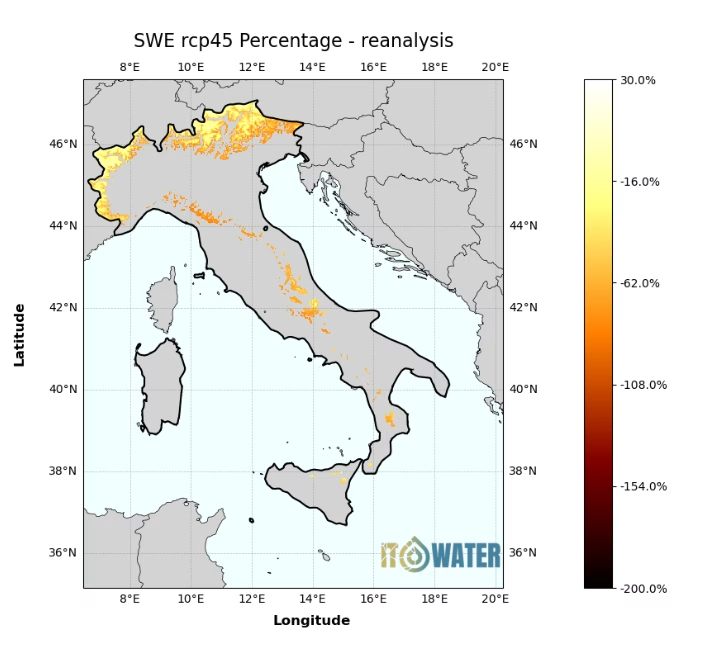
The map shown above illustrates this national analysis, presenting the percentage variation of SWE in the future relative to the reference period, under the RCP 4.5 climate scenario, a “strong mitigation” pathway that assumes the implementation of measures to limit emissions.
Where snow is declining: a clear signal along the peninsula
The most evident feature emerging from the map is the spatial distribution of SWE loss.
Alpine regions appear among the most affected areas, particularly the Western Alps, the Maritime Alps, and areas closer to the sea, thus exposed to moist and mild air masses from both the Tyrrhenian and Adriatic sides.
In these regions, orange shades indicate significant percentage reductions in the amount of water stored in the snowpack. The signal is not uniform but highlights a strong sensitivity of areas more exposed to atmospheric dynamics and air mass exchanges.
Significant signals also emerge along the Apennine chain: fragmentation of snow-covered areas, widespread reduction in SWE, with localized hotspots of loss in the Central and Southern Apennines.
These are regions where snow already represents a more intermittent component of the hydrological cycle compared to the Alps; therefore, percentage reductions carry even greater weight in terms of water availability.
The map reveals more than a simple decrease in snow cover: it indicates a transformation in the timing and magnitude of water release. SWE is, in fact, a key variable for understanding future water availability.
Reductions in SWE are substantial, on the order of –40% to –60% on average across elevations, and particularly pronounced below 1500 m.
More to come
What is presented here is only a first result, an initial preview.Hydrological analyses are currently being consolidated and will be integrated with additional indicators and variables to build an increasingly comprehensive picture of Italy’s water resources in the context of climate change: soil moisture, vegetation evapotranspiration, river discharge, and glacier thickness. All these elements will converge, in autumn, into a detailed report that will support the national water resource management system.
In the coming months, new data and further analyses will allow deeper investigation of seasonal dynamics, assessment of impacts at the basin scale, integration of the snow component with other drought indicators.
Within the context of Earth Day, these images take on even greater significance: they are not only a representation of ongoing change, but a tool to interpret it and anticipate its effects.
Understanding today how snow in Italy will evolve in the coming decades means equipping ourselves with concrete knowledge to guide decisions, policies, and adaptation strategies. Because the future of water resources is not built solely by observing what is happening, but by understanding, through data and models, what will happen.
- IThe IT-WATER project is funded under the PNRR – NextGen EU programme. ↩︎
- RCP 8.5 is a high-emission scenario, often defined as a “worst-case”, in which greenhouse gas concentrations continue to increase rapidly throughout the 21st century, reaching levels three to four times higher than pre-industrial values by 2100.
RCP 4.5, on the other hand, is a “strong mitigation” scenario, assuming the implementation of measures to control emissions
See CMCC https://www.cmcc.it/it/scenari-climatici-per-litalia. ↩︎