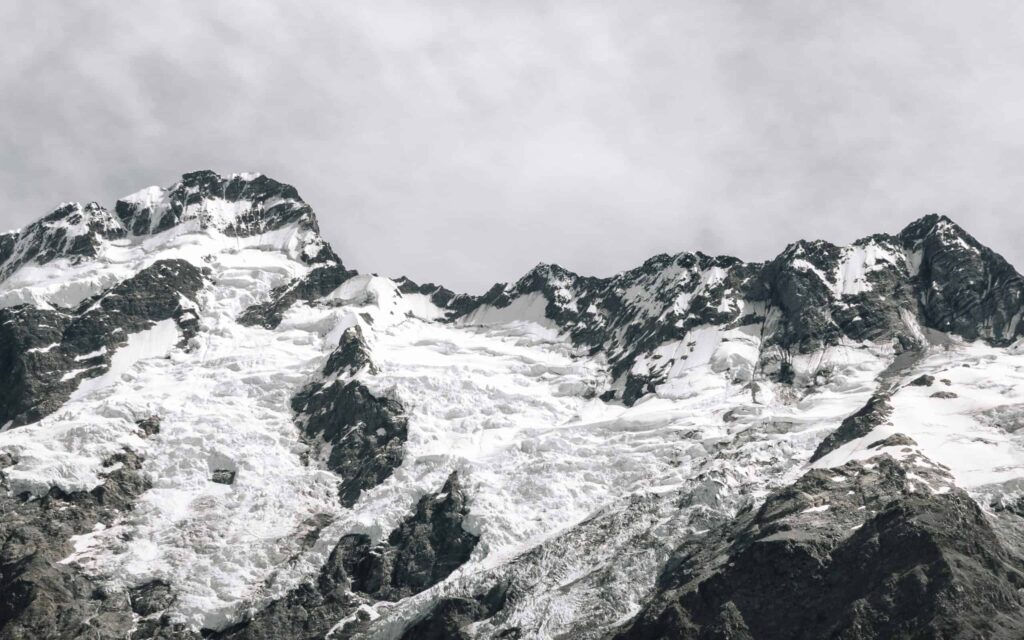
The Snow Multidata Mapping and Modeling (S3M) model developed by CIMA Research Foundation has been recently presented in a preprint article. The model allows one to study the evolution of glaciers and snowpack over time and across the landscape .
How much snow is accumulated in the mountains? Knowing this amount as precisely as possible, as well as knowing how much glacier ice melts over summer, is vital for the management of water resources in mountains as well as across lowland regions. This is because snow and ice accumulate during winter and then melt during spring, thus ensuring water in the downstream areas during the mostly dry and warm summer months.
This important role of the cryosphere for worldwide water security has led to the development of various models for the description of snow and ice dynamics. However, these models are rarely coupled with hydrological models, which allow for the description of the fate of meltwater through the water budget.
A study, published in preprint and currently under revision, describes a model that has exactly this feature: it is the Snow Multidata Mapping and Modeling, or S3M. The article is authored by our researchers of the Hydrology and Hydraulics Department, in collaboration with colleagues from ARPA Val d’Aosta and the civil-protection department of the Autonomous Region of Val d’Aosta.
Water, snow and ice
As we discussed some time ago,mountains are water reservoirs:winter precipitation in the form of snow, as well as glaciers, “store” water during winter and then release it during summer, thus supporting water supply when demand is higher. Water from snowmelt, at the same time, can be responsible for flooding in mountain environments, especially during spring and fall.
For these reasons, it becomes important to answer a number of questions. For example, how much water resource, in the form of snow or ice, is present at a given time across the mountain landscape? In which areas is snow still accumulating, and where has melting begun? Or, is it the snow that is melting, or is water also flowing from glaciers? And if so, what is the exact proportion?
From upstream to downstream
The model described in the new preprint contributes to answer these questions: “S3M, and more precisely version 5.1, has been developed by CIMA Research Foundation to describe the evolution of glaciers and snowpack over time”, says Francesco Avanzi, researcher of Hydrology and Hydraulics Department and first author of the study. “The model includes a set of elements that allow us to study the real-time situation in a given area, at different time scales, such as the partitioning of precipitation phases (that allows us to estimate how much of the total precipitation falls to the ground in the form of snow or rain) and distinguishes between glaciers and snowpack.”
“One of the most important elements characterizing S3M is the possibility to use it together with hydrological forecasting models – and in particular with the Continuum model, also developed by CIMA Research Foundation”, the researcher adds. In this way, S3M can be a very useful tool also for the evaluation of possible scenarios of water resource availability, allowing to couple forecasts and assessments of snow and ice with their “fate” once melted.
Prospects for future studies
S3M v5.1 is the last version of a model that has been developed at CIMA Research Foundation for various years. Besides improvements operated thanks to real-world operational usage, a peculiar characteristic of this version of S3M is that it is an open access model; therefore, any user can contribute to its development. Researchers at CIMA Research Foundation will continue to work on improving it to take into account, for example, the influence of wind and vegetation. In the meantime, however, the implementation of the model in the northwestern Italian Alps has already shown satisfactory results in predicting the mass balance of snow and glaciers, which allows for the estimation of variations between snow (or ice) accumulated during the winter months and that melted during the spring.
“In addition, the relatively fast computation times suggest that the model can be used in both research and operational fields, even taking into account the possible effect of global warming,” Avanzi concludes.