In a cost-benefit analysis under different climate scenarios, a team of researchers including CIMA Research Foundation’s Francesco Dottori and Lorenzo Alfieri investigates which adaptation strategies might be most effective to offset the rising river flood risk in Europe
The climate crisis makes it increasingly urgent and necessary to put adaptation strategies, as well as mitigation, at the center of policies. So what type of adaptation? How can we, in the face of different risks, identify the most effective strategies? A new study, published in Nature Climate Change, begins to address this question by focusing on river flooding, which is a growing risk in Europe. Simulating different types of interventions, the study’s authors present a cost-benefit analysis to help identify the best strategies for limiting land vulnerability to flood risk.
A quantitative estimate of costs and benefits
Climate change, combined with continued development and urbanization in some areas, has increased the risk of fluvial flooding in much of Europe; and, despite extensive efforts to reduce the risk, flood impacts have increased in recent decades.
Therefore, as a 2020 JRC report points out, it is now crucial to be able to find effective and environmentally, socially and economically sustainable adaptation strategies. Strategies that, by acting on one or more of the factors that make up the risk equation (exposure, hazard and vulnerability), will reduce the risk itself to communities. However, these strategies must be planned, starting with a thorough study of the different options depending on the most likely scenarios, so as to avoid measures that are ineffective or, even, lead to so-called maladaptation, that is, such as to make the situation worse.
This is precisely the purpose of the study just published and signed by, among others, Francesco Dottori and Lorenzo Alfieri, researchers in our Hydrology and Hydraulics Department. “This research represents, in fact, the continuation of a work we conducted a few years ago that led us to model flood risk on a European scale, estimating the current damage and for the future,” Alfieri says. “What has been missing, however, and is still poorly investigated in the available scientific literature, is a quantitative estimate at the continental scale of the possible costs and benefits associated with implementing the different adaptation measures available.”
Four strategies
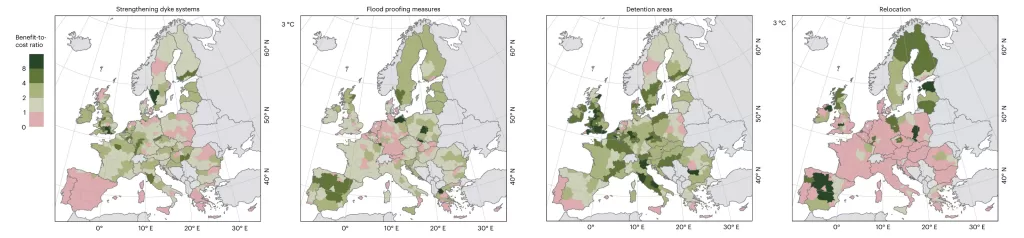
The research focused on four types of adaptation strategies, acting on different elements of the risk equation. The first type of intervention is increasing flood protections – in other words, raising dikes, which allows the watercourse to carry a higher flow: this is an intervention that acts on reducing the vulnerability of the system. Two other strategies investigated are flood proofing, which indicates interventions carried out on individual buildings (e.g., with internal or external waterproofing) and relocation, i.e., a managed retreat from areas at risk; both of these interventions act by reducing exposure. Then, authors of the study evaluated interventions that fall under the nature-based solutions that, according to the European Commission’s definition, are able to provide benefits not only for human communities but also for ecosystems. Specifically, in the field of flooding, strategies based on the creation of detention areas are considered of particular interest: these are the restoration of natural wetlands and floodplains, as well as the creation of man-made polders, that surround a section of the river and can be flooded in a controlled manner, thus reducing the danger to populated downstream areas.
“For each of these adaptation strategies, we conducted a cost-benefit analysis based on the Net Present Value, a methodology that allows us to also actualize future benefits by integrating the costs required to implement that particular measure with the economic damage it can avoid,” Alfieri explains. “So, we conducted a very large number of modeling simulations for different levels of global warming, comparing different measures to each other and evaluating which ones would best contribute to reducing the impacts of flooding.”
This complex modeling work shows that the use of detention areas can have a significant effect in influencing flood risk: in fact, the authors estimate that by 2100, under a scenario with no mitigation to global warming and a 3-degree increase in temperatures, it can reduce the population exposed to floods by 84 percent, while economic losses would be reduced from 44 billion euros per year to just over 8. In practice, the researchers write, the risk at the end of the century would be comparable to the current one.
Do not forget planning
In short, the benefits of detention areas turn out to be particularly attractive, at a lower cost than other measures. And not only that, explains Alfieri: “Although this study was not intended to analyze beneficial effects in environmental terms, these are precisely among the most relevant aspects of nature-based solutions, thus including detention areas. In fact, wetlands around the river course can contribute, for example, to the protection and restoration of biodiversity and to counter habitat fragmentation.”
Of course, this does not mean that there is one adaptation measure that is globally more effective than others: as Alfieri says, “There is a lot of variation depending on the area, and in particular depending on the current risk and its future variation, as well as other elements such as population density.” Thus, for example, strengthening and raising levees may be particularly effective for protection against frequent but low-magnitude events, while detention areas may be more effective for mitigating more extreme flood peaks.
In general, moreover, the effectiveness of adaptation measures increases
with the global warming, because the benefits (understood as avoided damage) grow faster than the costs required to implement adaptation measures, due to increased frequency and exposure to flooding. And, the article specifies, population pressure and the benefits that arise from settling near rivers have led to significant expansion of urban areas into flood-prone areas in past decades. This trend does not seem to have slowed down in recent times; if we consider the possible effect of the climate crisis on flooding, this only increases the risk. “Therefore, the adoption of adaptation measures should in no way be considered as an alternative to (and therefore exclude) adequate land use planning, capable of taking into account the risks of that area,” Alfieri concludes.
Image credits: modified from Dottori, F., Mentaschi, L., Bianchi, A. et al. Cost-effective adaptation strategies to rising river flood risk in Europe. Nat. Clim. Chang. 13, 196–202 (2023). License: CC BY 4.0