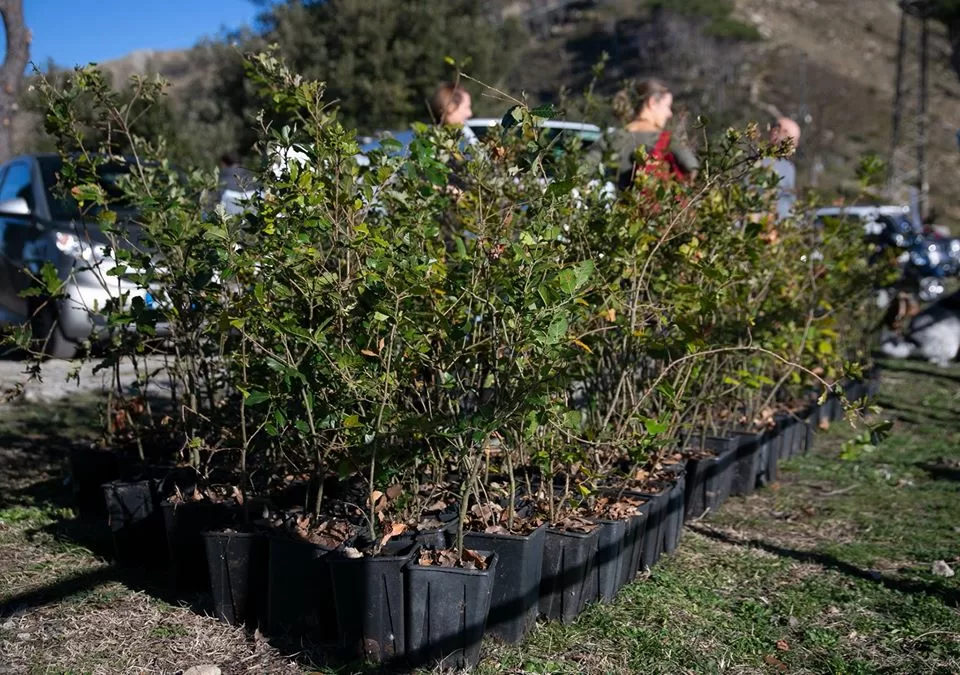
CIMA Research Foundation donated 200 plants to the A Thousand Trees Project, which aims to reforest Mount Moro, in Genoa. The trees will not only increase the biodiversity of the area, but also its resilience to fires
CIMA Research Foundation supports the A Thousand Trees Project, which aims to plant and follow the growth of 1,000 trees in Genoa. To help the project in planting trees where now there is only brushwood, CIMA Research Foundation has donated 200 plants from the Pian dei Corsi Forest Nursery.
Plant the trees back on Mount Moro
The trees are being planted on Mount Moro, in Genoa. “Long ago, the mountain was used for grazing. Over time, the pastures—often responsible for forest fires in the area—have ceased. Vegetation could slowly grow again. Unfortunately, the first species that have started growing are those that are most flammable”, says Paolo Fiorucci, head of the Wildfire Risk Management and Forest Conservation Department of CIMA Research Foundation. “The process allowing seeds to come back in the area can be very slow, because the seeds are taken by animals or by the wind, and they must be given the time to take root and grow. If there are not fires, the vegetation can modify the upper layer of the land and promote forest development. The time required for this process is usually around one human lifetime, but the presence of humans in the area often leads to the development of fires, both intentionally and unintentionally. Under some conditions, the fires can be particularly strong. Where fires occur too frequently, the long process of reforestation goes back to its initial state. This is what has been happening on Mount Moro”.
On Mount Moro and on the nearby Mount Fasce, there are frequent forest fires of varying degrees, with the last having occurred three years ago. In order to increase its biodiversity and its resilience to fires, the plants donated by CIMA Research Foundation are of less flammable species, such as ashes, Quercus ilex and pubescens.
Biodiversity and resilience
Almost all of the trees, accompanied by a specific European passport as required by the recent law, have been planted in just one weekend. The plants have been cultivated since 2014 in the Pian dei Corsi Forest Nursery and come from “seeds collection areas”, so that their origin is well defined.
“We deeply believe in the A Thousand Trees project. Taking the more suitable plants back in the areas where human activities have caused them to almost disappear accelerates the natural process, creating richer and more resilient ecosystems. This is the reason why CIMA Research Foundation manages the Pian dei Corsi Forest Nursery, where we can cultivate the plants necessary to work in the areas where planting new trees can accelerate the evolution of the upper land. These areas are limited compared to the huge forest extension of Liguria Region”, adds the researcher. The Liguria Region has the highest percentage of forested land in Italy, almost 80%. Once there was coppice, but now this forest is almost completely abandoned. From 1949 to 2015, the Ligurian forest has grown by 120,000 hectares, an increase of the 43%.
Yet places such as Mount Moro still need our attention because they are highly flammable and near highly inhabited areas. “In these areas, we need to manage the upper land in order to mitigate the impact of extreme events. At the same time, in other zones, the forest is in an unbalanced situation due to its abandonment. Therefore, it is urgent and necessary start forest management activities. These shouldn’t necessarily be aimed towards production, but towards the valorization of our territory, the regional biodiversity (which has economic value) and also, if necessary, the return to pastoral and agricultural activities”, says Fiorucci.