
The snow season does not end on a specific day. Instead, it gradually changes phase: accumulation gives way to melt, and the snowpack begins to transform into the water resource that will feed rivers, lakes, reservoirs, and soils during the warmer months.
April 2026 clearly marked this transition.
This is not simply the normal spring melt. Data show a much faster decline in SWE compared to climatology, especially across the main Alpine river basins.
Just a few weeks ago, in mid-April, much of Italy – and particularly the Po basin, the snowiest area in the country – was still close to seasonal average conditions. Then the system accelerated rapidly: above-average temperatures, limited precipitation, and an exceptionally dry month intensified snowmelt processes. Today, national Snow Water Equivalent (SWE) has dropped to around –48% compared to the climatological average for this time of year.
And it is precisely this transition – faster than normal across many areas of the country – that represents one of the most significant signals emerging from this final update of the Italian snow season.
April: warm, dry, and with very little snow
Meteorological conditions over the past few weeks help explain what happened.
April was extremely dry across much of Italy, especially in northern regions and along the Tyrrhenian side of the Peninsula, where precipitation anomalies locally dropped below –80%. On the Adriatic side, by contrast, the effects of abundant snowfall events from early April are still visible.


At the same time, temperatures were exceptionally high, particularly in northwestern Italy, where thermal anomalies exceeded +3°C above climatological averages. This marked a sharp contrast with previous months, which had remained relatively cool across northern mountain regions.
The result was a rapid reduction in SWE. In the Po basin, for example, the melt curve became much steeper than climatology: within just a few weeks, conditions shifted from near-average values toward levels more similar to those observed in 2022.
As noted by Francesco Avanzi, snow hydrology researcher at CIMA Research Foundation: “When temperatures rise this rapidly in spring, snow changes behavior within a matter of days. What we observe is not only the normal seasonal melt, but a real acceleration in the transfer of water from snow toward soils and rivers. This changes both the timing and rate of water availability, especially in view of the summer season.”
The deficit conditions across the Alps also become evident when analyzing SWE distribution by elevation band. Even in the Po basin, deficits are now extending to the highest elevations, indicating that rapid melt processes are affecting the entire mountain profile.

Different regions, different snow seasons
Once again, Italy’s snow season did not follow a single trajectory.

Northwestern Italy experienced a relatively positive winter overall, with snow accumulation often close to average during much of the season. Yet even here, accelerated melt during recent weeks has pushed conditions back into deficit, including at higher elevations.
The situation in northeastern Italy has been markedly different. The Adige basin remained below average throughout the season and now shows a deficit exceeding –56%, with melt rates faster than normal and conditions locally even lower than those observed in 2022. Only the cooler temperatures recorded during the first days of May temporarily slowed the process.
Across the central Apennines, the end of the season confirms how dynamic snow resources can be. Just one month ago, abundant snowfall had pushed snowpack conditions toward their seasonal maximum; today, much of that snow has already melted rapidly due to high temperatures, bringing river basins back toward near-average conditions.
Interpreting SWE during the melt phase
Interpreting SWE deficits and surpluses at this stage of the season is more complex than during winter months.
Part of the water released through snowmelt may already have entered soils, rivers, or reservoirs. This means that a late-season snow deficit does not automatically correspond to a complete loss of the resource.
At the same time, entering summer with below-average snow reserves remains an important factor to monitor, especially considering the increasing water demand expected during the coming months.
From snow monitoring to reservoir monitoring
To better understand how these dynamics affect actual water availability, CIMA Research Foundation integrates snow monitoring with satellite-based monitoring of surface water resources in reservoirs, analyzing variations in the percentage extent of water surfaces (% Extent) relative to their historical maxima. These analyses are based on data from the Copernicus Sentinel-2 constellation, using methodologies described in Cenci et al., 20241.
And it is precisely by observing Italian lakes and reservoirs that very different signals emerge between northern and southern Italy.
In northern Italy, some major lakes – such as Garda Lake – are showing a gradual decline compared to winter conditions, while still remaining within near-average historical levels. This does not currently resemble the extreme conditions observed in 2022, but it does confirm the importance of continuous monitoring throughout summer.

In central and southern Italy, however, the situation appears substantially different from recent years. Following the severe water crisis observed in 2024, 2025 had already shown signs of recovery, while in 2026 several reservoirs are displaying significantly improved conditions.
San Giuliano Lake, in Basilicata, provides a clear example of this evolution: satellite-derived monthly % Extent time series and associated anomaly values indicate a return toward conditions much closer to climatology compared to recent years.

As explained by Luca Cenci, satellite monitoring expert at CIMA Research Foundation: “Satellite observations allow us to monitor the evolution of surface water resources in reservoirs almost in real time and compare current conditions with those observed in previous years. In southern Italy, recovery signals compared to 2024 are very clear. This does not mean the system is no longer vulnerable, but it does indicate that conditions today are significantly less critical than those observed just two years ago.”
Additional signals also emerge from soil moisture observations. According to ERA5-Land data, soil moisture conditions are currently slightly below average across much of Italy, precisely as the irrigation season begins.

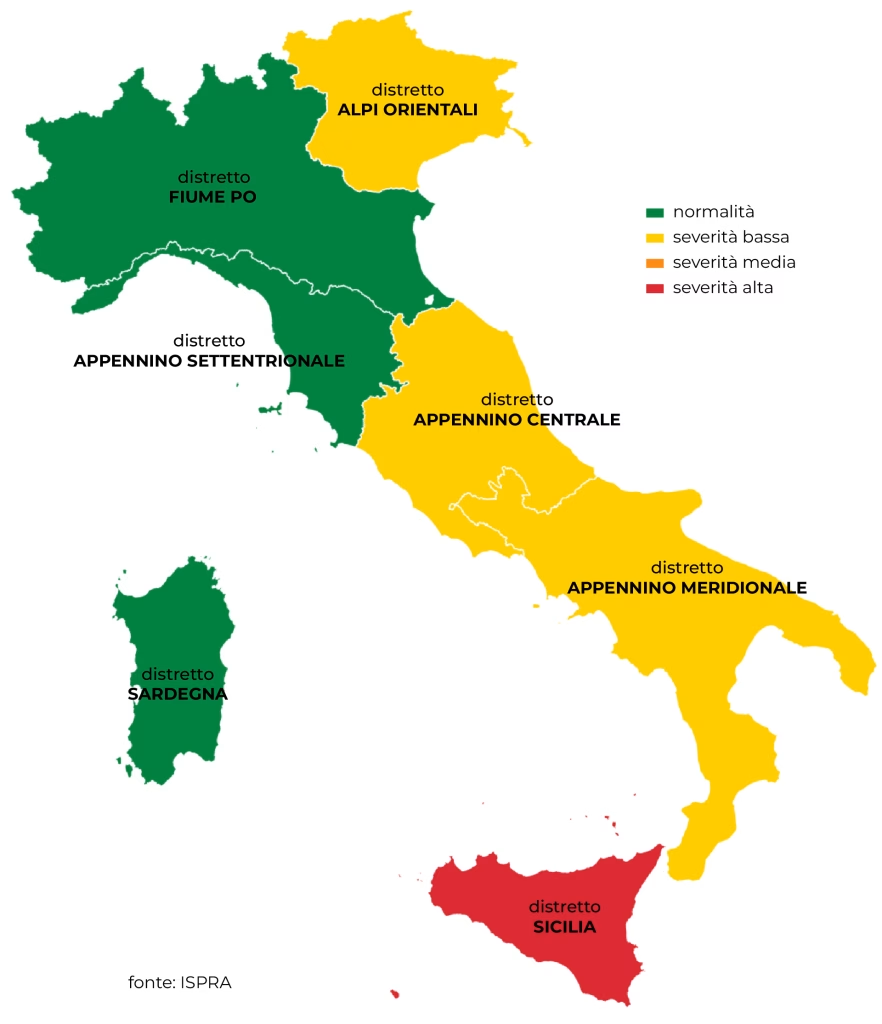
This is not a nationwide critical situation, but rather a series of localized warning signals that deserve careful attention. Several Italian River Basin Districts have already entered water scarcity alert conditions.
The end of the snow season
The 2025/2026 Italian snow season therefore concludes with a highly heterogeneous picture: overall positive in northwestern Italy, more unstable and variable across central and southern regions, and persistently below average in northeastern sectors.
But above all, it ends by reminding us once again that snow is not simply a winter accumulation. It is a dynamic process connecting atmosphere, mountains, soils, rivers, and reservoirs, influencing water availability well beyond the end of winter.
We will return with new SWE updates next winter. In the meantime, monitoring of water resources will continue throughout summer, because it is precisely now that much of the snow accumulated during winter begins to reveal its real impact on the territory.
- L. Cenci, G. Squicciarino, L. Pulvirenti, S. Puca and A. Duro, “Validation of a Prototype Monitoring System of Water Bodies Extent for Civil Protection Applications,” IGARSS 2024 – 2024 IEEE International Geoscience and Remote Sensing Symposium, Athens, Greece, 2024, pp. 3765-3769, doi: 10.1109/IGARSS53475.2024.10641198. ↩︎