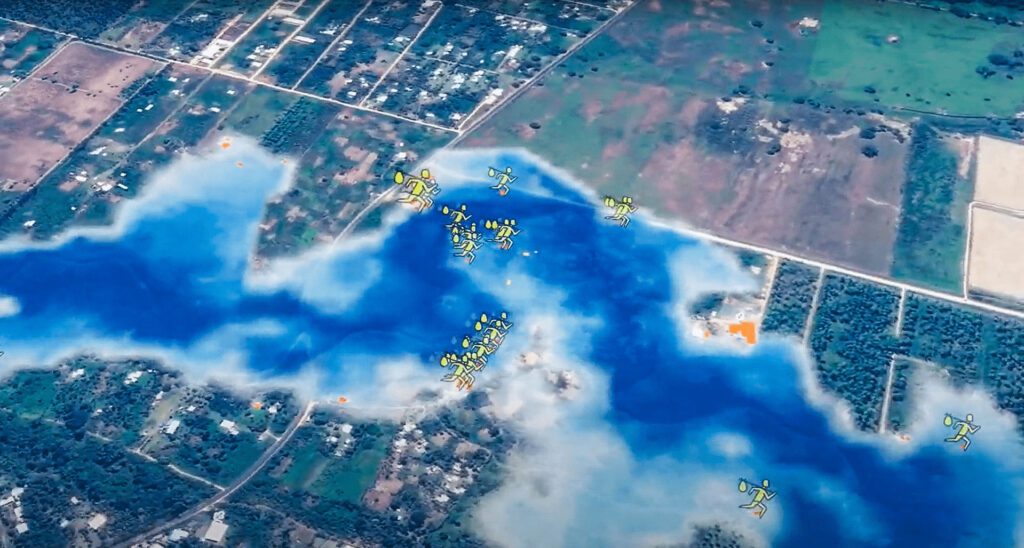
A recent report by the International Displacement Monitoring Centre presents the study conducted by CIMA Research Foundation to assess the risk of population displacement due to the occurrence of floods under different climate change scenarios, employing an assessment methodology that considers not only the loss of housing, but also the loss of livelihoods. It shows that even under the optimistic climate change scenarios, flood displacement risk would double as early as 40 years from now
Impacts of natural hazards may result in damage to property, physical injury and death, but also displacement of individuals and families. For instance, those living in a flood-affected area may find themselves forced to leave their homes and jobs. But can we quantify how a certain disaster affects the risk of displacement? Knowing this would be important to determine the best preparedness and response strategies (think of the organization of humanitarian aid), especially in the current context of climate change, which makes many of these phenomena more frequent and intense.
Such quantification, however, is far from simple, because it requires to consider both the physical elements of a certain territory and the social elements. Even looking only at the physical elements, there are several factors that can influence people’s response. At the moment, however, studies tend to consider only some aspects of the physical vulnerability: for instance, they assume a threshold of hazard intensity that makes a house uninhabitable, forcing people to leave it.
A step forward in vulnerability assessment methodology with regard to displacement risk is presented in a recent report, which describes the work conducted by CIMA Research Foundation in Fiji and Vanuatu islands for the International Displacement Monitoring Centre (IDMC).
Assessing the damage: housing and livelihoods…
Small Island Developing States (SIDS), Fiji and Vanautu are particularly vulnerable to the effects of climate change, such as sea level rising that can put their coastlines at serious risk. The new report focuses on a particular risk, riverine flooding, focusing on two different climate change scenarios. The methodology uses the probabilistic risk assessment, that provides a comprehensive analysis of possible impact scenarios related with their probability of occurrence, in an innovative way:
“In addition to quantifying the damage to residential buildings, we assessed damages that can occur on people’s livelihoods” says Lauro Rossi, lead author of the publication.
If a person finds himself not only with his damaged home but also deprived of the ability to work, obviously the probability that he has to move increases. This is the assumption underlying the study, which, therefore, presents for the first time a methodology that can quantify the possible damage also to agricultural fields, industries and other resources that may be affected by floods. “Basically, we tried to calculate the damage that an event can cause to assets (residential buildings, agricultural field, etc.) and then assess how his function (residence, crop production, etc.) is reduced or made unavailable. ” Rossi adds.
… And, in the future, primary services
This aspect involves another new element addressed in the report. Although not yet integrated into the displacement risk assessment methodology, the authors also considered disruption to services upon which communities rely. In particular, they have identified the population relying on health and education services (schools and hospitals) which may become more susceptible to displacement in case those services becomes unavailable.
Although this remains a separate data point now, its integration into risk assessment is planned for the future. How? “Basically, we need to understand how the unavailability of services affects the propension of people to displacement . The rationale is that a person that experience only little damage to his/her home would not leave, but becomes susceptible to displacement if he/she also lose work and access to primary services” explains Rossi.
Displacement, an increased risk
Under this methodology, the paper reports that, even in the “optimistic” scenario of climate change (that assumes a one-degree temperature increase by the end of the century), displacement could at least double, in both Fiji and Vanuatu, as early as 2060. And, in the most pessimistic scenario (five-degree temperature increase) the situation would be even worse, because even the rarest flood events, which currently occur about once every 250 years on average, could become much more frequent, occurring once every five to 25 years on average.
The term displacement encompasses many different situations and conditions in which people are displaced, from temporary evacuation (more common for floods than for other natural disasters that last longer in time) to migration. But people forced to flee their homes remains a serious issue, and even more serious when considering that not everyone has the opportunity to leave. In some respects, displacement can also be seen as a strategy for adapting to a phenomenon, but there is always a part of the population that have no means to move away (involuntary immobility).
The data emerging from the report are therefore particularly worrying, especially when one considers that, as Rossi explains, “These estimates are produced with unchanged population and distribution of assets at risk in the present and future scenarios. This allows us to isolate and quantify the contribution of climate change to the increased risk. How but it also means that the situation in the future could be even worse given the expected increase in population and the degree of urbanization”.