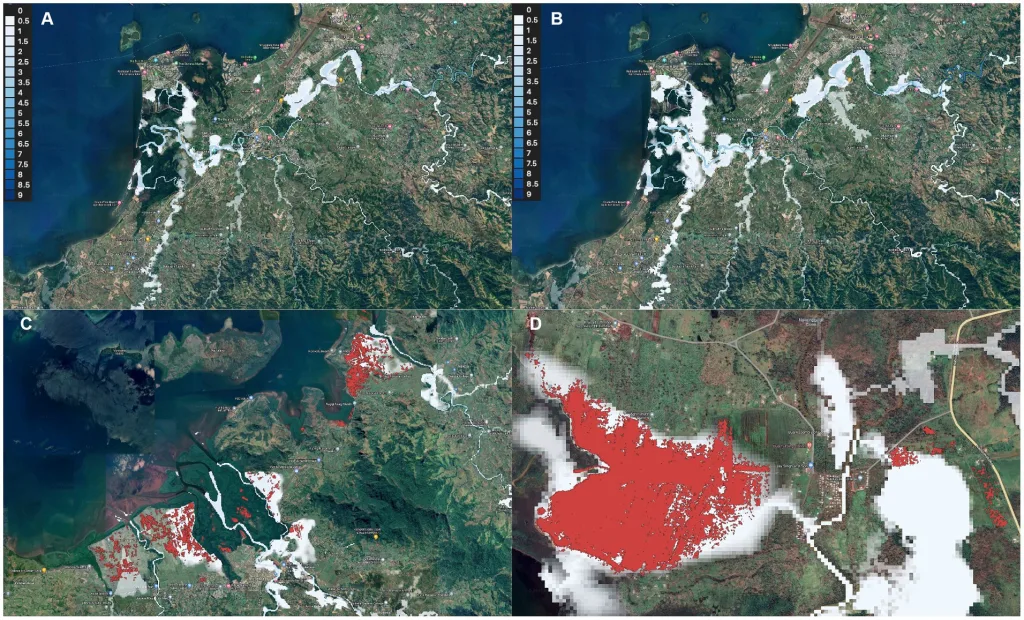
A study led by CIMA Research Foundation, in collaboration with IDMC, introduces a new methodology for evaluating the risk of people displacement under different climatic scenarios
Floods, droughts, desertification, and cyclones represent just a fraction of the phenomena affected by climate change. These events not only endanger human lives and cause damage to property and infrastructure but also contribute to the displacement of people, both temporarily and permanently, within their own countries or across borders.
Understanding the likelihood, patterns, and impacts of such displacements is crucial for effective protection measures. While prevention may not always be feasible, having insights into the dynamics and probabilities of displacement occurrences enables the development of mitigation and response strategies. These strategies may include targeted humanitarian aid distribution or proactive measures to prevent or facilitate movement during emergencies, all aimed at safeguarding affected populations.
This area of study is known as displacement risk assessment , and it is the focus of recent research published in Frontiers in Climate by researchers from CIMA Research Foundation in collaboration with the International Displacement Monitoring Center (IDMC).
The research introduces a novel methodology for assessing displacement risk that emphasizes the vulnerability of populations. Unlike traditional assessments, which primarily consider housing loss, this methodology explores the potential impacts of livelihood and essential service loss on community vulnerability.
Risk displacement: a new assessment methodology
The study focuses on Fiji and Vanuatu. Like other small island developing states (SIDS), both are particularly vulnerable to the impacts of the climate crisis. These impacts, such as rising temperature and sea levels and altered rainfall patterns, pose significant threats to economic and food security in regions already facing challenges due to their isolation, limited size, and scarce resources.
“Quantifying risk of , however, is a complex task due to the interplay of structural and socio-economic factors in displacement dynamics.” explains Lauro Rossi, the lead author of the study. “Traditionally, risk assessments have centered on damage to homes, establishing intensity thresholds that render dwellings uninhabitable. In our study, we’ve developed a methodology that considers not only housing damage but also loss of livelihoods (such as crops, pastures, businesses, and services), directly integrated into our calculation model. Additionally, we consider the loss of access to essential services like schools and healthcare facilities , as exacerbating factors that increase the likelihood of displacement.”
The research group used a probabilistic approach and considered three different climate scenarios: with the current climate (the data refers to the period 1979-2016), with medium-term projections and with long-term ones (from 2060 to 2100). For each of them, projections with more or less significant temperature increases were taken into consideration.
The assessment concerns the risk of river floods but, the authors specify, it can also be applied to other climate risks, such as coastal floods. In practice, the evaluation is based on a modeling chain: once a specific climate scenario has been selected, the Continuum hydrological model, developed by CIMA Research Foundation, simulates river flows. From these, a second model simulates the resulting floods, which are used to create hazard maps. Finally, an exposure and vulnerability module that characterizes agricultural areas, built-up areas, commercial services and industries exposed to risk completes the modelling chain ultimately enabling the calculation of displacement risk.
How risk changes in different climate scenarios
The results obtained by “running” this forecast chain clearly highlight the role that the climate crisis can play in the risk of displacement. In fact, the researchers estimate that in the worst climate scenarios (with a temperature increase of +5°C), the average annual displacement increases three times in Fiji, and by four in Vanuatu, in the long term. But even less extreme climatic conditions would make their effects felt significantly: in Fiji, for example, the displaced could be more than double the current number even in the most optimistic scenarios.
The method proposed by the research group has the merit of helping to understand the main reasons that lead to displacement, precisely because it also takes into consideration elements other than just the loss of housing.
“In all the scenarios considered, at least 20% of the displacement is attributable to the loss of employment, due to damage to assets such as the agricultural field or the industrial buildings”, explains Dr. Rossi. “This implies that the risk of displacement may have been previously underestimated by existing models, underscoring the significance of incorporating these factors into future assessments.” And he concludes: “The purpose of this study is to present a new methodology that takes these contributions into account and measures them quantitatively. Now the new challenge for us is to extend and generalize this methodology so that we can then apply it to other areas of the planet and ultimately on a global scale. We are already working on this.”
Cover image from: Rossi L et al. A new methodology for probabilistic flood displacement risk assessment: the case of Fiji and Vanuatu.Frontiers in Climate, Sec. Climate Mobility, vol. 6 (2024) License: CC BY 4.0 DEED