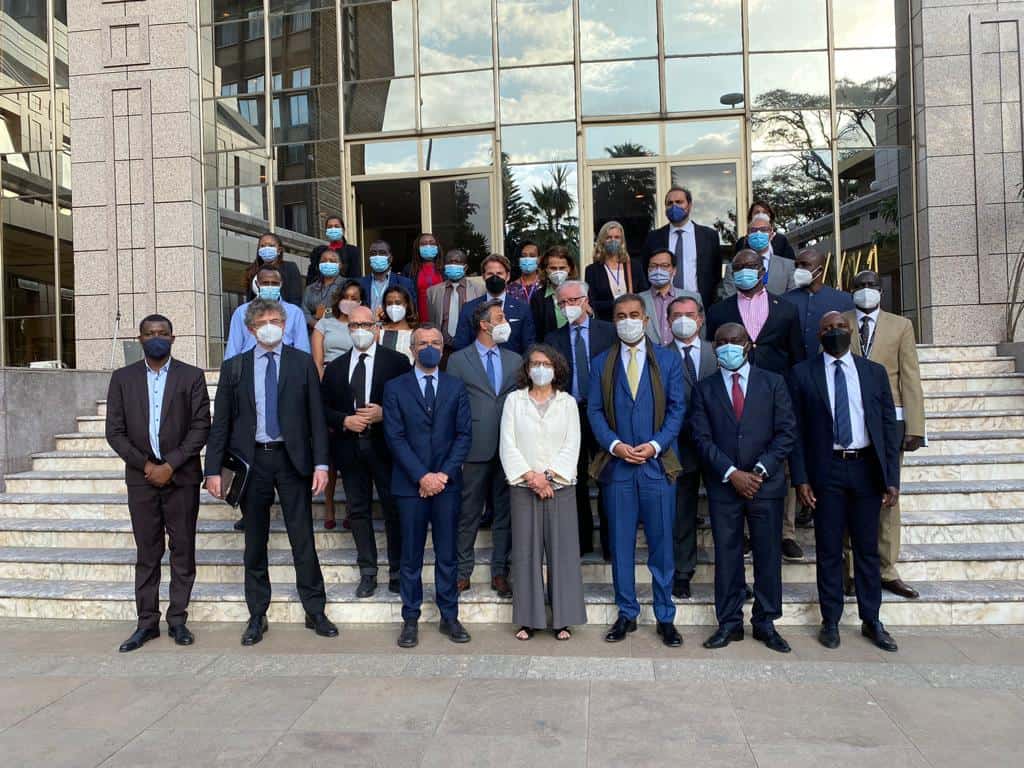
The Italian Deputy Foreign Minister Marina Sereni inaugurated on Monday, February 28, the African Union Situation Room for the prevention and management of environmental risks. Funded by MAECI and AICS, implemented by UNDRR and CIMA Research Foundation, the situation room represents a fundamental element in the African Early Warning System program, designed thanks to Italian support and expertise
A room open 24/7 for 365 days a year, that works as hub for the coordination and centralization of data from the two other situation rooms in Niger and Kenya. The Addis Ababa continental watch can inform the African Union (AU) bodies in real time and with the greatest possible accuracy, about any potentially critical environmental disaster risk situations, especially hydro-meteorological ones, on a continental level.
The Continental Watch in Addis Ababa has been operational since last December and it has already been activated for the cyclones that hit Malawi, Mozambique and Madagascar, allowing for the first time coordination at both preventive and post-emergency levels of solidarity for the most affected countries. On February 28, it was symbolically “handed over” by the Italian Deputy Foreign Minister Marina Serena, who to underlined the importance of carrying on this work in the coming years, when, according to experts’ forecasts, the climate change will lead to an increased risk of various natural phenomena, such as floods and droughts.
Thanks to the financial support of Italian international cooperation (MAECI and AICS), the African Union is, in fact, implementing the African Multi-Hazard Early Warning and Early Action System for Disaster Risk Reduction (AMHEWAS), a program to strengthen risk management at continental level. As part of the program, three different situation rooms have been set up: in addition to the continental one just opened in Addis Ababa, there are in fact IGAD’s Disaster Operation Centre in Nairobi (Kenya) and the Advisory Room in Niamey (Niger).
These three situation rooms facilitate the exchange, monitoring and analysis of data and information for risk reduction. Their realization has been possible thanks to the collaboration with the UNDRR office in Nairobi and the technical-scientific support of CIMA Research Foundation, which has provided its expertise in risk reduction and its skills on the open source platform myDEWETRA.world, developed for the Italian Civil Protection Department, that allows real-time monitoring and forecasting of risks.
The official ceremony of the AUC Continental Room represented also a moment to highlight the importance of a multi-risk approach for a continent, the African one,that is very vulnerable to natural disasters, exacerbated by the increasingly evident impacts of climate change, to which it is possible to respond effectively with transnational work and multi-state coordination in the medium term. In addition, the methodology of multilateral work between the Italian government, international technical expertise (UNDRR and CIMA Research Foundation) and policy makers (AUC, Regional Economic Communities, Member States and African centers of competence) is a virtuous model that makes possible to address emergencies increasingly from the standpoint of prevention and towards development.
For those interested in learning more, CIMA Research Foundation has described its work in this video: