Approved in early 2023, the Regional Strategy for Adaptation to Climate Change (RSACC) of the Liguria Region has seen our contribution. In collaboration with the DAD of the University of Genoa and CENVIS, CIMA Research Foundation provided scientific support to identify the most suitable measures for the territory, working in direct confrontation with technical representatives from different sectors of activity
Rethinking the territory and its activities, to protect the environment and people from the possible impacts of climate change: this is the main purpose of adaptation, the tool that (together with mitigation) allows us to face the climate crisis. Many Italian regions are therefore equipping themselves with climate change adaptation strategies: among the most recently approved is that of the Region of Liguria (approved by the Regional Council at its meeting on January 20, 2023), developed also with the support of CIMA Research Foundation.
The Regional Strategy for Adaptation to Climate Change (RSACC) represents a compass for actions and interventions aimed at reducing the impacts of climate change on the Ligurian territory, also grasping where present possible positive effects of the changing climate. A key aspect of the document is that it was constructed based not only on the scientific literature but on the expertise and experience of the technicians, officials and managers of the various regional business sectors that will be most affected by the changing climate, also gathered through participatory listening, discussion and design meetings. What, then, was the path that led to the creation of the RSACC?
Climate change scenarios in Liguria
The project to implement the RSACC was funded as part of the implementation of the Italian National Strategy for Sustainable Development. “The RSACC is a tool closely related to sustainable development, because the latter cannot take place without taking into account current climate trends and expected future effects,” says Filippo Fraschini, researcher in the Planning and Procedures Department who contributed to the realization of the RSACC.
The work was the result of a collaboration between the Department of Architecture and Design of the University of Genoa and the Center of Services for Western Liguria (CENVIS, also belonging to the University of Genoa) and CIMA Research Foundation. “Our first objective was to carry out a reconnaissance of existing studies regarding climate scenarios and expected impacts specific to the Ligurian territory. Next, we were to identify the tools already present in regional legislation and regulations for the implementation of adaptation measures and, finally, to identify the objectives and macro-measures most consistent with the territory”, says the researcher.
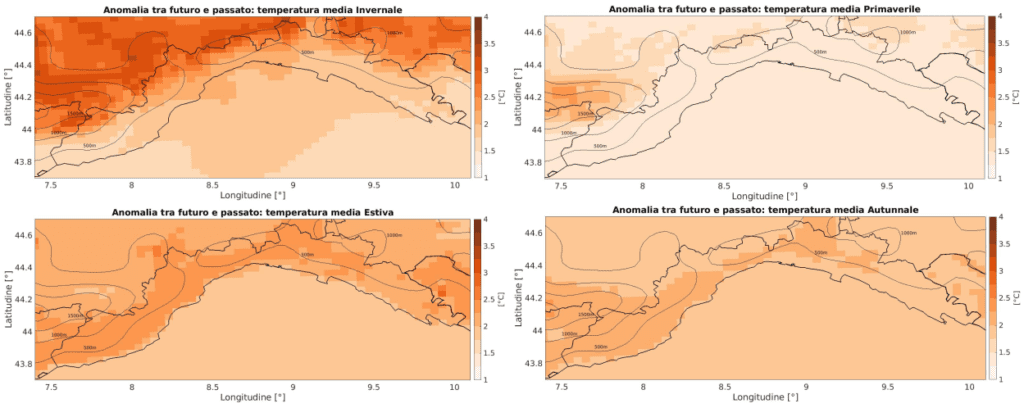
Initially, climate change scenarios for Liguria were missing; only national scenarios were available. In 2021, however, the Ligurian Regional Council deliberated on the climate scenarios produced by the CIMA Research Foundation’s Meteorology and Climate Department, which thus became an integral part of the process of defining the Regional Climate Change Adaptation Strategy (the scenarios were the subject of an acknowledgement by the Regional Council in Resolution No. 850 of 2021). “The projections refer to the period 2038-2068 and are based on historical data provided by ARPAL, the regional environmental agency; although there are uncertainties at the modeling and climate level, this first study has allowed us to begin to indicate and define the areas in the Liguria region subject to greater variations in temperature and/or precipitation between the future and the historical period.” the researcher continues. “In addition, we were also able to rely, at least for the Imperia area, on hydrological scenarios, thus more closely related to the water cycle, developed by CIMA Research Foundation as part of the ALPIMED Climate project.”
Shared measures: the dialogue with the technical community
CIMA Research Foundation researchers combined information on climate scenarios with a review of ongoing projects in the region to identify the most affected sectors. Then, a key part of dialogue and involvement of officials and managers from the different socio-economic sectors affected began. “Involving the technical community of the sectors of the regional administration in the definition of the Strategy was one of the most significant steps of the work: technical expertise and knowledge of the territory is needed to support the indications provided by the scientific studies,” says Dr Fraschini. “Through various meetings, we tried to identify the impacts that climate change could bring about in the different sectors of the administration, from water resources to health, in short economic-productive activities but also environmental ones. The tool chosen for discussion with regional stakeholders was impact chains, an analytical tool that allows us to relate ongoing and expected changes in the climate drivers with the elements of vulnerability and adaptive capacity specific to the territory, identifying the main risks generated or exacerbated by climate change for each sector. The impact chains are built on the basis of scientific information, but feedback from the different sectors allowed for the inclusion of knowledge, data and experiential knowledge from those who confront the critical issues of the territory on a daily basis and the necessary policy tools.”
Through the impact chain meetings, objectives and sector-specific adaptation macro-measures were identified, both based on the review of what was already present in regional planning and through the indications present in the Italian National Adaptation Plan. Based on the tools identified, the Liguria region was then able to define the final Adaptation Strategy document. In this regard, it is worth highlighting that the RSACC is not a binding regulatory instrument. Rather, it should be understood as a guidance document, or set of guidelines, for regional policies.
“Liguria is a particularly complex territory, where various types of natural hazards are articulated, from storm surges to floods, from drought to avalanches. This complexity requires strongly coordinated policies, capable of integrating the skills and needs of the different sectors and of including in the choices the most up-to-date scientific knowledge with respect to the climate changes in progress and expected in the future. “Our work has therefore been, on a basis on the one hand scientific and on the other of dialogue and qualitative assessments, to put together the different aspects in order to be able to compose, also, the most suitable measures,” Dr Fraschini concludes.