Climate and civil protection, the celebration of 15 years of CIMA Research Foundation
A day to talk about civil protection, in particular its relationship with climate change that is altering the dynamics of our planet leading to an increase in floods and droughts. A day to talk about it in terms of science and policy, but also society and art.
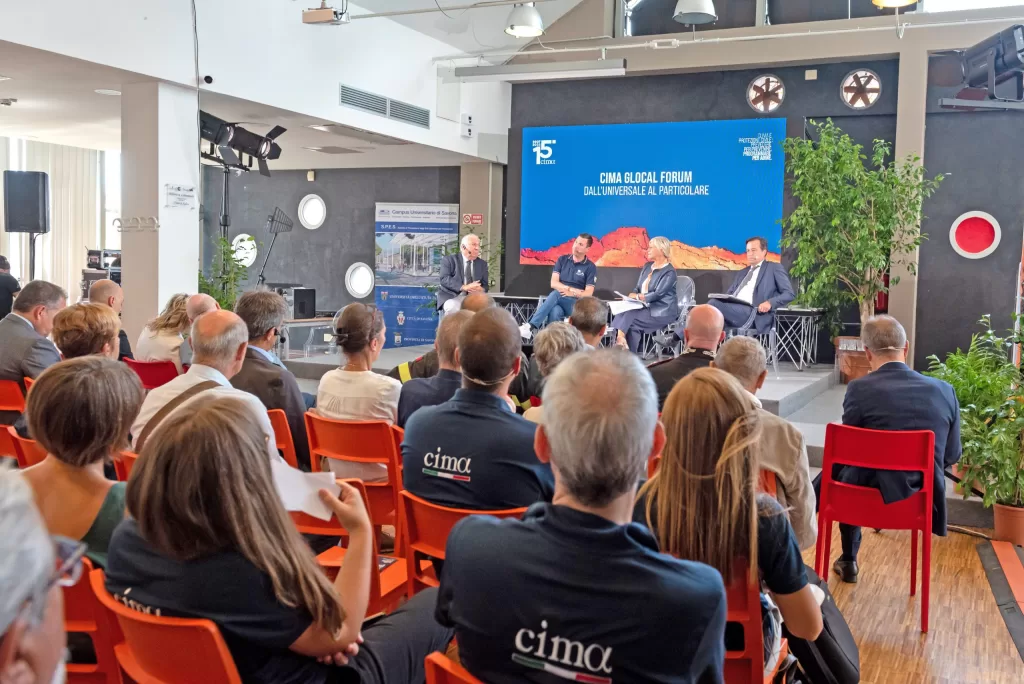
This was the event Climate and Civil Protection: predict to prevent, plan to act, on Sept. 5, the day on which CIMA Research Foundation celebrated its 15 years of activity with an “unconventional conference” (here the full recording, in Italian), which gathered at the University Campus in Savona exponents of international institutions, national and international politics, civil protection experts, scientists and artists.
“15 years ago, a group of visionaries thought of starting this beautiful anomaly called the CIMA Research Foundation: a research but also an operational facility, functional to the activities of the civil protection system. We didn’t know for sure at the time, but today we can say that that vision was correct, and we spent the next ten years in trying to prove it, accepting increasingly ambitious and risky challenges that have taken us far,” says Luca Ferraris, president of CIMA Research Foundation, opening the proceedings after institutional greetings from University of Genoa Rector Federico Delfino and Savona Province President Pierangelo Olivieri. Reviewing the history of CIMA Research Foundation and thanking for the role and commitment of all the colleagues who made this journey possible, Professor Ferraris spoke of today’s challenges, which often, unfortunately, also arise from yesterday’s mistakes: “The future presses while the present is already rich in the knowledge and tools useful to predict to prevent, but above all to plan to act. We have no time, and we must act now”.

The “party” was thus an opportunity for a dialogue between disciplines and sectors, a small “forum” (CIMA Glocal Forum) inaugurated by a panel discussion, moderated by RAI journalist and president of the Cinque Terra Nature Park Donatella Bianchi. On the one hand, the close link between climate crisis and civil protection was emphasized and, on the other hand, there was a reflection on how aware we are (or are not) of the urgency of addressing climate change adaptation.
In the first session, the conversation invested an international scope, toward the world and Europe. Speeches included the Italian Deputy Minister of Foreign Affairs and International Cooperation Marina Sereni, who said, “While climate change is difficult to halt and reverse, we can act now to reduce its impact on our territories and populations. To do this, it is essential to review our approach to risk reduction,” stressing the importance of a preventive rather than reactive approach: a direction in which Italy is moving, particularly with the adoption of early warning systems.
Marco Toscano Rivalta, director of UNDRR Office for Asia& the Pacific, by video link, then highlighted how hazards and climate change have been increasing over the past few years: “Data show that between 2015 and 2030 there has been an increase in disasters, as if we are going in the opposite direction from that indicated by the Sendai Framework for Disaster Risk Reduction. Civil defense systems are therefore faced with two things: strengthening and improving “early warning” systems and at the same time guiding and stimulating the prevention approach to change the development processes that are creating the risk instead of reducing it. A very important aspect is what is called the “last mile,” the ability of civil defense and other actors to reach the civilian population”. This includes through volunteerism, whose fundamental role Rivalta emphasized in this now critical historical period: “The ability of civil protection to reach local communities is also due to volunteers, whose role is never talked about enough: yet it is through them that the culture of awareness becomes a reality”. Rivalta went on to emphasize that today it is essential to treat risks not as separate and distinct units, but as events and phenomena that influence each other-as the recent COVID-19 pandemic and the impacts of the conflict in Ukraine have also well demonstrated. For this reason, it is necessary to treat risks with a multidisciplinary approach. “In this sense, actors such as CIMA Foundation have the ability to bring together various expertise, and I would like to emphasize that of the social and economic sciences, to understand how they can contribute to a greater understanding of risk and thus also of population behavior”.
Referring to the European Council’s request to the member states, dated February 2022, to adapt their civil protection systems to extreme weather events caused by climate change, the head of the JRC’s Disaster Risk Management Unit Alessandra Zampieri translated its meaning for civil protections: “The impacts of climate change can no longer be managed as they once were, for example, because they do not occur individually. Other elements need to be taken into account, and civil defense is being asked to recognize this new scenario and equip itself not only with more means but also with new knowledge and skills, collaborating with the scientific world, that will enable them to be more and more on the cutting edge and help policy and citizens anticipate phenomena and manage them more effectively and efficiently. In short, it is necessary a change of pace”. Zampieri closed his speech by recalling the importance also of the integration of different disciplines to address climate change-related issues, such as social sciences, recalling that for example we are observing the spread of what is called “climate change anxiety” among citizens.
The director of AICS , after mentioning the results born from the collaboration with CIMA Research Foundation (including, for example, early warning systems in several countries around the world and activities to strengthen African civil protection), also introduced the “human factor” in disasters: “Natural phenomena turn into disasters when we do not prepare the necessary measures to reduce their impact and manage their consequences in a timely manner. Becoming aware of this reality also means taking responsibility for it and, therefore, taking action and investing resources so that the necessary protection is provided to people exposed to the risk”.

In the second roundtable session, the discussion shifted from the international to the local perspective. The Liguria Region has been a pioneer in civil protection and alerting, partly and unfortunately because of the many risks to which it is exposed. And, says Ligurian Civil Protection Councillor Giacomo Giampedrone, it is also ready to be so when it comes to climate change adaptation. The alderman cited three examples that show steps in this direction, such as the creation of scenarios describing the possible impacts of climate change at the regional level for the next 30 years (carried out by CIMA Research Foundation), used for the adaptation strategy; the use of PNRR resources to address climate emergencies; and, finally, the attempt to adapt policies to change by informing and involving citizens.
What alliances and strategies are needed for a city to address climate change? Marco Russo, mayor of Savona, says, “Adaptation and mitigation must be experienced not just defensively but as an opportunity for an area, and I think this is the key vision that CIMA Research Foundation encourages us to take on in local government. This needs to be addressed both from a strictly structural point of view and from a community point of view”. For this reason, the mayor explained, CIMA Research Foundation was asked to start a civil protection planning process that was participatory, a way to translate scientific knowledge into processes that involve citizens. “Another example is the work we have to deal with for the Legino neighborhood in Savona, where the University Campus in which we are now located is located: they are not only a way to mitigate the impact of a possible flood and to safety but also an opportunity to create an integration between the University Campus and the neighborhood, and to change the face of the place in terms of sustainability and inclusiveness”.
Carlo Cacciamani, director of the ItaliaMeteo Agency, also agreed on the need to look at climate adaptation not only as a duty but also as an opportunity. Cacciamani then returned to the theme of the relationship between civil protection and climate change: “It is a combination that almost has an obligation to work. Climatology is fused with the need to secure a territory and with civil protection training, which must take this into account at all stages”. He added, “If I had to give a recipe, it would be to build communities of different expertise working together,” because climate change touches many different sectors – and therefore requires different expertise, from science to communication. “There is a real need to work together: it is not a slogan, but a necessity. We live in a society that is too complex to think about finding the solutions as individuals”.
Manuela Gagliardi, secretary of the Environment Territory Public Works Commission of the Chamber of Deputies, by video link addressed the issue of policy awareness on climate change: “I believe that competence is the first limitation of the national political class on these issues,” she said. “In the last five years, Italy has passed important regulations, but they have come mainly from input from the European Union: it is true that the issue of climate change should be addressed by considering a vast area, but individual states in turn should adopt their own policy on the matter,” Gagliardi continued, stressing when it is important for the Italian political class to place climate change as a priority on its agenda, without treating it as something distant but rather as a problem of today: “If we fail to realize that these issues are a priority for the welfare of the country and its citizens, we have failed”.
Gagliardi concluded her speech with a commentary between legislation and the practice of civil defense: “We must be able to bridge the gap between the abstract norm and the concrete need. As a Ligurian, I am proud to have such a center of excellence as CIMA Research Foundation in the territory and such a state-of-the-art civil protection. I think such a virtuous system should be exported: let’s take a cue from those who have already put it in place to bring it to the national level,” she said, so as to improve what is still not working optimally.
Closing the panel discussion, Fabrizio Curcio, head of the Civil Defense Department, briefly recalled how much civil protection has changed and grown over the past two decades. Curcio talked again about awareness: “For example, the poor snowfall this winter in Italy was already known from the first months of the year, yet we only arrived at the emergency (at least from a legislative point of view) in July. We need to think about the fact that climate change phenomena can have time-delayed effects, and that by the time we see them we are already behind schedule”. This, Curcio pointed out, is an international problem, not just an Italian one, with many elements of complexity and occurring in equally complex societies. In addition, Curcio explained how emergency management is a more or less time-limited period in which we operate in an extraordinary way, while addressing climate change requires a change in the general, ordinary approach. This issue is of particular importance when thinking about the role of civil protection in dealing with the climate crisis, including from a regulatory point of view. “The current civil protection code is the child of an important path taken in the past, but it has some stakes,” Curcio explained. For example, the Italian Civil Protection Department cannot act at the level of infrastructure (except in some exceptional cases), nor does it have a role in the energy sector. “How then can we play an important role with these constraints? We have to be careful not to put the focus on something we don’t have the tools to act on,” Curcio commented. In short, regulatory tools are also needed for civil protection to be placed in a position to meet the challenge of climate change. “Italian Civil Protection is ready to do its part, but the pathway and what is expected must be clear,” Curcio concluded.
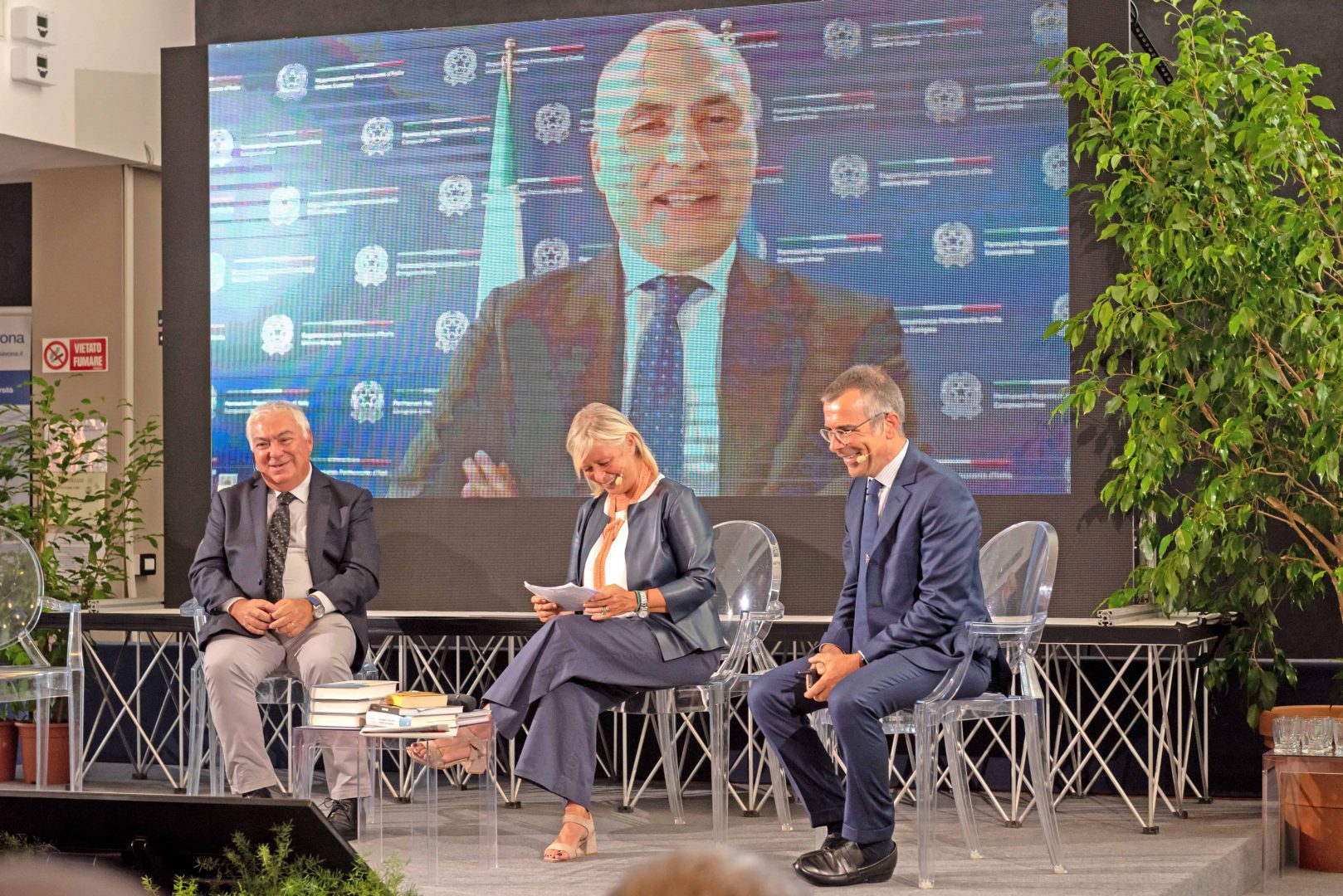
Interspersing the panel discussion were two “CIMA-talks,” short dialogues between researchers. The first featured Laura Poletti, from the Hydrology and Hydraulics Department, who deals mainly with floods, and Gustavo Naumann, expert on droughts: two voices to reason about the gulf that separates science and opinion, and the difficulties that arise in communicating the former, especially regarding the uncertainties that characterize it. The second talk featured jurist Francesca Munerol, who works on participatory plans at CIMA Research Foundation, and Filippo Fraschini, political scientist and expert in climate change adaptation plans. The two speakers showed how, in order to address this global challenge, it is also necessary to start from local studies: among the examples cited were the activities carried out by CIMA Research Foundation in Liguria with participatory pathways, involving citizens, in the Cinque Terre and the hinterland of Imperia.


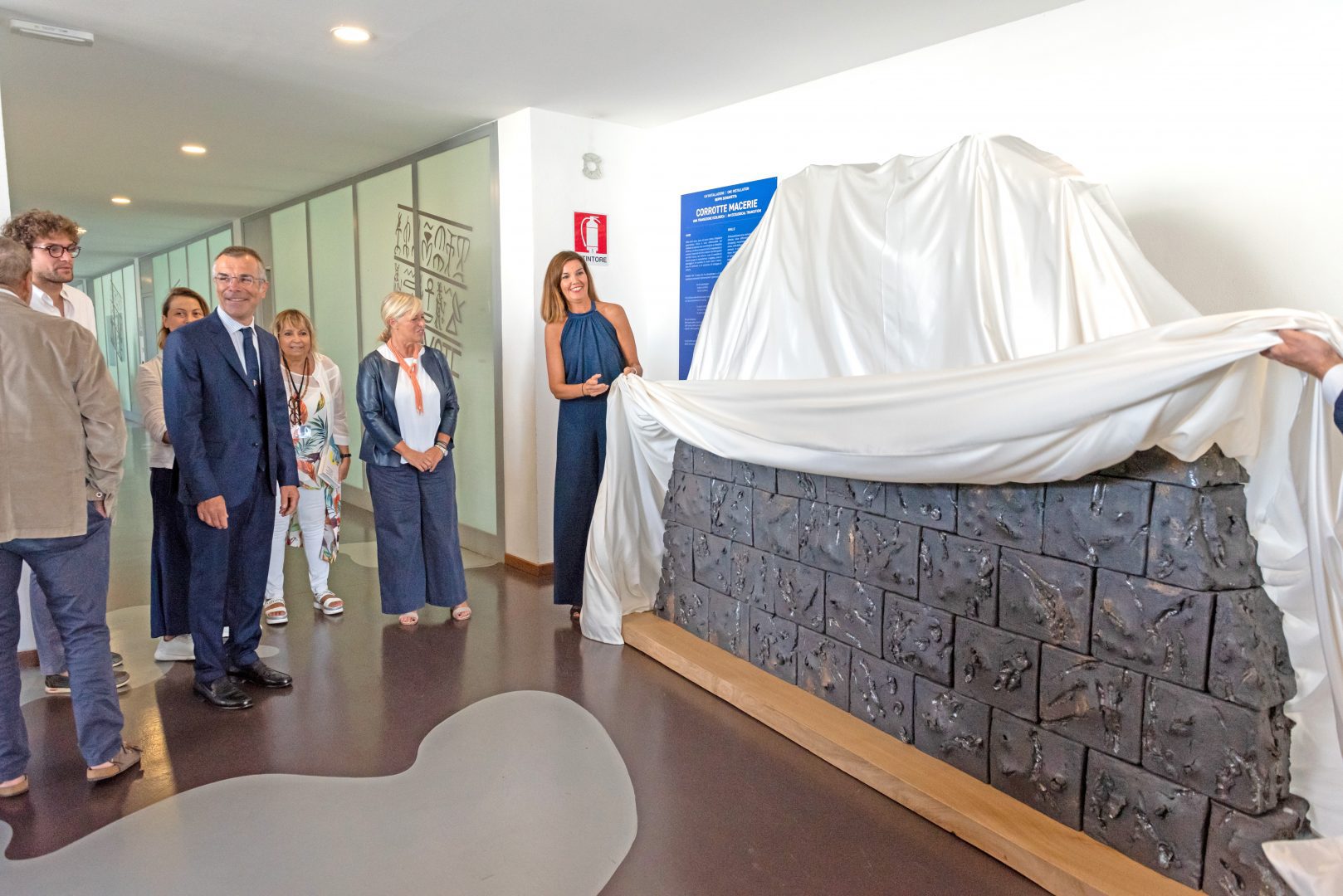
The morning closed with an “im-possible dialogue” between art and science, involving CIMA Research Foundation president emeritus Franco Siccardi, artist Beppe Schiavetta, CNR Institute of Geosciences and Georisources director Antonello Provenzale and assyriologist at Rome’s La Sapienza University Lorenzo Verderame: a reflection on how artistic interpretation can become a means of communicating scientific reality, helping to spread its message. This is a theme traditionally dear to CIMA Research Foundation, which has been collaborating for years with Ligurian artist Beppe Schiavetta: the September 5 event, in fact, was also an opportunity to unveil his latest work, entitled Corrotte macerie (“Corrupted ruins”): a stoneware wall inspired by the artist’s previous series of paintings, Lamentazioni di Ur (Lament for Ur), a reference to the Mesopotamian city destroyed by drought and desertification.

The afternoon was devoted to a series of scientific seminars by CIMA Research Foundation researchers, moderated by Fabio Castelli, professor at the University of Florence and coordinator of CIMA Research Foundation’s scientific committee. Some of the most representative topics of our research activities were touched upon: the study of snow and glaciers, meteorology, forest fires and the role of participation and paths taken with citizens to build civil protection activities and strategies. Thus, Francesco Avanzi, from Hydrology and Hydraulics Department, addressed the topic of hydrological digital twins, innovative models for the representation of terrestrial phenomena and systems that could help overcome some of the limitations of current hydrological models, representing the water cycle also including, as the researcher said, “the most important and perhaps least studied hydrological process, human kind”.
Next, Vincenzo Mazzarella gave an excursus on the activities he carries out by the Meteorology and Climate Department, working with forecasting models and data assimilation techniques, which today also include information on lightning events, going so far as to determine future climate scenarios. Activities that find fundamental uses in a wide variety of areas, from air traffic management to the definition of climate change adaptation plans.
Marina Morando, head of the Planning and Procedures Department, focused on the path the area has taken in recent years: “Since the Genoa flood of 2011, we realized that it was not enough to implement forecasting capacity without working, in parallel, on improving the effectiveness of civil protection planning, collaborating with both operators and the population, so as to build planning that is participatory. In recent years, our activities have expanded further and we have also begun to address planning aimed at climate change adaptation,” she said.
Finally, the afternoon of seminars closed with a talk by Andrea Trucchia, researcher of Wildfires Risk Management and Forest Conservation Department. Trucchia told about his work on wildfire management in Ethiopia. “Ethiopian context has several critical issues, such as the emphasis on action rather than prevention and the difficulty in reaching the often remote communities,” Trucchia explained. The approach to address these issues has been the study of fire characteristics and dynamics in the region, the development of modeling that highlights the importance of prevention by providing hazard and risk maps and including AI tools to identify connections between different factors, the implementation of open source platforms for data sharing, and finally, the production of easily disseminated bulletins. “A good paradigm never dies,” said Trucchia: several Ethiopian agencies are indeed continuing to use these systems, and a network of fire risk expertise has been established in the country.
“It is said that when the Titanic was about to sink, the orchestra was asked to keep playing. We don’t have to be those musicians: we are the crew that could have sounded the alarm. Because today we really are on alert and we cannot insist on playing like the orchestra, ignoring the danger we are facing,” professor Ferraris concludes. “Addressing the challenges posed by climate change requires joining forces and knowledge, from politics to science, actively involving citizens, as we did on this day that united diverse voices with a common challenge. We are called to tear down the walls that isolate us, and instead build bridges that allow us to work together for a sustainable future: we owe it to society as a whole and especially to the new generations“.