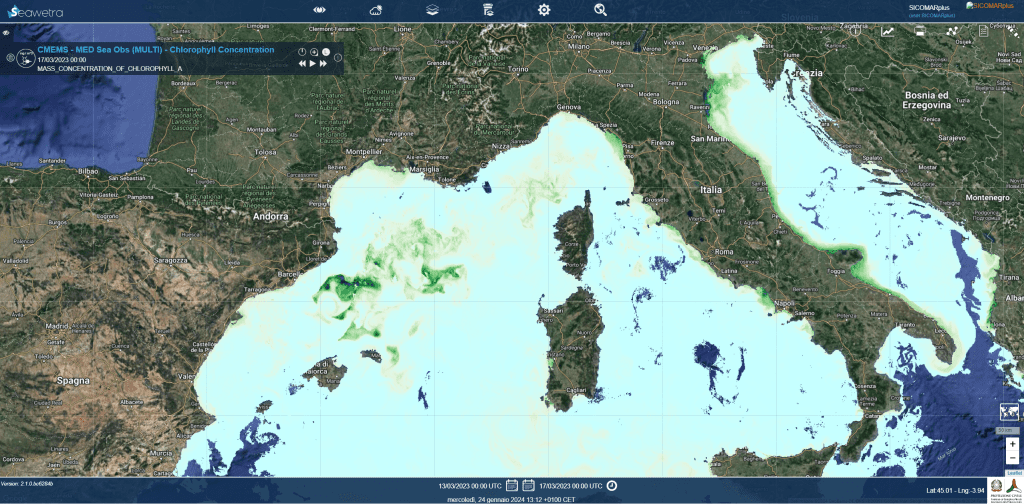
A study by researchers from CIMA Research Foundation demonstrates how, in recent years, the bloom of phytoplankton has become increasingly scarce. The cause appears to be the increase in winter temperatures due to climate change
This is a different kind of bloom compared to the one that colors the meadows in spring, but its role is equally important. We are talking about the “bloom” of phytoplankton, a group of photosynthetic microorganisms essential for our planet’s life. They are crucial because they contribute significantly to both marine and atmospheric oxygen production and serve as the foundation of the aquatic food web. Due to their critical role in marine life and their sensitivity to environmental parameters, phytoplankton is one of the most important indicators used to monitor the health of the sea and can provide information about the effects of climate change in the marine environment. This is the focus of the recent study published in the Science of the Total Environment, co-authored by researchers from Fondazione CIMA in collaboration with the University of Trento and the Institute of Geosciences and Georesources of CNR.
The results presented, based on the integration of data regarding phytoplankton bloom in the Mediterranean with meteorological and oceanographic data, indicate an increase in the frequency of anomalous years and, more importantly, a significant decline in intensity over the past seven years in all the sites studied. The correlation, as suggested by the authors, can be attributed to the rise in winter atmospheric temperatures in recent years. It is a strong signal that the effects of the climate crisis on the marine environment require attention and research efforts on par with those on land.
Blossoming microorganisms
Phytoplankton is a collection of unicellular organisms, including bacteria, algae, and eukaryotes, characterized not only by their life in aquatic environments but also by their ability to photosynthesize, producing oxygen by absorbing carbon dioxide and utilizing sunlight. In fact, they are estimated to be responsible for about half of the terrestrial oxygen production, despite their biomass being relatively limited compared to trees and other plants. Additionally, phytoplankton represents the first trophic level of the aquatic food web, serving as the foundation that sustains all other organisms.
If monitoring phytoplankton is worthwhile due to its significant ecological contributions, it becomes even more intriguing as an indicator considering its rapid response to climate change compared to other organisms. This is why it plays a prominent role in the assessment of water health, particularly through satellite-based monitoring of chlorophyll concentration, an indicator of phytoplankton presence, over large marine areas.
From cetaceans to chlorophyll
“The Mediterranean Sea is considered a biodiversity hotspot, and its health status is particularly valuable. Between January and April, we observe a phytoplankton bloom, especially offshore. However, only in recent times have we been able to collect sufficiently consistent data to study its trends,” explains Francesca Grossi, the lead author of the study and a doctoral student at the University of Genoa who, within the Marine Ecosystems Department of CIMA Research Foundation, studies the impacts of climate change on marine megafauna. These observations have provided the inspiration for the new research.
“In recent years, we have observed an unusual pattern in the presence of cetaceans, especially common fin whales: their presence remains constant, but sometimes the groups consist of a large number of individuals, while at other times they are very scarce. Furthermore, some groups are closer to the coast than usual,” explains Paola Tepsich, coordinator of the Marine Ecosystems Department and leader of the study. “We wondered what could be the causes and, in collaboration with Fondazione CIMA’s meteorology group, we realized that the same anomalous trends are also observed in meteorological parameters. This prompted us to try to relate them to what happens in the sea, starting with phytoplankton and its seasonal bloom, which determines the availability of food for cetaceans in the following months.”
The researchers then analyzed chlorophyll concentration data collected over 24 years: data for the period 1998-2007 were used as a reference to understand the intensity and duration of phytoplankton bloom in the northwestern Mediterranean, while data for the period 2008-2022 were used for the actual study, linking them to oceanographic and meteorological variables.
Higher winter temperatures, scarcer blooms
“Since the cooling of surface waters causes them to sink and thus mix the water column, it is the characteristics of winter weather that influence the bloom period. It is now established that, in the northern hemisphere of the planet, winters are becoming shorter, and low temperatures are concentrated in limited periods,” says Martina Lagasio, co-author of the study and researcher in the Meteorology and Climate Department of CIMA Research Foundation. “In line with what has already been highlighted by other researchers, we observed that, over the last 14 years, the winter temperature in the Mediterranean, both in the atmosphere and in the sea, has shown a significant increase. At the same time, precipitation has decreased. It is important to note that the increase in water temperatures affects not only the surface but also the deeper layers. This is a concerning fact because the northwestern Mediterranean is the only properly cold area in the entire basin. In fact, the phytoplankton bloom occurs recurrently only in this area. Here, cold waters form, influencing the deep circulation of the entire basin: thus, the observed warming, characterized by a layer that maintains water temperature constant beyond 400 meters deep, can potentially affect the dynamics of these deep waters.”
We are accustomed to associating the blooming of flowers with milder temperatures, so we might expect the same principle to apply to phytoplankton, where warmer winters correspond to more intense blooms. However, things are not that straightforward. On the contrary, it is the increased temperatures that are associated with periods of lower chlorophyll concentration.
“Statistical analysis shows that we are not dealing with random oscillations and correlations, but rather, in some areas, there is a significant association between higher temperatures and less intense blooms. Although we have observed a genuine decline only in some areas, the decrease in blooms is general across all the sites studied,” explains Mrs Grossi. “This result underscores the urgent need to focus attention on studying the effects of the climate crisis in the marine environment and its cascading effects. Consider that the same disrupted dynamics observed for cetaceans, which are correlated with the presence of phytoplankton, can also be applied to commercially important species like tuna, not to mention the role of phytoplankton in carbon dioxide absorption.”
In this regard, the researchers conclude that the study can be placed in a broader context of Ocean Literacy – understanding the importance of seas and oceans in the life of our planet. As terrestrial beings, our attention is inevitably drawn primarily to the environment in which we live. However, on the planet, all systems are intricately interconnected, and what happens at sea can have substantial effects on the land. “It was once believed that a ‘buffer system’ as vast as the sea could never be substantially altered,” concludes Dr. Tepsich. “But things are not like that, and today we are seeing it.”
In the cover image: the chlorophyll concentration map for March 2023, displayed on the Seawetra platform