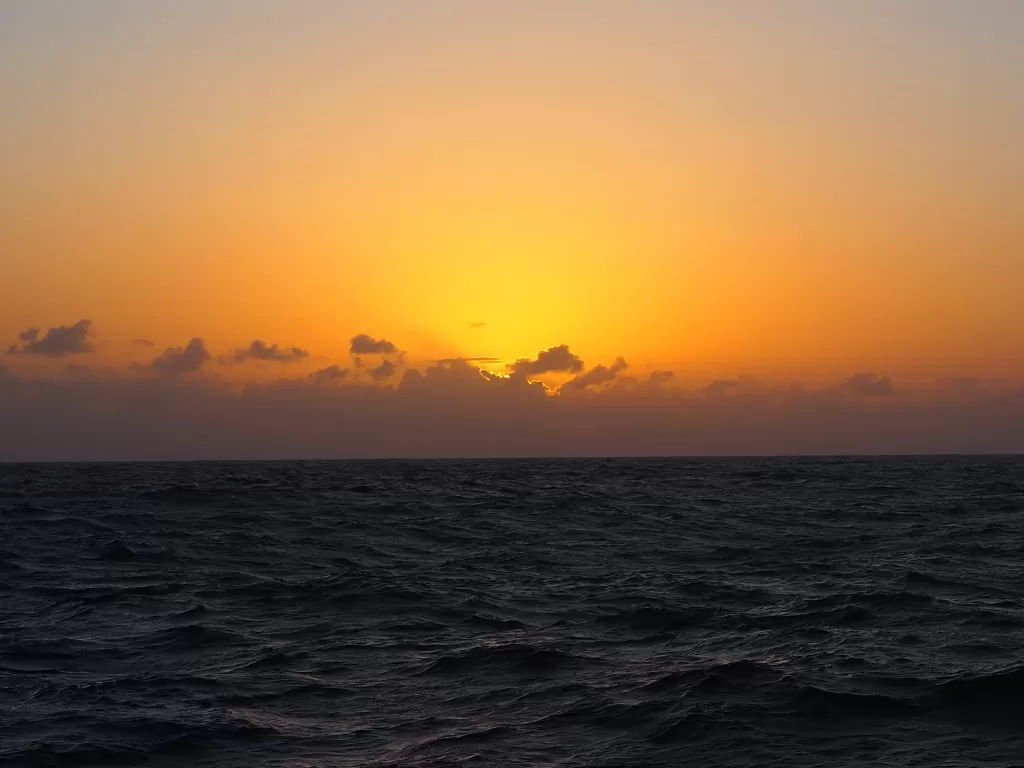
As part of the EUREC4A project, dedicated to the study of the relationships between clouds, oceans and climate, Agostino Meroni and Anna Napoli, collaborators in the Meteorology and Climate Department, participated in a campaign at sea chasing the eddies, oceanic whirlpools, to investigate their interactions with atmospheric dynamics
There is a close reciprocal relationship between clouds, oceans and climate: clouds contribute to regulating the temperature of the planet, while oceans influence the Earth’s atmosphere, and climate can in turn influence the oceans and (indirectly) the characteristics of clouds. The change of clouds will in turn have an effect on the climate, and so on, in a continuous circle.
To understand in detail the mechanisms by which these elements change and influence each other, EUREC4A, an international initiative using satellite and ground-based remote sensing, advanced modeling and new automatic measurement systems, was held between January 20th and February 20th. Within EUREC4A, scientists from around the world also worked on the field: they had to fly or sail, as did Agostino Meroni, researcher at the Politecnico di Milano, and Anna Napoli, PhD student at the University of Genoa, both collaborators in our Meteorology and Climate Department. In January, they took part in a month-long campaign at sea, EUREC4A_OA. During this period, spent aboard the research vessel L’Atalante, they collected the data necessary to study the complex interaction between ocean, clouds and climate, starting from the Caribbean Sea and ending off the coast of French Guiana. We asked them to tell us about this experience.
Apparently, clouds are well known objects: we know how they are made, the atmospheric phenomena in which they participate… Why is it so important to know them better?
Agostino: Actually, clouds represent the great unknown of climate models. They are complex, vary rapidly over time and are controlled by mechanisms that take place on a microscopic scale, with the phase changes of the tiny droplets that make them up. This makes them difficult to study and, consequently, current climate models have great uncertainties. Furthermore, we know that they play a dual role in climate regulation: they reflect part of the radiation emitted by the sun, helping to cool the earth’s surface and, at the same time, they trap the thermal energy emitted by the earth, thus increasing the temperature. However, some of the mechanisms by which they act are not yet fully known. And for studying the clouds, we must also study the sea, which influences the Earth’s atmosphere in several ways.
The EUREC4A project wants to investigate different atmospheric and climatic mechanisms, which are closely intertwined. What exactly was the purpose of the campaign you took part in? Which of these was it dedicated to?
Anna: Our research group was dedicated to the study of the so-called marine forcer, i.e. the role of the ocean in atmospheric dynamics, such as winds and cloud properties. In particular, we worked on the relationship between the atmosphere and eddies, circular oceanic vortexes that are formed from strong ocean currents, such as the Gulf or – in our case – Brazilian currents. The interesting aspect of eddies is that they carry water with physico-chemical properties different from the surrounding ones, for example in terms of temperature or salinity. This means that they represent abrupt variations in ocean properties: our aim was to investigate how these variations affect the atmosphere.
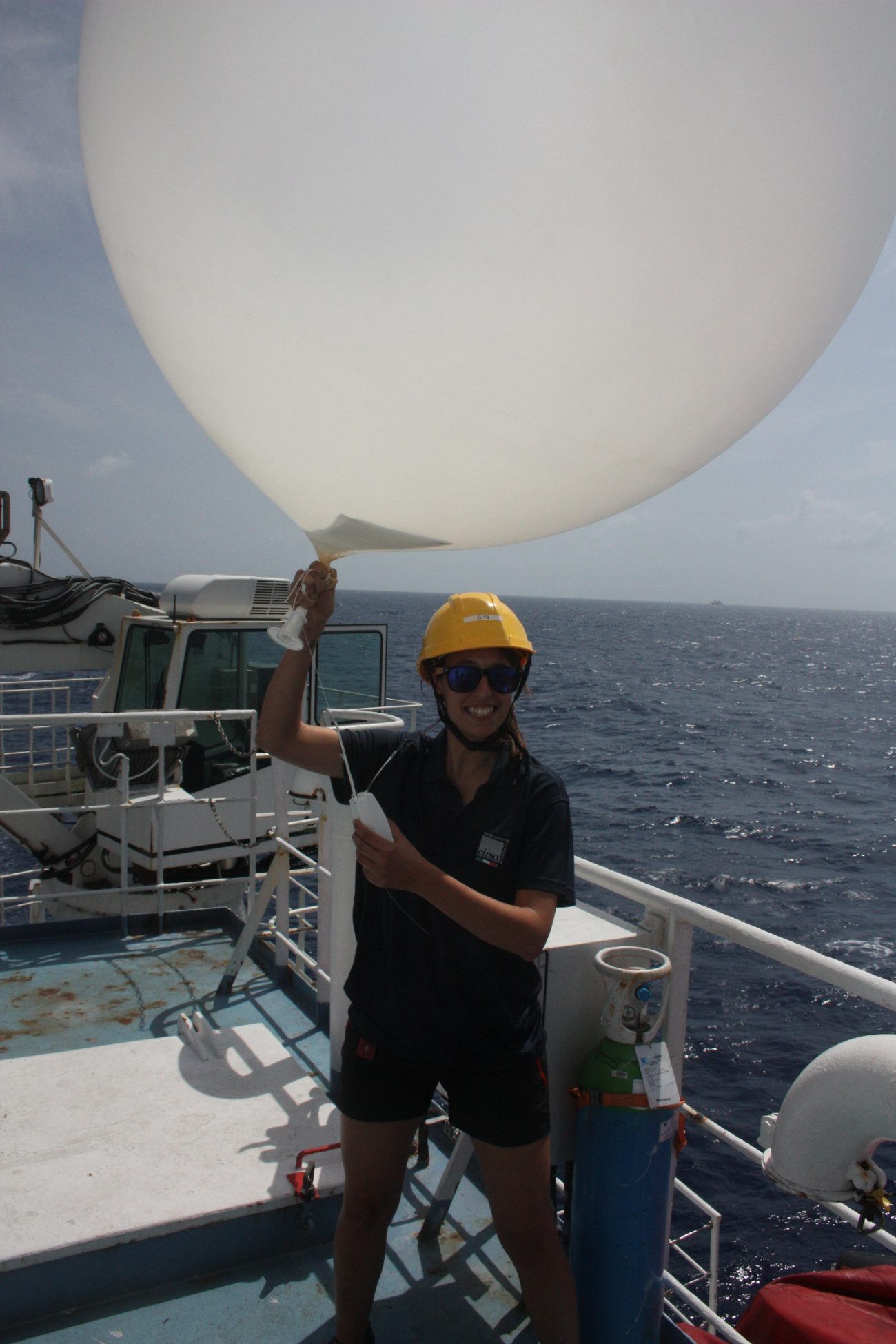
But why did the campaign take place in the tropics?
Agostino: Because they have atmospheric and oceanic characteristics that are particularly interesting for this type of research. On the one hand, in fact, they receive a great quantity of light, and therefore energy, from the sun throughout the year, that the atmospheric and oceanic currents then transport to the Poles. On the other hand, even the clouds themselves that characterize the tropical regions, the so-called “trade-cumulus”, are thought to play a fundamental role for the climate of the entire globe: they are in fact a persistent characteristic of the region, and observing them for a certain period of time makes it possible to understand the diurnal cycle, the mechanisms of formation and, possibly, to predict their dynamics, also taking into account the possible effects of climate change.
Your work is usually done in the office: wasn’t it difficult to change and start working in the field?
Anna: Actually, the most difficult part was getting used to the rigid shifts: we had only one month to do it, and a lot of data to collect. Our days were therefore set to four-hour shifts, which also covered the nights. In a short time, however, we got used to it! And we were also lucky: there weren’t too many summer showers, which in the tropics are very strong and make it really difficult to take measurements on board.
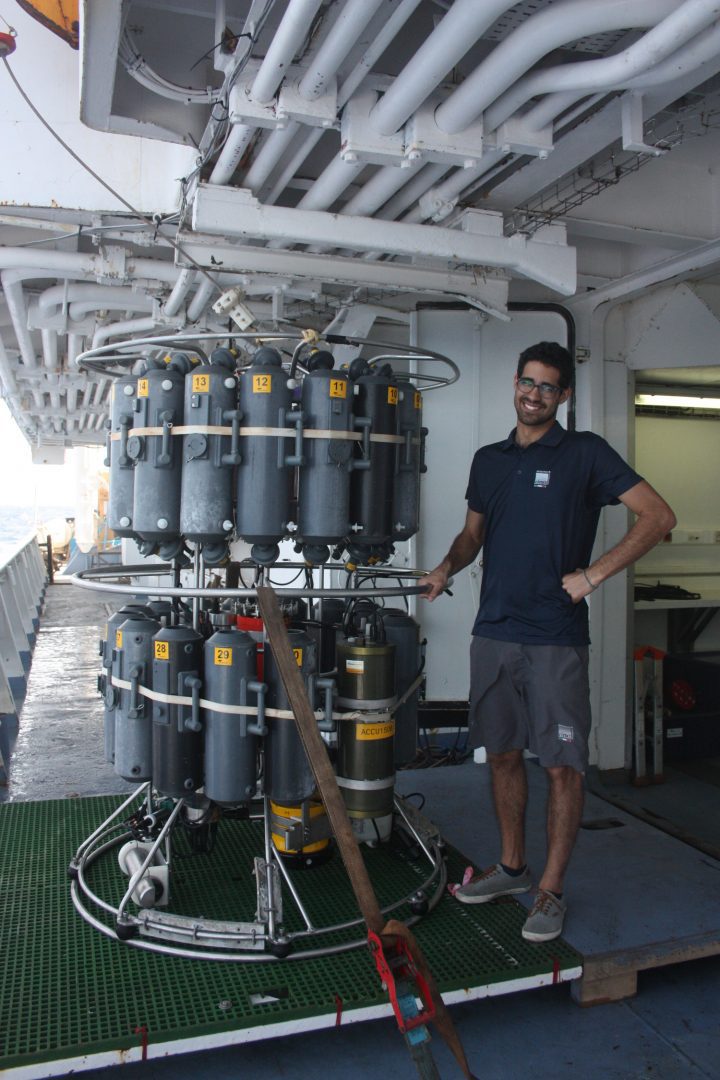
And what about the type of research? What’s the difference between carrying them out in front of a computer and carrying them out at sea?
Agostino: They were a great added value to the experience! We are used to working with numerical models, which give back a parameterized and simplified reality. But climate science, like all sciences, starts from observational data and it is important to be able to touch them: understand how measurements are taken, what limits they have, and go back from the virtual world of models to the complex world of natural reality. It allows us to have a more complete view of the mosaic of meteorology and climatology.
The researchers on board the Atalante formed an international and heterogeneous group. This must have enabled a vast exchange of knowledge…
Anna: On board there was what I called “research air”, perhaps the most important thing that left me with this experience. We were able to confront each other continuously, ask questions, learn, and explain our work with other researchers, each with their own professional experience in the meteorological and climatic sciences. This is a continuous stimulus to ask other questions, to deepen and study: it is the lifeblood of scientific research.