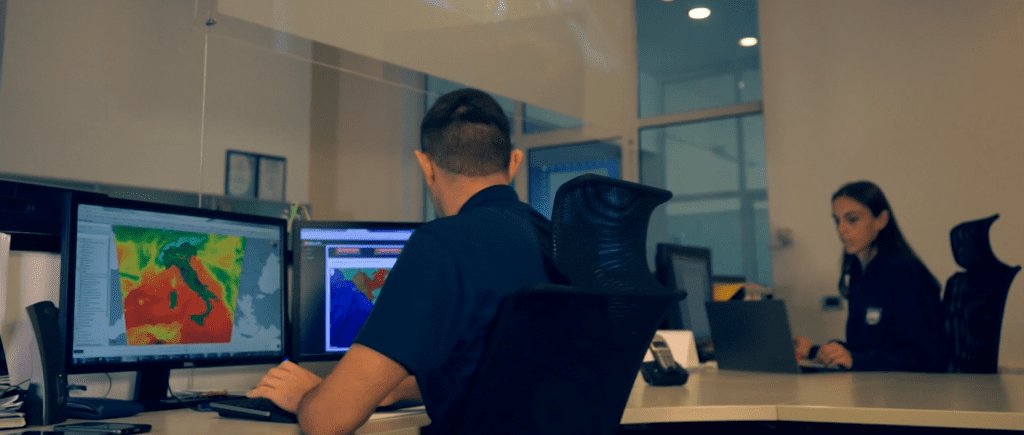
On February 27th, we commemorate the twenty years since the issuance of the Italian Warning Directive. As this anniversary approaches, we dedicate an in-depth analysis to the role of technological and scientific development in predictive models, as well as in the necessary phases of monitoring and surveillance of meteorological, hydraulic, and hydrogeological phenomena
We have recently retraced the history of what is known as the Italian Earlt Warning Directive – or, more precisely, Directive 27 February 2004: operational guidelines for managing the national warning system for hydrological and hydraulic risk. This marks the origin of the warning system, based on the network of Compentence Centers, which in Italy ensures forecasting and monitoring activities for meteorological, hydrological, and hydrogeological events, allowing the definition of specific warning levels and the implementation of appropriate prevention and protection measures, including public information.
The history of the directive is accompanied by the history of technological and scientific development, which generally characterizes all activities and research in the field of risk management. We discuss this with Luca Molini, researcher at CIMA Research Foundation.
Research and development, a mutually reinforcing duo
“This represents one of the few cases where scientific contribution is directly and explicitly integrated into a directive, since it defines the role of Competence Centers in terms of supporting knowledge and for the development, improvement, and updating of the many tools used in the alert system,” says Dr Molini. “This role becomes particularly evident when considering the evaluation phase.”
As we have explained, indeed, the Directive clearly defines a prediction phase followed by a monitoring and surveillance phase. In the prediction phase, predictive models (meteorological, hydrological, hydraulic, and for landslides) and their interpretation play a leading role. Moreover, the development of ground observational tools, satellites, and the national meteorological radar network has allowed a refinement over the years, resulting in increasingly accurate and precise predictive capabilities. “The radar network, for which CIMA Research Foundation has played an important design role, has been the element that has bridged the gap between prediction and observation the most, and consequently also between prediction and monitoring,” says Dr Molini. “In fact, algorithms have been developed that, based on information provided by radar, allow for short-term predictions (on the order of about an hour), fundamental for monitoring rapid events – which are often also the most intense.”
In some ways, this is a self-reinforcing cycle. The increase in computing power has fueled the advancement of predictive models, leading to more accurate forecasts and analyses even at very small scales (necessary, for example, in cases of phenomena such as flash floods). The same scientific and technological advancements have allowed the study of phenomena in increasingly finer detail, which in turn enables the development of models capable of describing scenarios more accurately. “In short, basic research and modeling development feed off each other, allowing us to increase our knowledge more and more,” comments Dr Molini.
Parallel to the development of available tools, the expertise of operators has also had to grow and evolve. Warning emissions (and management), in fact, are not based solely on the model’s results but require interpretation based on the skills and experience of the operators, who increasingly must be able to interpret the framework provided by the modeling output. As Dr Molini explains, “Before 2004, figures that performed this type of evaluation were not ufficially defined. These are skills that had to be mainly acquired and refined with the implementation of the Warning Directive, in order to define hazard scenarios by combining experience and numerical data.”
Artificial intelligence and warnings reliability: perspectives for warning
Scientific and technological advancement cannot ignore – and can benefit from – the leading “new entry” in many research fields today. This is, of course, artificial intelligence, whose role in risk management we had already dedicated an article to some time ago. “AI can potentially mimic what human forecasters do today, reconstructing the evaluation part through algorithms ‘trained’ to link certain parameters and values (for example, in terms of precipitation on a certain type of territory) with their effects on the ground,” says Dr Molini. “This does not mean diminishing the human role, certainly not in the short term. However, it means being able to analyze data massively to relate them to situations that have already occurred in the past and to identify extreme events that probabilistic forecasting struggles to identify.”
When thinking about the prospects of Italian warning system, there is also another aspect that could attract attention in the coming years. It is not strictly scientific but straddles science and society and concerns the assessment of warning. In fact, while their role in terms of civil protection is undoubtedly important, analyzing them is not straightforward. As we had explained, indeed, the Directive has changed over the years, introducing warning for hydrogeological risk linked to thunderstorms and a color code shared among all Italian Regions in 2016; before this date, therefore, the system was more composite and difficult to compare between one Region and another.
“One of the big open issues is the harmonization of the verification system, to have a comparison between actual ground effects and predictions. Currently, it is not possible to take into account some ground effects that occur when, for example, the ground is already saturated (so even relatively limited precipitation can have significant effects), or for phenomena not strictly measurable, such as hail. We would need a shared approach and a robust and homogeneous methodology for recording damages at the regional level, in order to understand the real impact of different events and correct any biases of over- or underestimation of the events,” says Dr Molini. “This would also allow us to provide even better information to the population.”