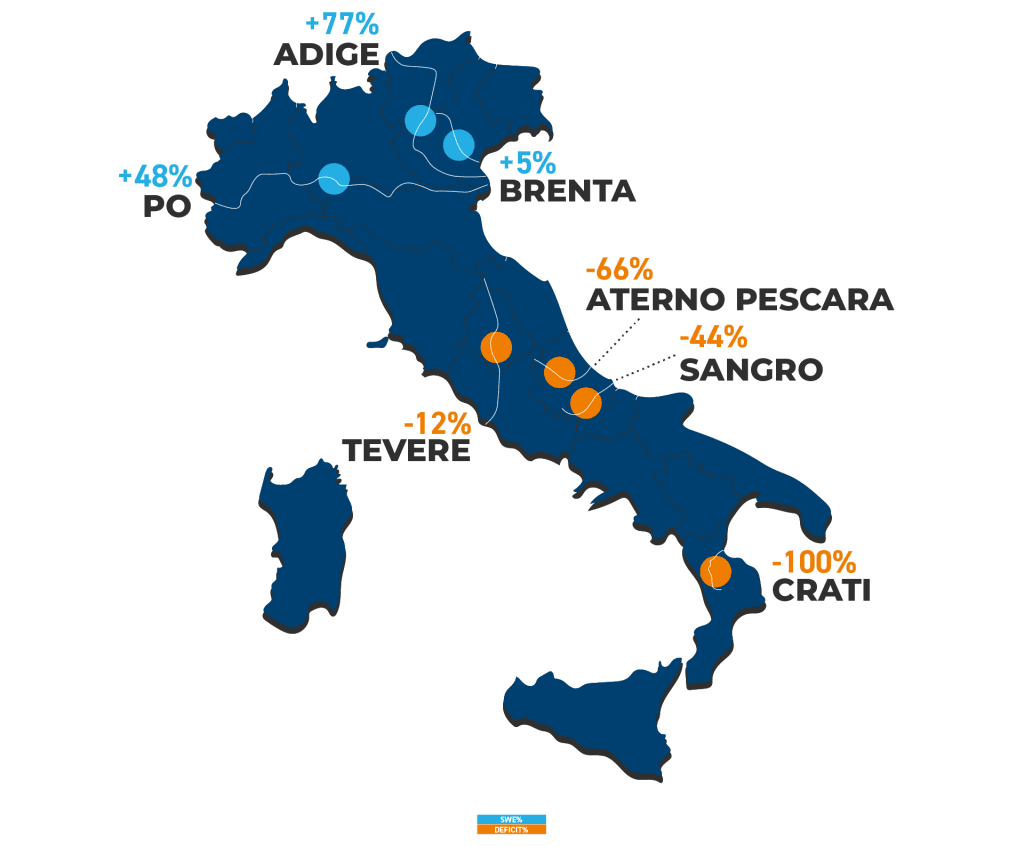
Today we conclude our winter bulletins of snow monitoring in Italy: the situation at the beginning of May confirms the positive trend already noted in April, with a national Snow Water Equivalent that even marks a +42%. But the situation is not the same across the entire peninsula. The situation is good for the Alps but not for the Apennines
This month, we close our periodic updates on the state of snow in Italy, reporting the latest data and taking the opportunity for a more general reflection on the accumulation of water in the form of snow during the winter months.
First, some good news. In our latest update, we reported how, after two years of deficit, snow resources for the 2023-24 winter had been replenished between February and April. The latest data confirms this and even reports a significant improvement: the Snow Water Equivalent, an indicator defining the water content in snow, has risen nationally from +1% in April to +42% today.
“If we consider the situation at the beginning of winter, when the deficit seemed ready to follow that of previous years, the change we observe is a clear confirmation of how, when it comes to snow, the situation can evolve substantially. This is why it is important to assess the season as a whole and not based on individual snowfalls,” says Francesco Avanzi, researcher at CIMA Research Foundation. “We also recall that when talking about snow, the main players are always the same: precipitation and temperatures. In the Alps, the recent weeks have been cool and humid, leading to positive SWE data (+44%). However, the situation remains significantly different in the Apennines.”
Indeed, another less positive characteristic of this winter season is the profound difference between Alpine and Apennine snow conditions. Once again, the most recent data from CIMA Research Foundation confirms that of the previous month: the assessment for the Tevere River (index for the central Apennines area) estimates a deficit of -12% compared to the historical period, although by now it is clearly an underestimate at this point in the year.
“We reiterate what was said in the last update: it’s as if there were two winters, one for the Alps rich in precipitation, and one for the Apennines, rather lacking in precipitation and thus snow,” says Dr Avanzi. “Therefore, we cannot talk about a single ‘Italian drought’: our country is complicated from a climatic point of view, where many local situations can occur, also very different from each other.”
Another important aspect to highlight at the end of this winter is that a significant snow deficit continues to be observed at altitudes below 1800 meters above sea level, both in the Alps and the Apennines. Snow has managed to be abundant only in the Alps and above 2000 meters, where the seasonal freezing level has not been significantly exceeded. In other words, below certain altitudes, temperatures have been too high, and even with abundant precipitation, they have led to an early melting of the snow.
We conclude this last seasonal update with some final considerations. “In the northern part of the peninsula, we have a significant snow water reserve for this time of year. The moderate temperatures of the past few weeks have also helped preserve the snow, avoiding early melting. But these are precisely the variables to monitor: it is important that temperatures do not rise too much and too fast because for snow to be useful, it must melt until late spring,” concludes Dr Avanzi. “If we compare April precipitation with evaporation (related to temperature), we see that surface water resources are already starting to be in deficit now. In short: it is important to continue monitoring, as we will also do through the Rain and Drought Observatory, realized by the Italian journal Il Sole 24 Ore in collaboration with CIMA Research Foundation, which reports updated data on the most significant variables.”