
Snow represents a fundamental water supply for basins during the spring months. Now, the snow season has begun, and, as in previous years, we are monitoring precipitation and snow accumulation across Italy. We are beginning to report the data, which, unfortunately, indicate a deficit of -44% at the moment. This situation is reminiscent of previous years
Christmas is approaching. But can we talk about a “white Christmas,” as the famous Irving Berlin song suggests? CIMA Research Foundation has initiated its usual winter snow monitoring, and we can now present the initial data. According to this data, the Italian situation can be considered slightly better than the winter of 2022-23, but not so much.
Snow plays a fundamental role in the hydrological cycle; it serves as a water tower for the spring and summer months, when it melts and feeds downstream rivers. Therefore, monitoring this resource during winter is crucial, because it provides an estimate of the “water reserves” we can rely on, represented by a parameter known as Snow Water Equivalent (SWE), which describes the amount of water contained in the snow.
“Unfortunately, in the three years during which we have conducted our monitoring, we have consistently observed a deficit in the Italian Snow Water Equivalent,” explains Francesco Avanzi, researcher in CIMA Research Foundation’s Hydrology and Hydraulics Department. “This holds true for the last few months of 2023 as well. Despite good snowfall in early November, the national deficit is currently -44%.”
The situation, however, appears quite varied, with a snowpack deeper than average in northwestern Valle d’Aosta and the central Alps, and a significant deficit for the rest of the Alps. These regions represent the most important “water towers” for the peninsula, as they feed the Po basin, which currently registers a deficit of -36%. In fact, across the three major hydrological basins of national interest for snow hydrology (Po, Adige, and Tevere), the data show a similar deficit between the Alpine and Apennine regions.
Two main factors contribute to snow accumulation: temperature and precipitation. These are not unexpected factors but play a crucial and synergistic role, which unfortunately has not (for now) cooperated this year. While November recorded lower temperatures than recent years across most of the Alps, the southwestern Alps and the Apennines experienced higher temperatures than usual. These factors are the main contributors to the current SWE deficit, combined with a significant precipitation deficit in November and early December, especially in the western Alps and northern Apennines.
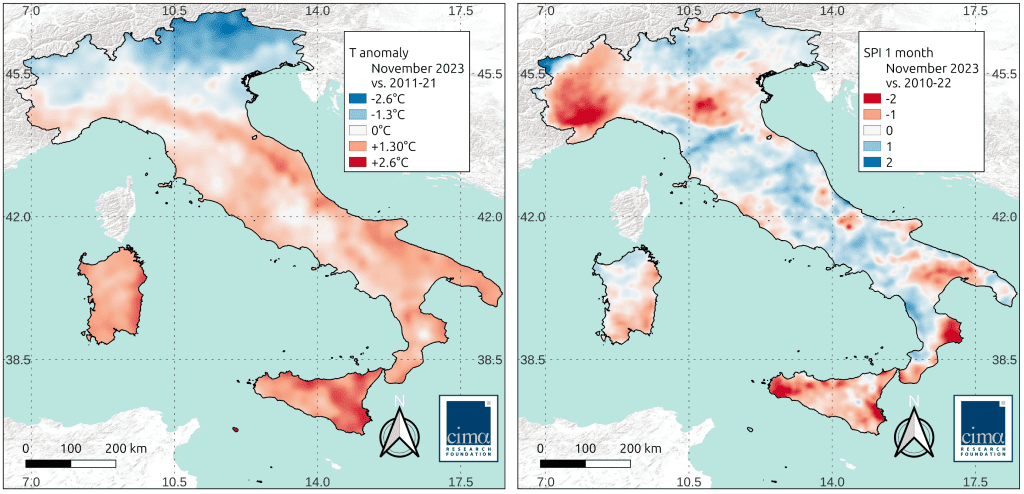
“Building the snowpack is a team effort that requires the persistence of cold and wet conditions,” Avanzi further explains. “However, snow accumulation is like a marathon, meaning that snow needs time to accumulate steadily over relatively long periods. We are only at the beginning of the snow season now. For instance, in the Apennines, we have just experienced the first significant snowfall. The situation may change substantially in the coming months.”