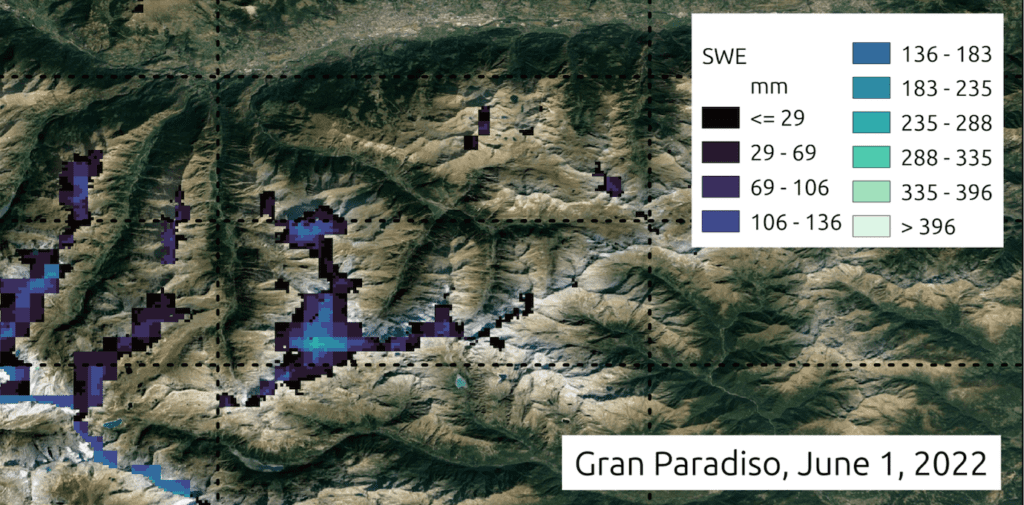
Although May’s precipitation also brought some fresh snow at high altitudes, the Snow Water Equivalent (water contained in snow) deficit nationwide remains significant
In Italy, May 2023 was decidedly rainy – with some very serious consequences, too, as for the floods in Emilia-Romagna Region – and certainly June did not begin in “good weather” either. But what does this mean for Italy’s snow water supply? Can it help us mitigate the drought of the past few months?
Let’s pick up the conversation we started some time ago by going to look at what happens to one of our most important water “reservoirs”: snow. CIMA Research Foundation has been tracking its progress over the winter, noting the significant deficit in Snow Water Equivalent (SWE), which is the parameter that describes the amount of water contained in snow.
The peak of snow accumulation is historically recorded, in Italy, in mid-March, and we had therefore already reported how the deficit (compared to the average of the last 12 years) could be defined as stabilized, in April, with a -64% of SWE. “Then, May brought the ingredient that was missing throughout last winter: precipitation. This is mainly rain but, at high altitudes, also some snow,” says Francesco Avanzi, researcher in the Hydrology and Hydraulics Department of CIMA Research Foundation. “Coupled with relatively cool temperatures for this period, this means that the current SWE is, in effect, double that of 2022 for this date, in some areas of Italy, such as the Aosta Valley.”
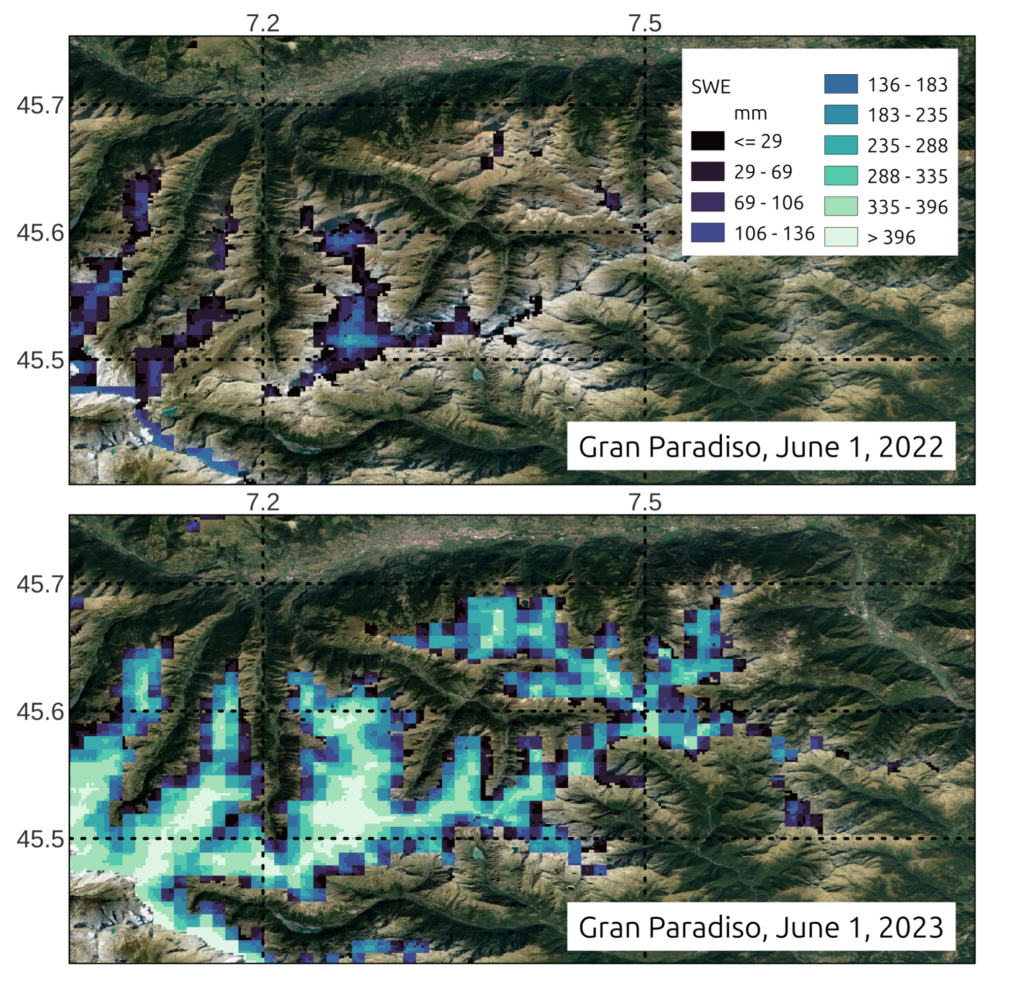
But this does not allow us to say that we have enough snow now, and there are mainly two reasons for this. First, most of Italy’s snow is above 2,500 meters above sea level, which is a very limited area of our peninsula (about 2 percent). This means that although the May snow may be good news for high altitudes (and thus for our glaciers, for example), it rarely significantly changes the SWE on a large scale, that is, for the whole of Italy.
The second reason lies in the inhomogeneity of snowfall, which occurred very differently in different areas of Italy. For example, the SWE deficit of the Italian Alps is very different between the eastern and western Alps, in which it is much more pronounced. Thus, despite a marginal improvement at high altitudes, the snow deficit in Italy remains profound: to date, our researchers estimate it to be about -49% over the past 12 years.
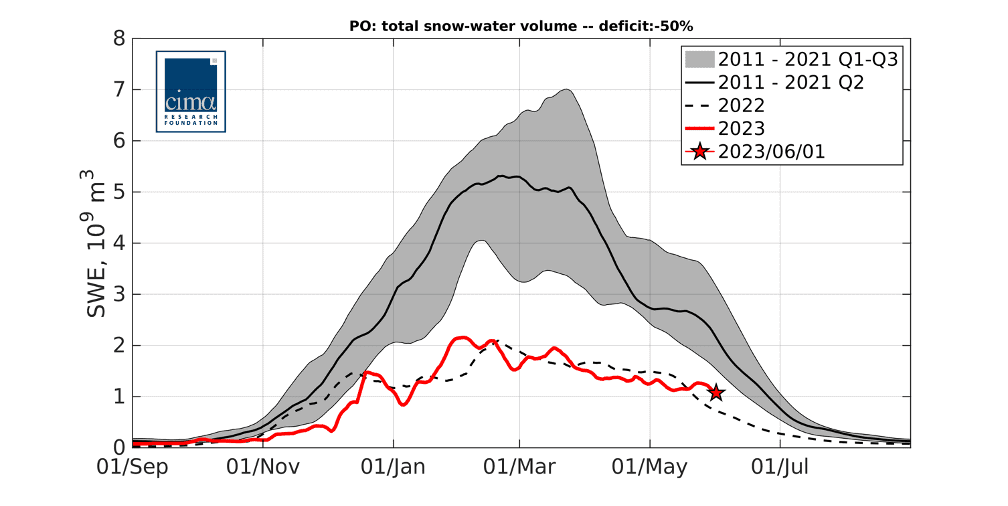
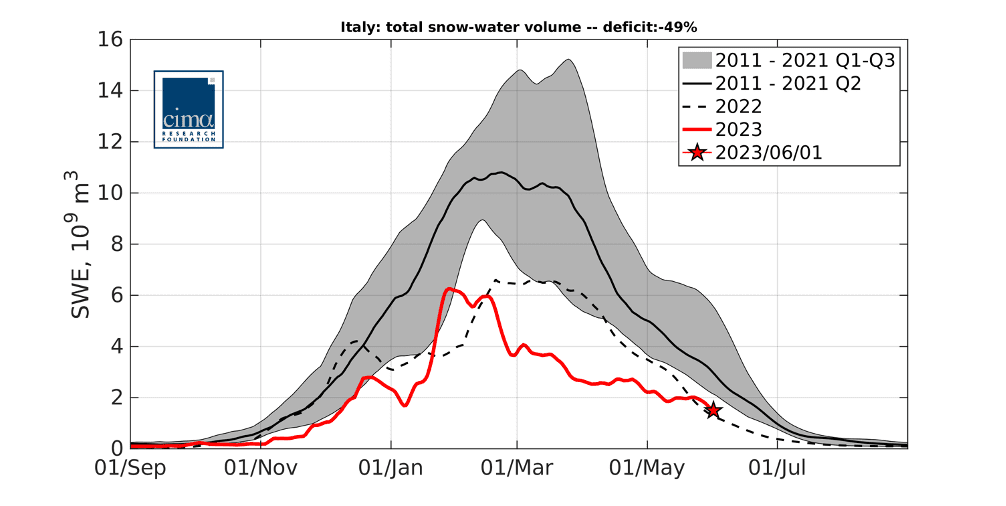
“We always say that the accumulation of snow must be seen as a marathon: it must last over time and be constant. Unfortunately, the same similarity of the marathon can also be applied to the phenomenon of drought. It too, in fact, develops over months (a few days without rain are certainly not enough to say that we are in a dry period), with a lack of rainfall and a depletion of the water supply that is gradually becoming more pronounced,” Dr Avanzi concludes. “And the effects of drought themselves emerge over time, as water scarcity becomes more and more felt on ecosystems, on crops, on energy supply, on the groundwater and therefore on our rivers. This is why drought monitoring tools are so important and, at the same time, complex, because they must be able to take into account all aspects of the water cycle, from the reserve represented by snow and glaciers to its use in human activities.”