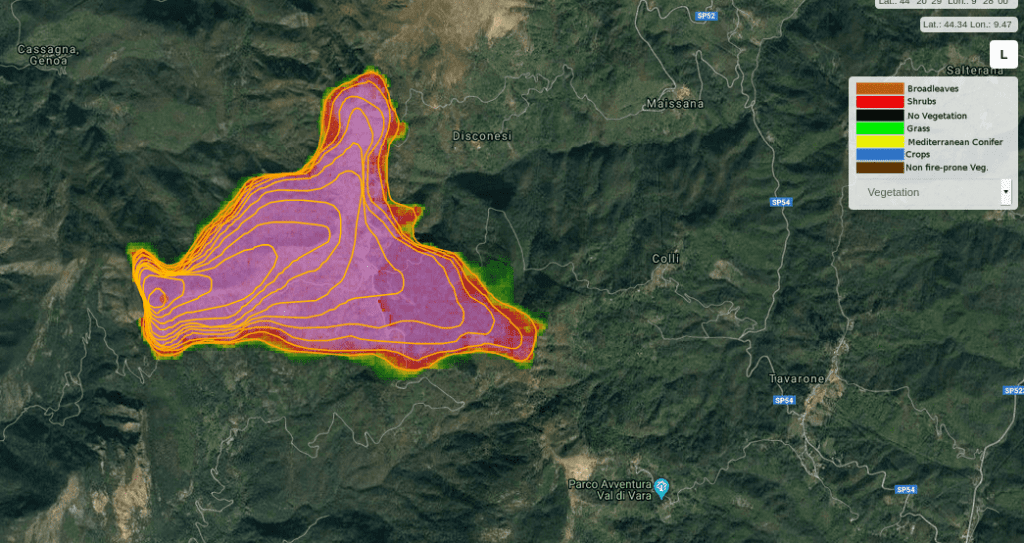
An article recently published in the journal Fire describes the characteristics and the latest implementations of the model developed by CIMA Research Foundation researchers for risk assessment and forest fire management
Predicting the possible dynamics that a wildfire can assume once it has started, even if it is affected by uncertainty, is extremely useful to in advance address the operations that can be carried out to prevent the fire from impacting potentially exposed people. From this point of view, mathematical models are extremely helpful. PROPAGATOR is a model developed by CIMA Research Foundation researchers that offers, in probabilistic terms, indications on how a fire can evolve under certain conditions and in a certain area. Employed for years in various research activities and operational tests, a recent article published in the journal Fire describes its characteristics and most recent implementations in detail.
The probabilistic calculation for wildfire simulation
How does a fire evolve? There is no unambiguous answer. There are many parameters to take into account, hence, fires are all different. The humidity of the air and the soil have their own weight, as do the wind, which can push the fire one way or another at different speeds. The slope is also a parameter that influences the speed and the prevailing direction of propagation. Moreover, the type of vegetation present, which can be more or less flammable depending on the species and on its phenological state (i.e. the life cycle stage it is in: is the vegetation full of leaves and rich in water or dry and bare?).
Notwithstanding these limitations, estimations of fire behavior, based on the values of these parameters in a given area and at a given time, provide an important support for civil protection activities, to evaluate if and when a fire can approach infrastructures, houses or areas with an important frequency of tourists, but also for the management and containment of the spread of the flame front.
The PROPAGATOR model does exactly that: “It is a fire simulator that, starting from a fire ignition, probabilistically determines how the fire can move based on specific parameters, which are provided by the user or taken from monitoring stations or other models. For example, data on vegetation humidity are provided by RISICO, another model developed by CIMA Research Foundation, which allows for the integration of information on air humidity and other meteorological parameters on dried fine plant materials present on the ground”, explains Andrea Trucchia, researcher in the Wildfire Risk Management and Forest Conservation Department of CIMA research Foundation and primary author of the study. “Being a probabilistic model, PROPAGATOR is in a way “less precise” than other mathematical models. In fact, it returns an average probability, but it works quickly, providing information on potential risks on a small scale and on the single fire event in a short time.”
Simulating fire-fighting actions
In addition, a specific feature of PROPAGATOR is its ability to take into account different parameters, which translates into the possibility to perform simulations (or even retrospective analysis of past fires), even on extremely heterogeneous areas. “Some of the main models available today are calibrated on algorithms designed to work on large and substantially homogeneous areas from an orographic and vegetation point of view. The possibility of using also PROPAGATOR in non-homogeneous areas makes it particularly useful in some territories, such as some Italian regions (including Liguria), where the vegetation is varied and the orography is often complex”, Trucchia explains.
PROPAGATOR has already found applications over the years, including in the context of several international projects—ANYWHERE, the Interreg MED-Star, and the MED COOPFIRE projects to name a few. In their new article, however, researchers also described some implementations of the model. “Among these, one of the most important has been the possibility to introduce fire-fighting actions. In other words, PROPAGATOR now allows for the simulation of the actions used during fire management, such as the positioning of firebreak lines, and investigating how this can change its dynamics”, says the researcher. “In general, the model has therefore become more and more versatile, able to gather a wider case history and, in the end, has been made more effective for the management and prevention of forest fire impacts.”