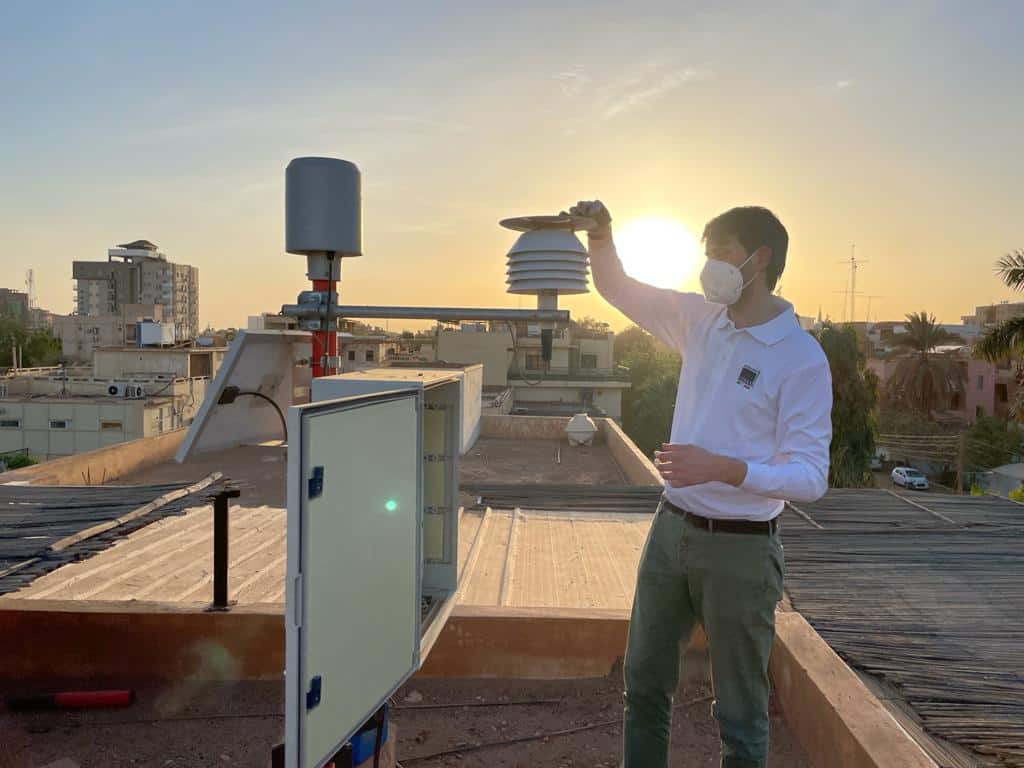
A mission took CIMA Research Foundation researchers back to Khartoum, to evaluate the results of the interventions carried out in Mayo, based on last year’s surveys and on the current status of the national natural early warning system.
The mission of CIMA Research Foundation in Khartoum, Sudan, took place in the last two weeks of March. The mission, organized together with the Italian Agency for Development Cooperation (AICS), aimed at improving the hydrometeorological risk management capacities both at local level in the camp for internally displaced persons (IDPs) in Mayo, and at national level, through a needs assessment regarding the national early warning system.
This year’s mission took place one year after the 2020 intervention implemented within the Mayo Up project, dedicated to perform a first assessment of the hydraulic risk in the area of Mayo Angola, on the outskirts of Khartoum. In that occasion, researchers of the Foundation were able to perform aerial surveys on the area by drone, providing indications towards mitigation and adaptation measures regarding the local hydraulic risk.
The main objectives of this years’ mission were twofold: to evaluate the results of the interventions carried out in Mayo on the basis of last year’s surveys and to assess the current state of the Early Warning System (in particular floods and droughts) at the national level, in order to understand further actions to reduce risk and to strengthen Sudan’s resilience to disasters.
The first water harvesting interventions promoted by the study and carried out by NGOs (COOPI and AISPO) – funded by AICS under the Emergency program – had a positive response and demonstrated good effectiveness, especially with regard to installations in public spaces such as schools and health centers. On the other hand, however, dialogue with representatives of the local community of Mayo and NGOs operating in the area has confirmed the critical issues related to the topography of the area. This is, in particular, the low slope of the area of Mayo Angola – one of the most degraded districts of Khartoum – which favors the stagnation of water and therefore represents a significant criticality especially during exceptional rains – such as those that hit Sudan in the summer of 2020.
The results and criticalities detected on Mayo therefore highlight the need to continue to intervene to strengthen local resilience to hydro-meteorological and hydraulic risks, including by increasing national monitoring and forecasting capabilities through the development of effective and high-performance warning systems.
For this reason, representatives of the Italian Embassy in Khartoum, AICS and researchers of CIMA Research Foundation met representatives of the National Council for Civil Defense, the Sudanese council responsible for civil protection that brings together the institutions involved in disaster risk management, to discuss the strengthening of the national Early Warning System for floods and droughts. The goal is to support the Government of the Republic of Sudan in strengthening its capacity to prevent, manage and mitigate the impacts of disasters, as per the Sendai Framework for Disaster Risk Reduction. In line with the existing links and synergies between the various institutional arrangements, the achievement of the Sendai goals will also contribute accordingly to the Sustainable Development Goals of the 2030 Agenda and the Paris Agreement, improving the country’s capacity to adapt to the effects of climate change.
Members of the National Council for Civil Defense expressed the need to improve the capacity to monitor, forecast and manage hydro-meteorological hazards that, as occurred in the 2020 rainy season, often affect the country. They also highlighted the urgency of creating a single platform for sharing risk data among all institutions involved in disaster risk management to facilitate early warning and response actions.
The mission was also an opportunity to continue the training activities with the Sudan Survey Authority (SSA), the institution in charge of topographic surveys for civil purposes in the country that had already accompanied CIMA Research Foundation researchers in the Mayo field survey campaign carried out in February 2020. The collaboration started with the SSA technicians will lead in the coming months to a joint activity of survey and subsequent data processing of the Khartoum area, as part of land mapping activities.
In order to allow a full exchange of experiences that will lead to an alignment between the needs of Sudan and the possibility of intervention of the Italian cooperation, a delegation representing the National Council for Civil Defense and the SSA will visit Italy by the end of April. The Sudanese delegation will have the opportunity to visit and learn directly some key elements of the Italian civil protection system.