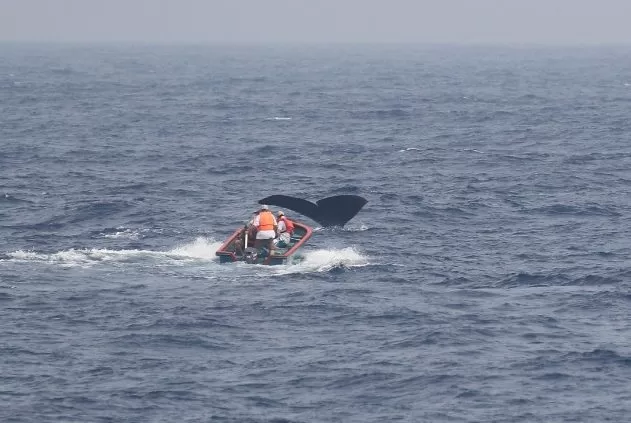
The collaboration between the main Chinese Oceanographic Institute and the CIMA Research Foundation has led researchers to investigate the richness of the South China Sea, which is home to more than a third of the planet’s species of cetaceans . The latest result of this academic collaboration is a letter that highlights the need for policies to better protect them
Conservation policies and investment in scientific research are needed to protect the species that inhabit the South China Sea. A letter just published in the journal Science, reaffirms this statement and represents one of the first outcomes of the prestigious Sino-Italian collaboration between the Institute of Deep-sea Science and Engineering (IDSSE) of the Chinese Academy of Sciences—one of the most important oceanographic research institutes in the world—and CIMA Research Foundation.
Cetaceans are apical predators with a fundamental ecological role. They are also an important component of marine biodiversity and indicators of the health status of ecosystems. More than a third of all species of cetaceans inhabit the South China Sea. It is in these waters that, in May 2019, Chinese and Italian researchers embarked on a mission to conduct the first dedicated survey on the presence and health status of different cetacean species in this still little understood sea. Of the eight species of cetaceans encountered, seven had never been reported before in the area. All observed species are protected by the Convention on the Conservation of Migratory Species (CMS) and listed in Appendices I and II of CITES, which protects species globally through the regulation of their trade.
“During this survey, we carried out several sampling protocols aimed at the census of animals both numerically and genetically, the latter through small skin biopsies, and satellite marking necessary to monitor animal movements. Thanks to the protocols developed by the DSFTA of the University of Siena, we also carried out pilot monitoring to quantify the presence of plastics, both through visual monitoring of floating plastics and through the capture of different species of fish, to understand the impact of plastics in the food chain”, explains Massimiliano Rosso, researcher in the Marine Ecosystems Department of CIMA Research Foundation and co-author of the letter. “The results of this investigation have highlighted a unique wealth in this sea; wealth, however, threatened by different human activities.” Fishing, above all, not only reduces the availability of prey for, but also poses the risk of bycatch, i.e. involuntary catches in hooks or nets dropped by fishermen coming from at least five nation states operating in the area under study.
The team counted on the presence of other Italian researchers such as Alessandro Bocconcelli, visiting scientist at CIMA Research Foundation, whose thirty years of experience in approaching animals was fundamental during the collection of biopsies, and Francesco Caruso, researcher at the Chinese Institute, specialized in bioacoustics. Dr. Caruso emphasizes: “Underwater noises produced by human activities can damage the hearing and orientation of cetaceans by altering their behavior and communication skills, a phenomenon that can have very negative effects on the survival of different species of whales and dolphins”.
It is these observations that led the authors of the letter to underline the importance of taking conservation actions. Songhai Li, project coordinator for IDSSE, aims to strengthen collaboration between the scientific and political communities to raise awareness and stimulate regional governments to change current policies for the protection of marine mammals in the South China Sea. In the meantime, research on cetaceans should continue and expand, including through international cooperation programs, in order to identify areas for conservation efforts to focus and implement protection standards through the better management of human activities.
“We have already signed a memorandum of understanding with the IDSSE of the Chinese Academy of Sciences. The project that the Sino-Italian group is carrying out—of which the letter published in Science is one of the latest results—was supposed to go ahead during May of this year, but was temporarily suspended due to the Covid-19 pandemic”, explains Luca Ferraris, president of CIMA Research Foundation. “However, the work carried out during this period has shown us how much collaboration with our Chinese colleagues is fundamental to help the protection of the environment and the conservation of these important predators, the marine mammals.”