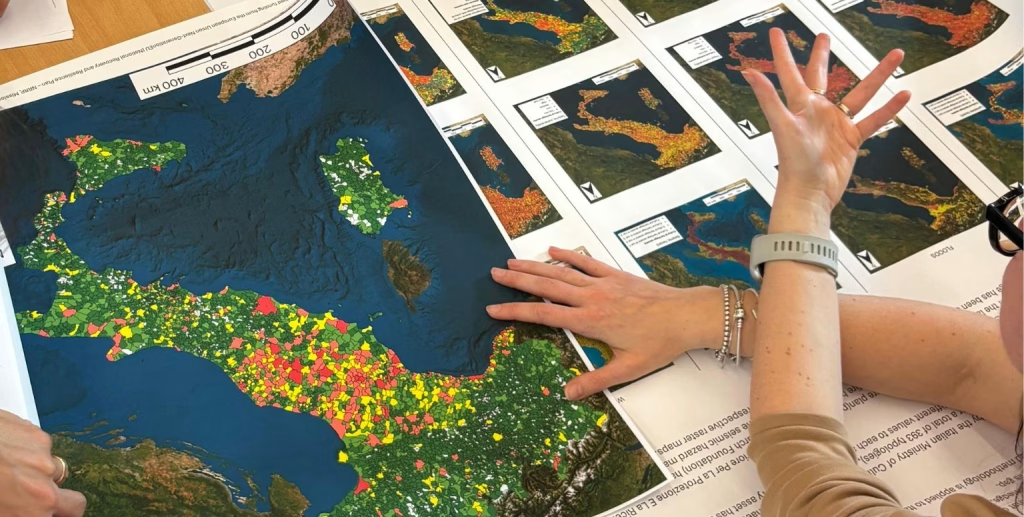
Risks do not respect boundaries, whether disciplinary or geographical. They arrive together, overlap, and amplify one another. A wildfire can pave the way for erosion and slope degradation; prolonged drought can evolve into a social and economic crisis; a flood can disrupt critical infrastructures and multiply the impacts of a single event.
For 41 months, this awareness has been the thread holding together the largest Italian scientific community dedicated to the integrated study of natural and anthropogenic risks. All of this has been made possible by RETURN – Multi-Risk Science for Resilient Communities, the PNRR Extended Partnership led by the University of Naples Federico II, which has brought together more than 800 researchers.
This network has consolidated multidisciplinary expertise, fostered new synergies, and worked to ensure that risk science becomes increasingly capable of interpreting the complexity of territories. The project’s final event in Naples, held from 3 to 5 December 2025, represents the moment when this journey is narrated and handed over to the future.
Intertwined risks, changing territories
At the core of RETURN lies the multi-risk approach. Not a simple juxtaposition of different studies, but a shared perspective: observing hazards as interconnected phenomena capable of generating combined impacts. This means recognising that the safety of a community depends on complex relationships between the environment, infrastructures, and social dimensions, and that only an integrated reading can provide effective tools for prevention and response.
Water: anticipating extremes, protecting vital systems
Among the central themes, water has been addressed as a sensitive indicator of climatic and territorial imbalances. CIMA Research Foundation contributed to the development of advanced methodologies and tools for managing flood and drought risk, integrating hydrological modelling with early warning elements.
The aim was to strengthen the capacity to anticipate events, assess their impacts, and support operational and planning decisions before extremes turn into emergencies.
Fire and environmental degradation: knowledge as prevention
The issue of wildfires has powerfully highlighted the link between environmental degradation and risk. Within RETURN, our Foundation contributed to improving forecasting and prevention capacities through predictive models and operational tools. Among the results is the evolution of the PROPAGATOR simulator: a stochastic cellular automata model, now available as an online and open-source application for fire spread prediction.
The integration of a module for crown fires and parameters describing fuel structure derived from LiDAR surveys using UAVs in pilot areas in Liguria and Molise has made simulations more robust even under extreme conditions, strengthening decision support in wildfire risk management.
Critical infrastructures: the resilience of connections
A territory is only as resilient as its essential networks. RETURN addressed the vulnerabilities and interdependencies of critical infrastructures under multi-risk scenarios.
CIMA Research Foundation contributed to this theme by analysing how damage can propagate not only as a result of a single event, but through the connections between systems and services, with the aim of increasing the resilience and operational continuity of vital infrastructures in a context where risks are increasingly interconnected.
Climate: turning scenarios into choices
Climate change is the framework that alters the frequency, intensity, and distribution of many hazards.
Our Foundation collaborated in the development of innovative climate services based on indicators, scenarios, and models designed to support mitigation and adaptation decisions. These tools are intended to translate scientific evidence into operational information and to guide public and territorial choices.
Communities: the human dimension of risk
Resilience, however, does not reside only in physical models. Together with the University of Florence, CIMA Research Foundation co-led work focusing on the social, economic, legal, and cultural dimensions of risk.
Within this context are the results related to civil protection planning: a self-assessment tool for public administrations, designed to identify strengths and criticalities in participatory processes within Civil Protection Plans, and an approach to incorporate the qualitative dimension of non-use values of territorial heritage – memory, identity, relationships – into risk models, tested in the Livorno case study.
What a community considers valuable profoundly influences how it perceives and addresses risk.
Within the framework of Spoke 7 – TS3: Communities’ resilience to risks: social, economic, legal and cultural dimensions, and in particular WP 7.7 – Legal and Ethical Aspects Prospect, CIMA Research Foundation carried out a review of liability and accountability profiles across different national contexts, promoting a shift from a “law of liability for natural risks” towards their prevention.
Tools such as the WikiProcessi, dedicated to cataloguing civil protection processes, and the Audit, aimed at mitigating the legal liability of operators within the National Civil Protection Service, were further developed.
The task sought to strengthen awareness of legal responsibility among and within the operators of the National Civil Protection System, with a view to improving system efficiency and effectiveness, good governance, legal certainty and adequacy of the regulatory framework, as well as the dissemination of a civil protection culture.
Participation and stakeholders: building bridges between science and institutions
Another tangible legacy is the pathway of stakeholder mapping and engagement, coordinated by CIMA Research Foundation together with EURAC and the University of Florence.
The creation of a digital database and continuous dialogue found a key moment in the World Café held on 5 June 2025 at the Politecnico di Milano, where 32 participants from research and institutions discussed tools and outputs across seven thematic rounds.
The final questionnaires reveal strong appreciation for the format and a dialogue perceived as genuinely useful: 100% of stakeholders identified proposals that could be integrated into their work, confirming the value of participatory methodologies in bridging research and public decision-making on risk reduction and adaptation.
A legacy that continues
At the Maritime Station of Naples, the RETURN journey comes to an end, but not its trajectory. The project leaves behind methods, data, and tools to address increasingly intertwined risks, and a national multidisciplinary community already prepared to work together across science and institutions. This network of knowledge and relationships is the most valuable result: the ability to remain connected as risks multiply, in order to make territories safer and communities more resilient.