June 17 is the date chosen by the United Nations to raise awareness and knowledge about two major hazards, desertification and drought. Drought, in particular, is expected to increase for many areas of the planet, including the Mediterranean region, it is therefore more urgent than ever to understand the risk and outline adaptation strategies that will enable communities to cope with it. This is what CIMA Research Foundation is also doing, working on several fronts nationally and internationally
Rising up from drought together: the theme chosen by the United Nations for the International Day to Combat Desertification and Drought, which is celebrated on June 17, calls this year for the importance of shared and participatory action to address an increasingly pressing risk to people.
A risk that many areas of Europe are already feeling the brunt of. Indeed, 2022 has begun under the banner of a drought affecting several countries, and which is particularly marked in the Danube and Po River basins: as the latest report from the JRC’s Global Drought Observatory, to which CIMA Research Foundation contributed, highlights, the impact is particularly felt in the agriculture and energy production sectors, and closely linked to the scarcity of water reserves represented by snow. The scarcity of snow, which is well below the seasonal average in the Alps, leads to problems in storing hydropower on the one hand and, on the other, to the reduced availability of water for crop irrigation, the production of which, especially in Spain and Italy, is already sub-optimal.
From snow to water
The central role that snow plays on water resource availability makes it particularly important to monitor winter precipitation in the mountains. This is what our researchers have been doing, who have been constantly monitoring the situation in the Italian Alps over the past few months. “As early as the beginning of 2022, the data collected showed the scarcity of snow compared to the average of the previous 12 years,” says Francesco Avanzi, researcher of CIMA’s Hydrology and Hydraulics Department. “More in detail, the parameter we analyze is the Snow Water Equivalent, which provides information on how much water is stored in the form of snow at a given point. This parameter was basically in line with previous years at the beginning of winter, but it has been dropping substantially over the months, maintaining the trend even during the spring. The result is that there is more than 60 percent less snow – and therefore water – in the Alps than in recent years, a particularly significant deficit that has important implications for water availability for sectors such as energy supply and agriculture”.
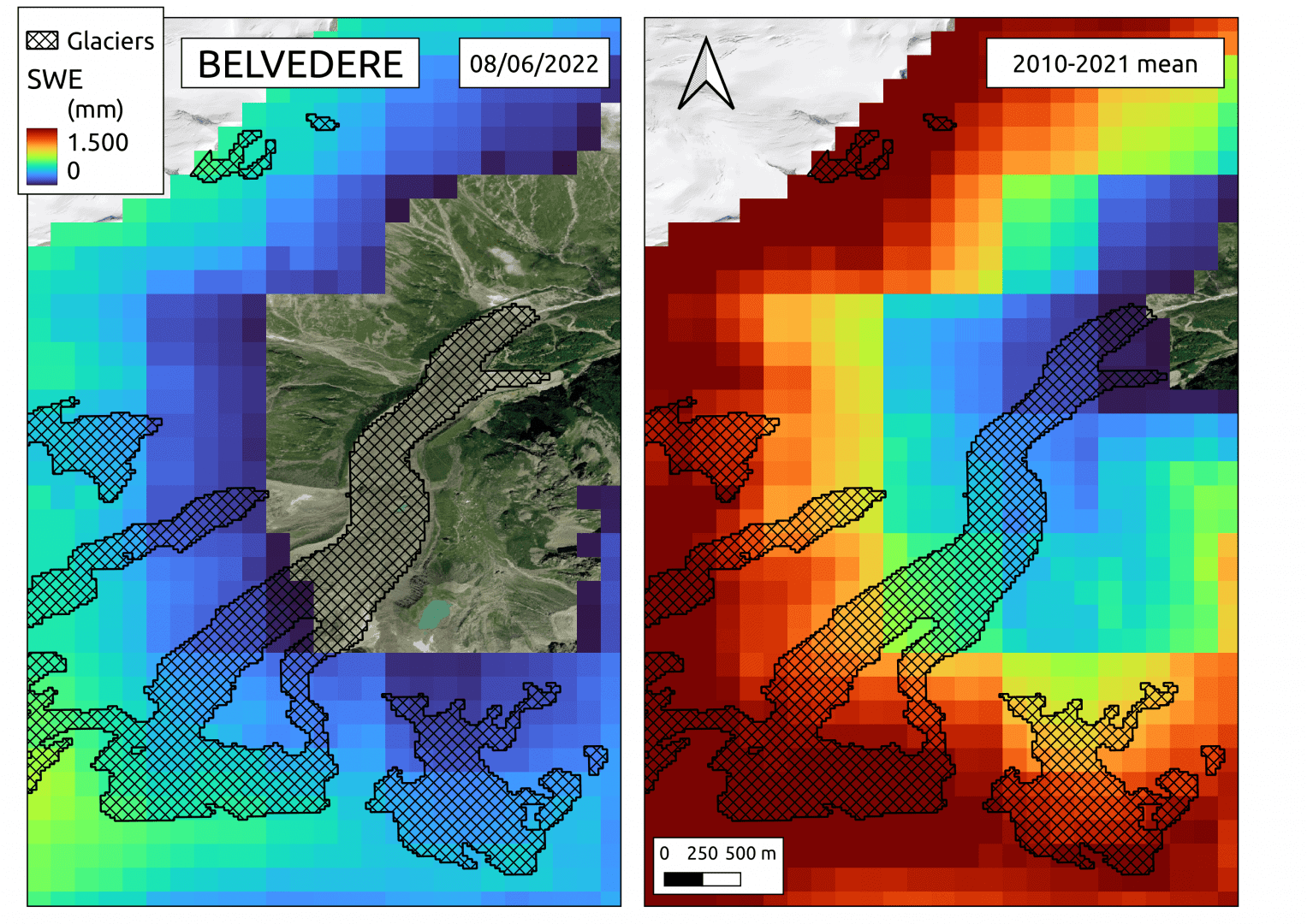
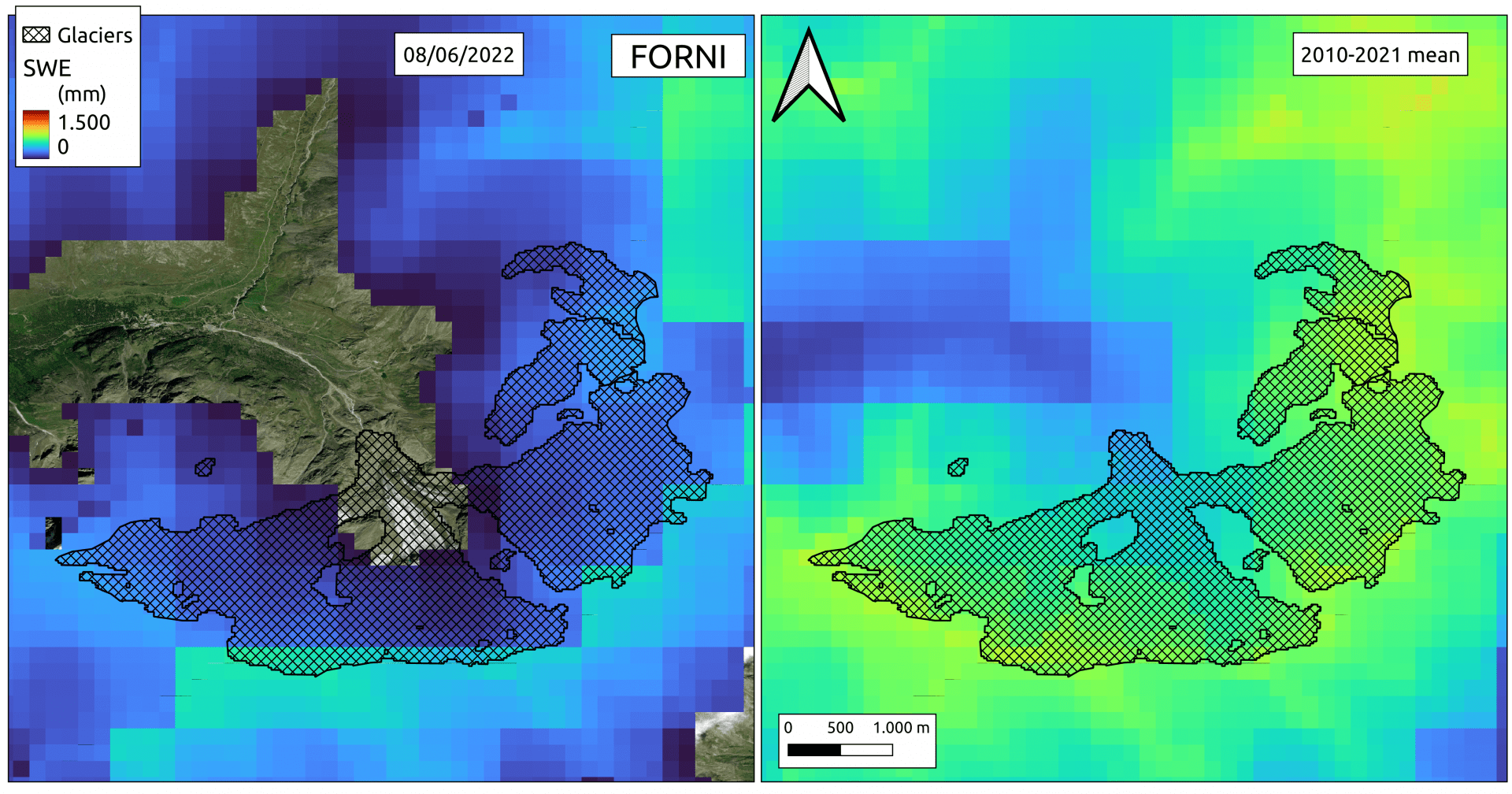
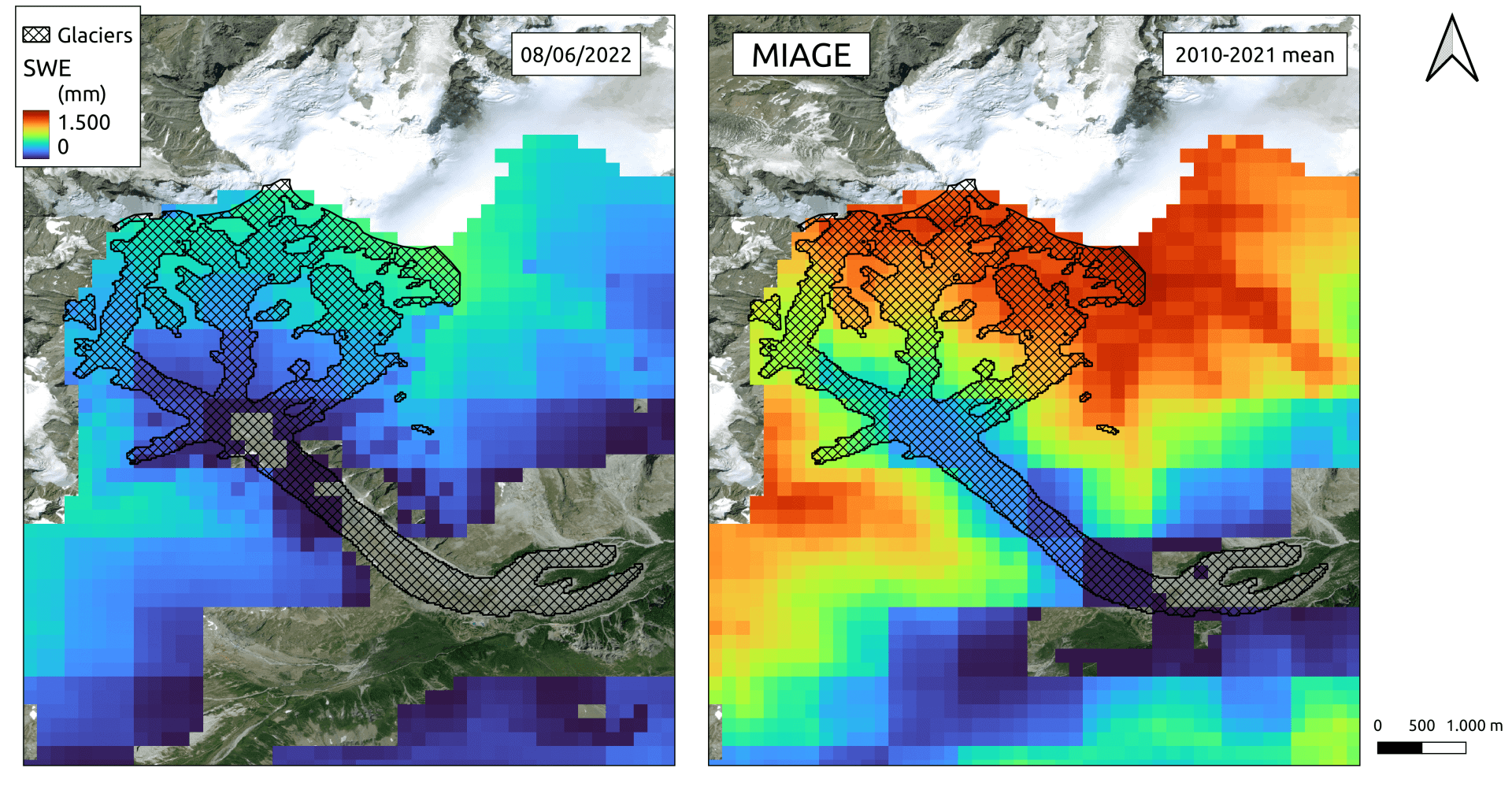
The severe scarcity of snow, less than half as much as in past years, also contributed to an early melting of available snow. In fact, analyzing data from three of the country’s most important glacial apparatuses, it is immediately evident that significant portions appear, by June, already without snow cover. “Snow represents a fundamental reserve of water, and that which melts in spring allows it to feed rivers and streams, meeting our water needs for the spring and summer months. In fact, the situation today is one of a shortage of water supply, accumulated in the form of snow. Of course, if rainfall were particularly heavy in the coming months, the drought could be mitigated to some extent; however, this would not be sufficient to restore the supply represented by snow,” Avanzi explains.
Coping with drought, a task for the future
“Unfortunately, drought will be an increasingly present reality in the future: in fact, climate change is expected to make it more frequent and intense for some areas, including the Mediterranean region,” says Gustavo Naumann, researcher in the Hydrology and Hydraulics Department and a specialist in the study of this phenomenon. “This is why we must learn to deal with it, studying strategies that allow us to mitigate its impacts-not least because the effects of drought, unlike other phenomena, such as floods, are felt in the medium to long term and involve a great many sectors. The first to be affected are electricity supply and agriculture, but the effects of drought also affect the general well-being of ecosystems and the services they provide us, the risk of spreading certain diseases, the availability of water for domestic purposes, and tourism”.
This is precisely the purpose of the EDORA project, led by CIMA Research Foundation. In line with the EU Climate Change Adaptation Strategy, EDORA aims to strengthen the EU’s resilience and adaptive capacities to drought: “This is an objective as ambitious as it is important, which requires first of all to improve our risk assessment, so as to take into account all the main sectors that can be damaged by drought. To do this, we will create a database of drought impacts that takes into account all the different sectors affected, and a risk atlas to provide a picture of both the current situation and future projections,” Naumann explains.
“This is a far from trivial goal, because it poses the difficulty of holding together both strictly engineering aspects, such as those concerning forecasting models, and socioeconomic aspects. In addition, at the technical level, we also face a very complex task because the impacts that drought can cause depend on so many variables, ranging from the resilience of a population to the physical indicators of the phenomenon (how intense it is, how long it lasts, and so on). And, for some areas (this is the case with ecosystems) these variables have so far been poorly investigated”, he adds.
Teamwork
But, as the theme chosen for the International Day to Combat Desertification and Drought reminds us, we need to work together to create real resilience to drought. A concept shared by the goals of the EDORA project, which in fact sees the creation of a network of observatories as its second main goal. Establishing connections between observatories already in place in member states, creating ones where they are missing, has the dual value of increasing the geographic coverage of European monitoring and strengthening coordination in monitoring and response activities. In addition, it will facilitate the exchange of knowledge, methodologies and best practices, helping to improve drought management and develop effective adaptation plans.
“With this in mind, the international meeting to be held on June 16 and 17 is of great importance: this is the kick off meeting of the European Drought Observatories Network, a time for experts, from different European countries, to meet and compare notes, dedicated to understanding the state of the art of observatories in the EU,” Naumann explains. “As part of the meeting, we have also organized an expert consultation on June 17, which will help us outline methodologies for the development of impact chains and risk analysis for different drought-damaged sectors, as well as the implementation of a European impact database. But in addition to addressing some of the technical aspects, the consultation will also be a time to discuss perspectives and figure out, together, how to move towards achieving results”.
Not only in Europe
The importance of acting synergistically in dealing with drought means not limiting activities to Europe: this is a risk that affects many other areas of the planet and, as the COVID-19 pandemic has well highlighted, the well-being of one region affects that of the rest of the globe, just as knowledge developed in the course of one experience can be a concrete help in other contexts as well.
For this reason, our researchers are not only working on the issue of drought at the national and European level. For example, with the Integrated Flood and Drought Management and Early Warning for Climate Adaptation in the Volta Basin project they have created risk profiles for both floods and droughts, which will help strengthen the warning systems of the Volta Basin countries. In the APIS project, on the other hand, we work alongside the Italian Agency for Development Cooperation (AICS) for the purpose of implementing a warning system to reduce damage while strengthening risk management in the country, with a special focus on floods and, indeed, drought. Last but not least, the Bolivia Drought Monitor, developed by CIMA Research Foundation’s researchers as part of the Pilot Program for Climate Resilience and used by local civil protection and water resource management institutions to anticipate location and impacts of water shortages on their areas of responsibility, has been operational since 2020.