
On the occasion of the International Day for Disaster Risk Reduction, the Italian Civil Protection Department and CIMA Research Foundation present the report produced within the IPA Floods and Fires program – a document that brings together the general criteria for concretely linking, at the operational level, early warnings as related to floods with early actions to ensure effective protection of people and livelihoods
From early warning to early action: this is the link that the recently published report under the IPA Floods and Fires (IPA FF) program focuses on. The report Establishing effective links between early warnings and early action: general criteria for floods , is a collaborative effort by experts from the Italian Department of Civil Protection, the lead partner in the Program and CIMA Research Foundation. It is directed primarily to hydrometeorological service and civil protection technicians and operators of the program Partners, but it also represents a set of guidelines that can provide support for other states and regions as well. The overarching goal is to ensure an effective translation of the information contained in the warnings into tangible, and anticipatory civil protection actions.
The IPA Floods and Fires Program
Divided into two distinct components, one dedicated to floods and another specifically targeting forest fires, IPA FF Program is funded by the Directorate-General for European Civil Protection and Humanitarian Aid Operation and it is dedicated, on one hand, to risk mitigation and, on the other, to bringing the regulatory frameworks of the program Partners (Albania, Bosnia and Herzegovina, Kosovo*, Montenegro, North Macedonia, Serbia,, and Türkiye) closer to European Union civil protection standards, with particular reference to regional cooperation and the EU Floods Directive.
In the context of the flood component, the final goals of the program include improving the capacities of the program Partners to develop flood risk management plans (with a focus on cross-border management) and, most importantly, including warning systems as related to floods in response emergency plans at all the relevant territorial levels, a goal that is also addressed in the newly published report.
The importance Early Warning Systems (EWSs) , moreover, is now widely recognized internationally. It is no coincidence that in 2022, UN Secretary-General António Guterres launched the Early Warning 4 All (EW4ALL) Initiative, which aims to protect the global population from weather and climate events with the adoption of early warning systems by the end of 2027.
EW and EA, the link in the new IPA FF report
Merely issuing an early warning, intended as a message produced on a forecasted event, is not enough to protect the population. The information about the level of the expected risk must also be translated into concrete and preemptive actions capable to protect people.
Early warning, therefore, must be matched with early actions (EA). It is only the integration and coordination between these two elements that can effectively ensure that lives, infrastructure and livelihoods are safeguarded, thus concretely reducing the impact of floods -which, it is worth remembering, are increasingly frequent and intense phenomena in different parts of the world due to climate change.
This is the goal of the new report, the result of a three-year journey that involved all institutional actors, at national and local levels, working in disaster risk management and EWS.
“The approach that led us to the definition of the criteria started with a series of analyses and a Command Post Exercise project involving the key relevant stakeholders of the EWSs of Partners to best identify strengths and weaknesses of the different national systems. This path allowed us to define the general criteria taking into account the different capacities and levels of development of the early warning systems in the program Partner,” explain Marta Giambelli and Sabrina Meninno, CIMA Research Foundation researchers and among the authors of the report. “In addition, we carried out an analysis of the literature and European and international standards already available on the topic of early warning system, civil protection and risk management. Afterwards, we also carried out a series of ‘training of trainers’ sessions, which were fundamental to increase participants’ knowledge and awareness on the essential elements of an effective EW-EA link and, at the same time, equipped them with the capacity to train collaborators and other operators as well.”
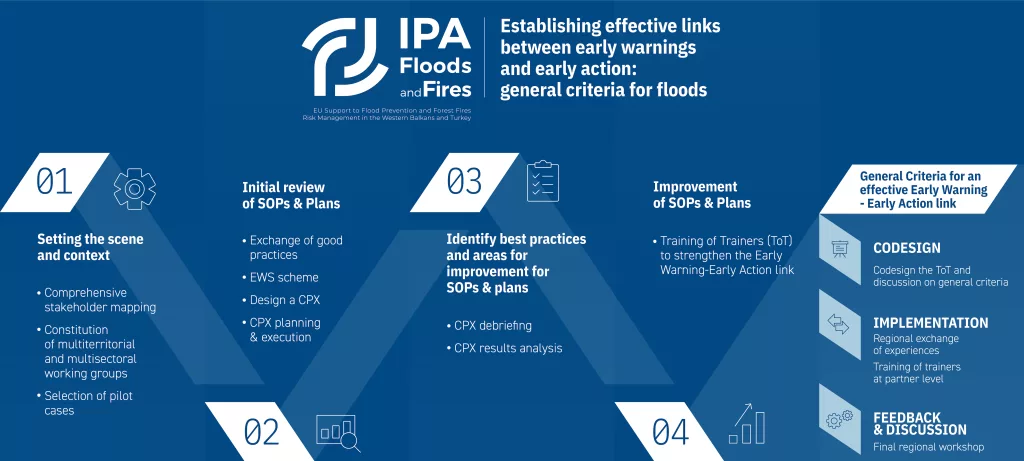
The result of this work is a report that ranks among the very first to provide operational directions for linking warning to action. “It is now clear that for civil protection and risk mitigation to be effective, early warning and early action must be deployed in a coordinated manner, ensuring that an early warning with a given severity is matched by the appropriate response and prevention actions. Yet, there is still little concrete guidance on how to implement this linkage – how to turn warning into action,” the researchers say. “Therefore, our work did not focus on providing technical-scientific guidance, but rather technical-operational directions. Our goal was to understand how the operational response to an early warning can be linked, in some conditions, to scientific information, thus providing operational guidelines for anticipatory response to phenomena such as floods, that can be forewarned, at least within certain limits.”
The document is divided into four main chapters, each dedicated to one of the main aspects of the early warning and early action system and containing the specific criteria identified for that particular part. Starting with early warning, the document aims to identify general criteria to create a common language between those who issue warnings and those who receive them – for example through the definition of specific thresholds and expected scenarios – as well as to identify crucial information to activate actions at the different levels. Regarding early actions and their integration of emergency response plans, the criteria mainly aim to encourage a gradual and coordinated activation of the system according to the level of alert, considering the specific risk in a given territory, and integrating these aspects into the emergency response plans. The criteria identified for communication and information flows between operational and institutional centers aim to ensure coordination before, during and after an emergency; and finally, and, as for exercise processes, the aim is to strengthen the interaction and capabilities of EW-EA systems.
“The criteria we have identified and presented can be used to achieve more mature and effective EW-EA systems by integrating the different aspects that have been highlighted. Taking into account the different territorial levels of risk management and response, then, we suggest a set of conditions (such as the gradualness of actions according to the level of warning, the coordination among the involved actors, the correct communication flow and the uniformity of the language …) which can allow for an effective translation of the scientific information conveyed in the warning to an operational response, concludes Antonio Gioia, researcher and leader of the Planning and Procedures Department of CIMA Research Foundation. “This makes the report a kind of internal recommendation for the IPA FF program Partners. At the same time, it also makes the report of possible use to other countries, that can take advantage of it for verification and possible improvement of their EW-EA link taking into account the identified general criteria.”