Drought represents a complex phenomenon, both in its dynamics and its impacts. Understanding its characteristics is fundamental to be able to then represent it in hydrological models, which help forecasting and water resource management. This is the kind of study conducted, during her PhD at CIMA Research Foundation, by Dr Giulia Bruno
Drought is a phenomenon with important impacts. We will have to deal more and more with it , as made very clear by studies showing how climate change plays an important role in influencing it, especially in the Mediterranean basin.
How to deal with it, then? The answer, as always for complex phenomena, is that we must first of all know and study it, including finding the most suitable methodologies to do it. The work carried out by Giulia Bruno, now a post doc at the Leibniz Institute of Freshwater Ecology and Inland Fisheries (IGB) The aim of the study, in fact, was analyzing the hydrological cycle in its entirety, and then being able to represent it effectively in models. We review here the main steps of it.
A complex phenomenon
Drought is a complex phenomenon right from its definition. The term, in fact, encapsulates both what is technically called meteorological drought, that is, the scarcity of precipitation, and drought described in its impacts. Thus, we speak, for example, of agricultural drought, which defines impacts on soils; hydrological drought, when referring to the availability of water in rivers and aquifers; or socio-economic drought when looking at impacts on society and the economy (think of energy supply and the possible impact of lack of water on hydropower).
Drought is no less complex when we look at the elements that combine to influence and characterize it. Some of them have always been the focus of studies of the phenomenon. This is the case with river flow, because the scarcity of water in a basin says a lot about its availability in the area. Others, however, have only begun to be considered relatively more recently, thanks to technological innovations – particularly satellites – that make it possible to collect data on them that would otherwise be difficult to have on a large scale.
The role of groundwater
“My work has focused particularly on evapotranspiration, that is, water that evaporates from the soil through plant transpiration, and groundwater during droughts,” Dr Bruno says. The latter does not play a negligible role. In fact, groundwater influences the water available to plants, and also the water needed for some human activities. “The first question we tried to answer, therefore, concerned these two elements: do variations in evapotranspiration and sub-surface water influence the evolution of a drought period?”
To answer, Dr Bruno analyzed available data for some of Italy’s major basins (over 100 basins analyzed) over the period from 2010 to 2019. The results show that, in most drought years, the flow deficit (i.e., water flowing into rivers) of river basins is less than would be expected from the precipitation deficit. This means that, somehow, in years when precipitation has been low, the vegetation, but especially the reservoir underground, have made up for the precipitation deficit, thus also alleviating the flow deficit.
“This is because, in dry years, the flow rate we have is mainly due to water that was stored underground and returns to the surface. This shows the importance of subsurface reservoirs but also their vulnerability during drought periods, which put them ‘to the test’ by drawing on the reserves they represent,” the researcher explains.
Representing drought in hydrological models
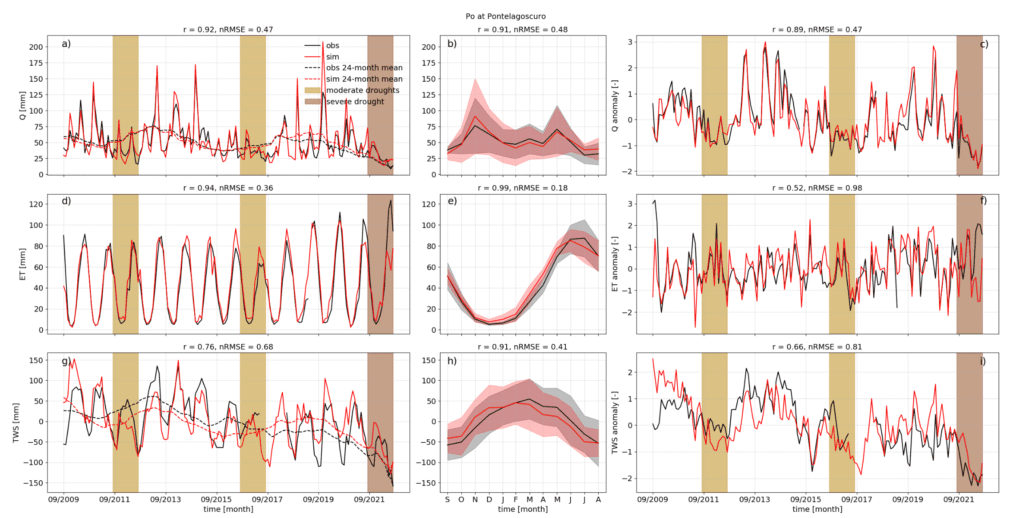
In a second part of the investigation (presented at the EGU General Assembly 2023, the leading international geoscience conference), the scope of work narrowed to the Po River Basin, the main Italian basin. At the same time, it shifted to the more purely modeling aspects: in fact, the goal was to understand how the Continuum hydrological model, developed by CIMA Research Foundation, was able to represent periods of drought and support water resource management during periods of water scarcity. The assessment took place over a 13-year period, from 2010 to 2022, and thus included last year’s drought-the most severe compared to the entire period analyzed.
“It emerged is that Continuum is able to represent very well, in terms of simulation of river flow and other relevant variables, the periods when water is abundant and those when drought is moderate, as happened for example in 2012 and 2017. Things get more complicated, however, when the drought becomes severe, as happened in 2022,” Bruno says. “This difficulty of hydrological models to represent the most intense droughts is a recurring problem in the scientific literature, and is therefore confirmed as a gap to work on. For my PhD work, the extra step we wanted to take was to try to understand why this happens.”
This is where satellite data come in, which, as mentioned at the beginning, also allow us to derive information on variables that are difficult to investigate and therefore often remain somewhat neglected in the study of drought. These are, again, evapotranspiration and the state of sub-surface reservoir. In fact, as we had already reported, it is precisely remote sensing that today makes it possible to estimate changes in groundwater, for example, based on data of changes in the Earth’s gravitational field. This makes it possible to collect measurements even on areas and variables that are difficult to estimate with ground-based sensors. It is worth remembering, satellites are also a valuable support in supplementing the collection of data that also can be collected with relative ease by ground-based sensors, such as precipitation and river discharge.
Underground water, evapotranspiration and the role of human activities
“Just by analyzing these data, we realized that, in particular, the model has difficulty estimating evapotranspiration during the most intense droughts. This causes a model calibrated during a period of moderate drought to be unreliable during more intense phenomena. “The reason is, most likely, the lack of the ‘human component’ in the representation of the hydrological cycle,” Dr Bruno continued. Our activities, in fact, play a substantial role in influencing water availability: irrigation, for example, directly alters the evapotranspiration.
This part of the study was addressed by a collaboration between the Italian CNR Institute for Hydrogeological Protection (CNR-IRPI), the Department of Agricultural, Food, Environmental and Forestry Science and Technology (DAGRI) of the University of Florence, the Department of Computer Science, Bioengineering, Robotics and Systems Engineering (DIBRIS) at the University of Genoa, and CIMA Research Foundation. Together, the research team has begun to investigate another aspect: for if the discourse so far has focused on the factors that influence the intensity of drought, and our ability to represent it, what can be said about the duration of drought? In other words, what happens when it is prolonged over time? As is readily apparent, a drought that lasts for years has much more profound impacts on ecosystems; the less immediate aspect, however, is that these effects are more severe even than would be expected from single years of water scarcity. Unfortunately, there is no shortage of examples in this regard, for example in California, Chile, Australia.
The research team set out to study the phenomenon of multi-year droughts in Europe as well, noting how multi-year droughts that have occurred in the past in some watersheds have actually had particularly severe impacts, with drastic reductions in basin flows. But why? What are the mechanisms behind these dynamics?
“We have linked them to an increase in evapotranspiration. In short, trying to give the full picture. In the case of moderate droughts, the groundwater contribution mitigates the water deficit – we taught the models to recreate this dynamic. However, in the case of more intense or more prolonged droughts, the vegetation component also comes into play. There are anomalies in evapotranspiration, which can be increased due to different mechanisms. For example, there is the anthropogenic factor represented by irrigation, or it may depend on the fact that plants respond to droughts on longer time scales, also using water from the deeper layers of the subsurface,” Dr Bruno concludes. “At the moment, hydrological models manage to represent these phenomena only in a simplified way. This implies opening up new avenues of research that allow us, for example, to better include the anthropogenic component in the representation of the hydrological cycle.”