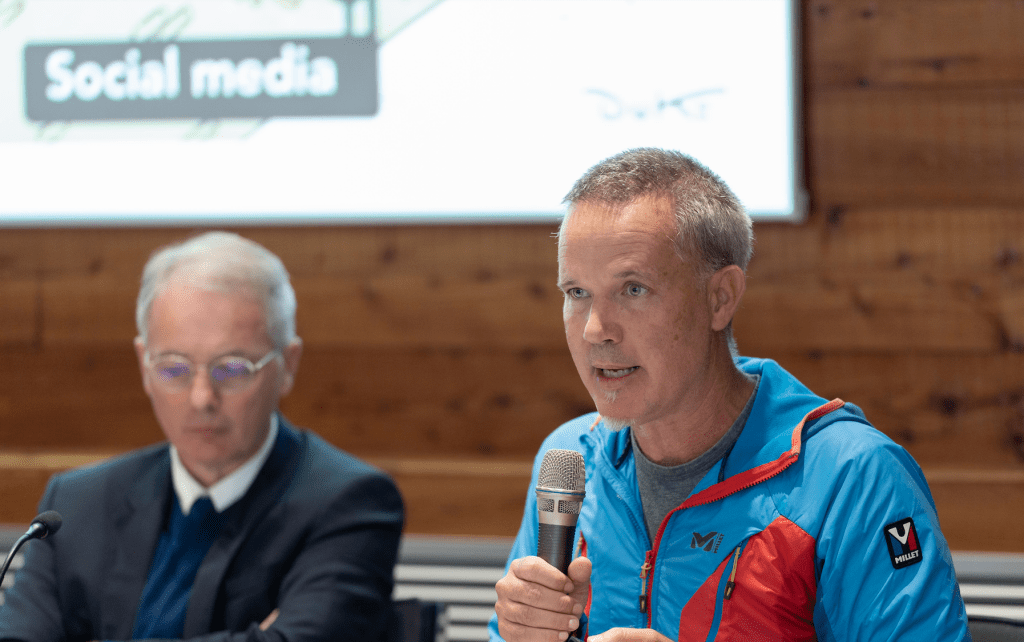
Scientific methods and dynamics are not always easily reconciled with the media’s ones. Still, it is now crucial to be able to communicate and inform both the public and policymakers about the impacts of climate change, and possible solutions. How to move forward, then? What useful considerations can be made, what suggestions can be given to those who, working in the world of research, are called upon to deal with the world of communication? We talk about these questions with Edoardo Cremonese, former researcher at ARPA Valle d’Aosta and now at CIMA Research Foundation, who recently discussed these issues at the conference Communicating climate change between science, economics and culture organized by Montagna Sicura and Courmayeur Mont Blanc Foundations.
First of all, can you tell us about your studies?
Partly by chance, like many young people, and partly driven by a passion for nature, I studied Environmental Science at the University of Milan Bicocca. After graduation, I immediately started working at ARPA Valle d’Aosta, where I stayed for the next 20 years, starting a research path that has accompanied me throughout my career: the study of climate change impacts in mountain environments.
Can you explain your studies in more detail?
The main focus is the impact of climate change on terrestrial ecosystems, the cryosphere (i.e., glaciers, snow and permafrost) and the water resource. In particular, our work was based on integrating satellite observations, models and field data to describe and model the processes and dynamics in play. For example, we established a network of observation sites for measuring carbon and water fluxes between the ecosystems and the atmosphere, one of the most important ecosystem functions. Today, these sites are part of a European Research Infrastructure.
Now, at CIMA Research Foundation, my research is more specifically linked to water resource management in the context of climate change, with a focus on the interactions between droughts and social and ecological systems.
Over time, you began to participate in projects that interacted with stakeholders and policy makers. How did you come to this “second nature” of your work?
It is a path that has developed over time, and especially over the past five years. Initially, I was involved in small local initiatives, which led me to engage with different stakeholders on climate change issues (e.g., local meetings with the public). Then, slowly, everything became structured and diversified. This also led me to work a lot on the science-policy interface, to translatethe results of scientific studies into actionable decisions for territories and communities, even, at the transnfrontal level – always in connection with the mountain environment, so in particular working with French and Swiss partners.
The science – comunication dialogue profoundly evolved in the last years thanks to several causes: the sensitivity of those who organize the events, first of all, has allowed them to extend and expand, comunication purposes and audience, always maintaining the involvement of the scientific community. Secondly, the increase in the expectations of the different stakeholders; in some cases, what might once have been simple curiosity has become a necessity. Mountain guides are a good example, because today in their training there is specifically included the part related to climate change. And finally, I think that working in communities – the mountain communities, where the impact of climate change is closer and more immediate – and immediately perceptible for the people that inhabits it, probably more so than in urban areas, helped. The scarcity of snow and water, the intensification of natural hazards, the change in the approach to frequenting the mountains, are all events that the population has had to deal with for a long time.
What are the most important things you’ve learned – and that you think should be emphasized for those who, as a scientist, have not yet had a chance to experience the communication aspects?
Definitely, thanks to the initial failures, I learned how not to talk about climate change: that is, not as if we were at a scientific conference. What we say has to fit who we have in front of us, and this is a nontrivial challenge, for those who come from the scientific world. Researchers, in fact, are used to following a specific path of method that leads them to make certain statements. But, in everyday life, the human mind is not rational. As many studies have shown, the cognitive processes that characterize us, our systems of processing reality and cognitive frames are not based on facts, or scientific evidences. Outside the “research bubble”, numbers, graphs and facts are not enough.
This is what we, as scientists, must be able to understand when we are called upon to do communication, even in the face of inevitable frustrations that we cannot fail to take into account. But, if we manage to start from this awareness, we can reduce many of the mistakes that have characterized science communication in the past and that have probably contributed to the climate of distrust and distance between the research community and the public.
And are there particular aspects related, more specifically, to communication with the media on the one hand and with the political world on the other?
Each environment has its own pitfalls to be aware of in order to avoid… But whether one is talking with a journalist, with industry representatives, professionals, the general public – in short, with any reality, the point is to be able to put oneself in the shoes of the listener to try to understand what he or she needs, and therefore how the scientific result can translate into shared reflection and have a concrete impact.
Let’s conclude with what is perhaps the key question: what for you is the most important value of facing, as a scientist, the world of communication, having to dialogue with professionalism so different from your own?
To me, it’s all about social and civic responsibility of science. The scientific community is not an ivory tower: we are part of society as a whole, and we are called upon to try to contribute to the maturation of public debate around complex issues such as the climate crisis. It is clear that not all of us can do everything, that the scientist does not always have the time, or the skills (or the time to develop them), to devote himself or herself to communication as well. Still, we have now learned how important this is and we can rely – even – on science communicators/staff who cover this precise role at the institutional level: and, then, it becomes important for the scientist to have the opportunity to collaborate at least with these figures.