As every year, researchers of our Marine Ecosystems Department carried out cetacean sighting campaigns in the Ligurian Sea between March and September 2023. Collected data allow for studying the ecology of these species, from their abundance to distribution to health status.
Specifically, in the 2,900 kilometers covered by our Headwind research vessel more than 360 sightings have been registered: most sightings (192) involve groups of striped dolphin, followed by 100 sightings of fin whale, 55 of beaked whale (a species that is difficult to study because of the long periods it spends in deep dive), 10 of sperm whale, 3 of pilot whales, and 2 of bottlenose dolphins.
During the campaigns, our research team also collected samples and other specific data for some species within Spoke 2 of the National Biodiversity Future Centre: samples of the blowhole (the jet emitted from the blowhole when the animal resurfaces), cutaneous biopsies, environmental DNA and metric data. A valuable support for the collection of this material is the use of drones, which, as we have told in past, enables both the collection of material emitted from the blowhole and photogrammetry surveys to assess the position and shape of cetaceans.
To the sightings recorded on CIMA Research Foundation’s vessel should be added those that occurred from the ferries plying the waters of the Pelagos Sanctuary, with which we collaborate as part of the FLT Med Net and, for 2023-24, within the project LIFE CONCEPTU MARIS for cetaceans’ data collection. The 53 surveys conducted in 2023 resulted in 418 sightings of fin whales, 248 of striped dolphins, 18 sightings of beaked whales, 17 of sperm whales, 5 of bottlenose dolphins, and 2 of pilot whales.
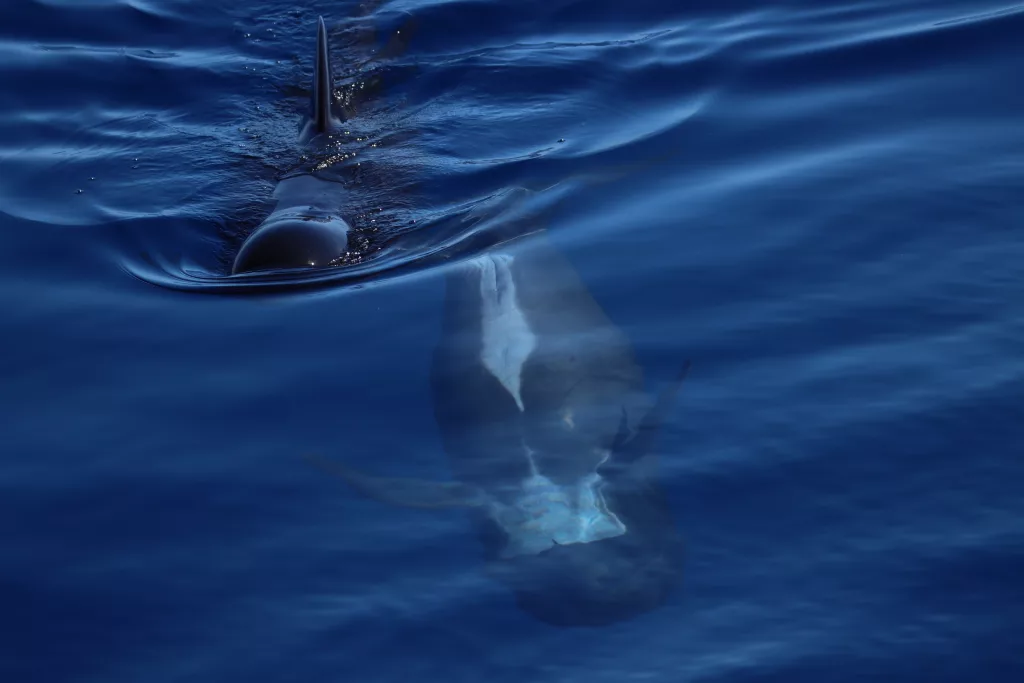
“Pilot whales are normally a rare species in Ligurian waters: on average we have one sighting per year, while this year we spotted them several times and more or less always in the same area,” says Dr. Paola Tepsich, head of the Marine Ecosystems Department. “This also allowed us to collect various data, including photogrammetry data, from which we hope to get more information about the pods that inhabit the Mediterranean, which is particularly relevant if we consider that the species is classified as endagered by IUCN Red List.”
CIMA’s experts also point to the abnormal number of sightings of fin whales, which were very present especially in the area between Loano and Savona and were often also present in groups of two to four individuals. “This is an unusual situation, but one that has been seen before: in fact, we would like to try to understand whether the heatwave that has affected the area may have influenced whale’s distribution,” Dr. Tepsich says. “It is certainly a situation to be monitored and investigated further, because this high concentration of fin whales increases the risk of collision with boats.”
It should be pointed out that the two types of campaign, the one aboard the Headwind research vessel and the one conducted on the ferries, are not comparable with each other. Headwind conducts ad hoc and species-specific campaigns and therefore, especially on some species (beaked whales in particular), lingers for longer in order to collect the necessary data. Ferries, on the other hand, continue their journey without pausing to collect more data on the sighted species and, as a result, the amount of sightings on board is higher.