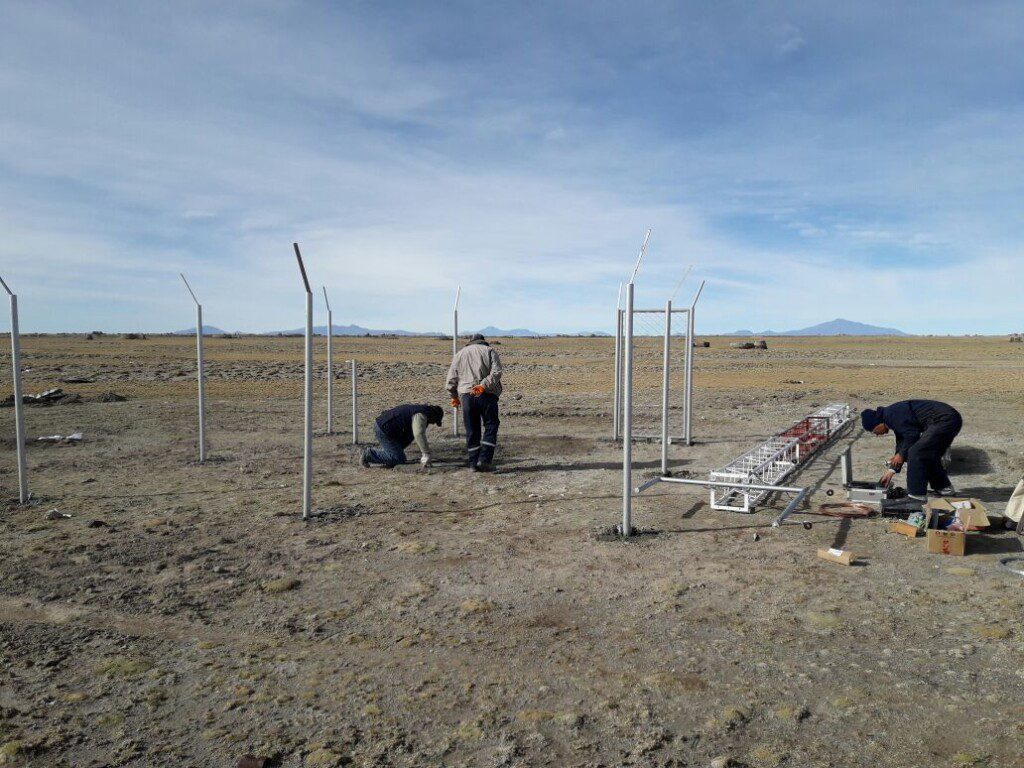
Last month, Bolivia’s Servicio Nacional de Meteorologia e Hidrologia (SENAMHI) installed an additional Acronet hydrological station in Chuqui Chuqui, in the municipality of Sucre, on the Río Chico a tributary of the Rio Grande, which drains into the Amazon. Since October 12, the station has been collecting measurement data, including rainfall patterns and the river’s hydrometric level.
The design, assembly and installation of the station took place in full autonomy, following the training we had proposed as part of a number of projects, which had already been completed some time ago.

In fact, our story in Bolivia began in 2013 as support to local institutions such as the Vice Ministry of Civil Defence (VIDECI), SENAMHI and the Ministry of Environment and Water (MMAyA). The development of a sustainable Early Warning system indeed requires capacity, human and financial resources, and a short, medium and long-term implementation strategy. And so it was.
In fact, we designed a progressive implementation plan aimed at maximising the effectiveness and operability of the system, through its development in four phases: data collection and exchange, improvement of the forecasting and real-time monitoring system, preparation and communication of warning messages, institutionalisation and emergency planning.
These phases were then implemented in different projects in collaboration with DG ECHO, FAO, the Italian Ministry of Foreign Affairs, AICS, World Bank and the NGOs WeWorld and COOPI.
The implementation of the Early Warning System in Bolivia also saw the installation of open-hardware weather stations that allow real-time monitoring of different parameters by feeding hydro-meteorological models for data analysis and processing, guaranteeing both economic and technical sustainability. Unlike classical proprietary stations, open-hardware stations stipulate that all design schemes and the list of components necessary for their realisation are freely released in order to be continuously improved by the community of experts. This has allowed a real appropriation of expertise by SENAMHI. Till now, eight Acronet stations are in operation in Bolivia at points of great hydrological interest, the last of which were assembled and installed in complete autonomy.
As proof that risk prediction and mitigation work is a programme that must be carried out in the medium and long term and that must be able to broaden intervention plans, today we are participating in a new activity carried out with funding (Seedcorn Fund) from the Natural Environment Research Council of the United Kingdom, together with Northumbria University in Newcastle and the Universidad Mayor de San Andrés of La Paz. This is a new project, a new journey with the institutions and local stakeholders we have known for some time to create an interdisciplinary study group to improve water resource management for the La Paz/El Alto area, starting with the monitoring of the Andean glaciers above it, which are in a critical condition.
It is a long-lasting and flourishing story that is based on capacity building and autonomy to ensure the direct and autonomous management of instruments, which we are proud to be part of and which we hope will continue for a long time.
Here a video about the Early Warning System implementation in Bolivia