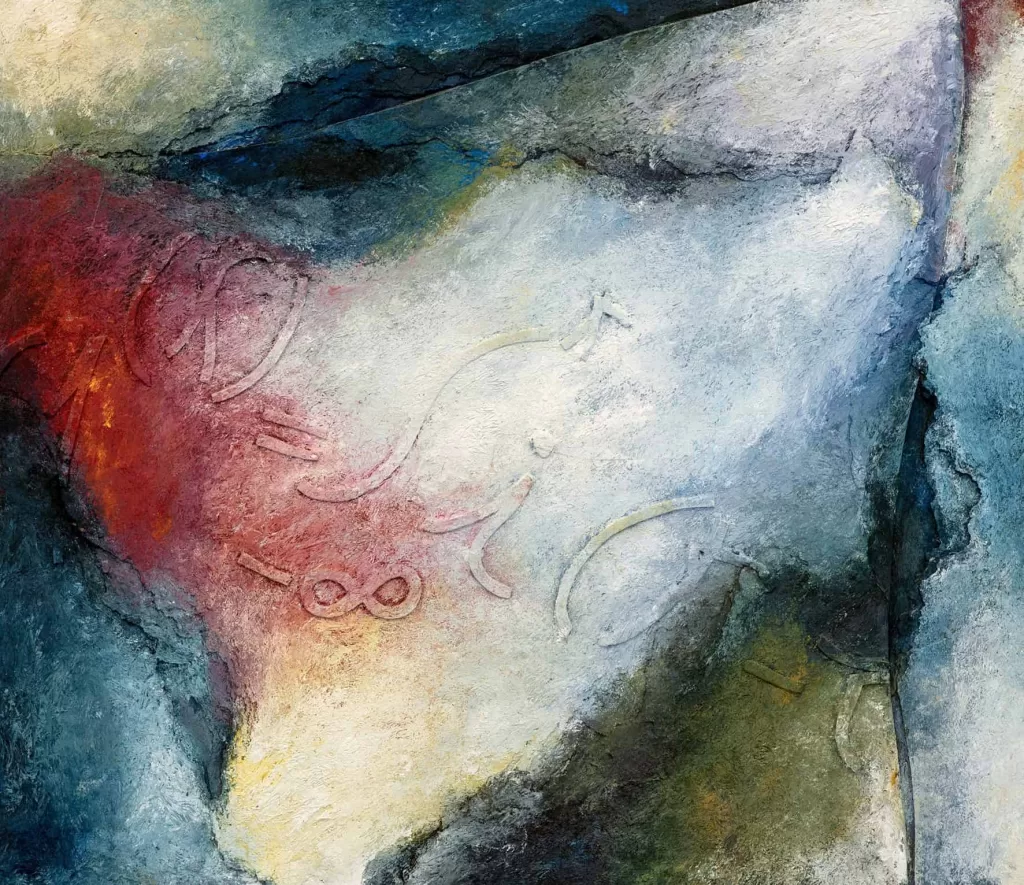
Over the years, art has become an increasingly important way for communicating the research taking place at CIMA Research Foundation, bringing back to the public some of the most important problems and issues facing society. Today, all of the Foundation’s artistic works are collected on a new site, along with many other accounts of how science can become art, and art narrate science
How to reflect on some of the great natural phenomena without necessarily having to narrate them with the mathematical equations that describe their dynamics? How to turn what the scientific world studies through complex numerical modeling into a message, or a moment of reflection immediately accessible to all? Art is undoubtedly one of the possible strategies – the one that CIMA Research Foundation has chosen to take the themes it studies outside of laboratories and computer screens, bringing them outdoors, to the public.
Through paintings, murals, sculptures, plays and photographs, art has helped us talk about droughts, floods, biodiversity loss-and the phenomenon that is most seriously affecting them, the climate crisis. Today, all of CIMA Research Foundation’s art collection can also be known from the new website, which collects the artworks and art events created over the years of activity.
“Art has a unique ability to arouse emotions and reflections even with a simple glance: shapes, colors, sounds can sometimes say more than long technical explanations,” says Luca Ferraris, president of CIMA Research Foundation. “And while this, of course, does not mean that art can replace scientific process and knowledge, it does make it a very important aid in communicating complex problems such as those facing our society. It is for this reason that we wanted to tell precisely with art some of the issues we work on.”
In this way, at CIMA Research Foundation, civil protection and risk mitigation have become the protagonists of a series of works collected in the offices and common spaces of the headquarters (and now visible online) that are the result of the collaborative work of our scientific and artistic worlds. Among them are the works created by Ligurian artist Beppe Schiavetta, who interpreted these themes, for example in the series of paintings entitled Lament for Ur, which retrace the collapse of the Sumerian city that occurred more than 4,000 years ago due to drought and desertification; or in Corrotte macerie (Corrupted Rubble)the stoneware wall inaugurated on the occasion of the celebration of CIMA Research Foundation’s 15th anniversary, a reflection on the limits and boundaries “that pretend to protect us,” as the artist described them.
But figurative art is not limited to paintings and sculptures: thus, the site also collects photographs revealing the underwater world of cetaceans, already the protagonists of an exhibition aimed at raising awareness of the fragility of marine ecosystems, taken by our researchers during their fieldwork. And, again, available on the site are the watercolors that Barbara Alessandri, CIMA Research Foundation environmental educator, made to tell the story of the biodiversity of Ligurian vegetation, during the experience of that open-air laboratory that was the management of the Pian dei Corsi Forest Nursery.
These are just a few examples of what the artistic contamination of our scientific research has led to: traveling through the pages of the site it is possible to find “im-possible” dialogues between researchers and artists, theatrical pièces (in Italian), murals and much more. Not forgetting the workshops and interactive experiences aimed at younger people. “In fact, we cannot forget that it will be the new generations that will inherit many of today’s challenges, and therefore need to be empowered to deal with them,” Ferraris explains. “For this reason, it is essential to address them as well, and CIMA Research Foundation has always been a promoter of activities designed for younger people and schools.”
“For a long time, science was left out of the public and political debate, but today things are no longer like that. And it is therefore more important than ever for society to be able to make informed decisions on scientific issues: this requires communication, a continuous dialogue with society,” Ferraris concludes. “And art, in addition to being an exceptionally vigorous avenue of communication, helps us to enrich the search for those emotions, that empathy that are its most important driving force.”