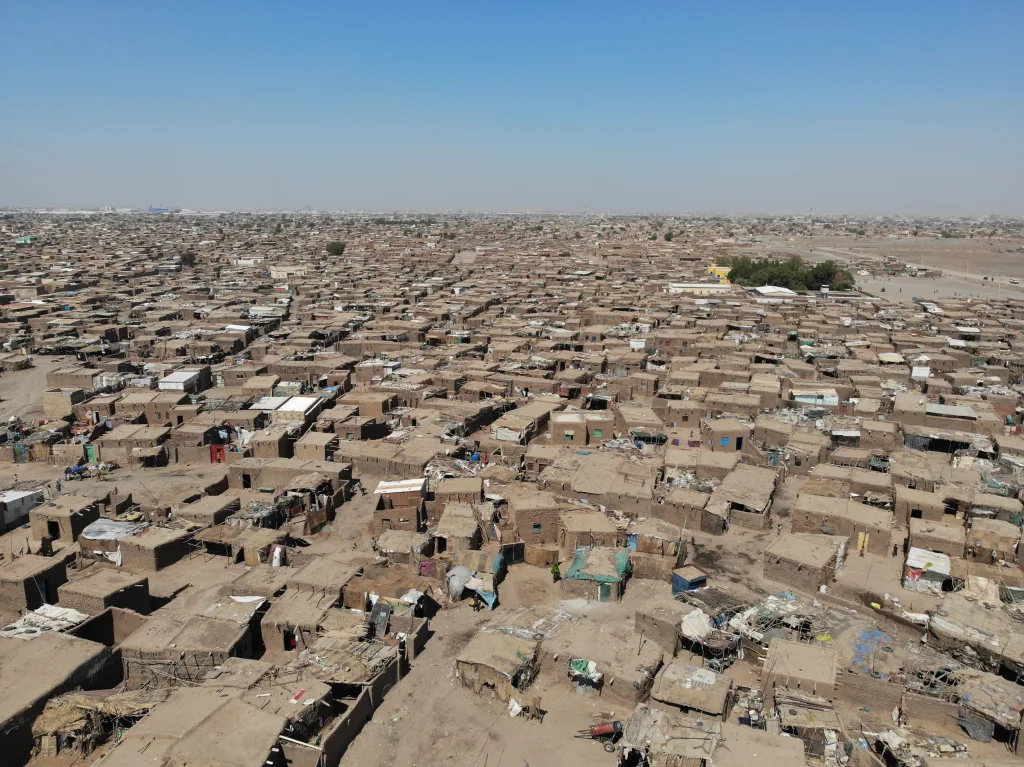
The conflict currently affecting Sudan erupted on April 15, 2023, exactly one year ago. It’s been an upheaval for the country, profoundly altering, among other things, the context in which we operate within the APIS project. Our researchers, in Italy and in Sudan, describe how activities have been adapted to respond to the country’s new needs within the project.
Exactly one year has passed since the outbreak of the conflict in Sudan. While perhaps overlooked compared to other conflicts that populate the pages of newspapers, the Sudanese one also has massive proportions in terms of casualties, displaced persons, and at-risk population.
Operating in this context is therefore complex and challenging, as well as fundamental. For CIMA Research Foundation, which began working in Sudan as early as 2022 alongside the Italian Agency for Development Cooperation (AICS), the need to increase efforts to provide concrete support has become a priority.
Before the conflict
The APIS project – Climate Change : early warning and civil protection funded by AICS, began in the early months of 2022, strengthening a collaboration that had already seen us operating in the country for a couple of years. The purpose of the project is to strengthen Sudan’s technical and operational capacities in disaster prevention and management. The country is frequently exposed to extreme climatic events of floods and droughts and, to reduce these risks, the project aims to implement an operational warning system on a national scale. In this sense, APIS also contributes to the EW4All Initiative, which aims to protect the global population from meteorological risks with early warning systems (EWS) by 2027.
The first phase of the APIS project was completed in March 2023, marked by a seminar, a training, discussion, and debate event held in Khartoum.
“The activities of this initial period had allowed us to map the regulatory and institutional context of Sudan’s warning system, gather risk information, and develop the meteorological forecasting component of the system,” say Nicola Testa and Alessandro Masoero, researchers at CIMA Research Foundation. “A second phase of activities would have brought, in May, the provision of the computing server to support the on-site execution of the WRF Sudan meteorological model (developed together with the Sudan Meteorological Authority, SMA) and the dispatch and installation of the first five hydrometeorological monitoring stations, according to the configurations defined with the institutes involved. The goal was to be prepared for the rainy season, which starts between June and July.”
The conflict erupted between these two phases of activity, disrupting, along with the Sudanese reality, the course of the APIS project.
APIS during the conflict in Sudan
The conflict in Sudan has made the operational scenario extremely complex and has forced the interruption of field activities. “Following the outbreak of war on April 15, 2023, and as result of the evolving situation, it became increasingly urgent to help communities adapt to disasters, therefore, the project shifted its focus to resilience-oriented approach”, says dr. Bouran Awad, National Early Warning System expert of the project, supporting the project team together with Dr. Sawsan Omer in liaising with national and regional stakeholders.
If the conduct of activities has become more complicated, its role has also become more important: the conflict, in fact, represents an exacerbating factor of the pre-existing natural risks to which the population is exposed and requires attention to new conditions of vulnerability (think of the displaced persons) and reduced response capabilities.
“To respond to these changed conditions, we immediately initiated dialogue with the various national and international actors (WMO, ICPAC Nairobi, NORCAP) involved in the project activities, to assess the context and above all identify the new needs of the stakeholders. Among these, some immediate needs emerged, particularly regarding monitoring and responding to the impending rainy season; others expected for the following months, such as the need to restore civil protection services and ensure their operability,” say Testa and Masoero.
To meet the needs posed by the rainy season, the first adjustment to the original project framework was made. CIMA and AICS have developed the Impact-Based Forecast (IBF) bulletin, operational as early as August. In analogy with the bulletin prepared as part of another project, PPRD EAST 3, for the conflict in Ukraine, the Sudanese bulletin is shared with organizations operating in the emergency context and focuses on aspects that most influence humanitarian activities such as the potential impact of extreme hydro meteorological events, like extreme rainfall and flooding, affecting the population.
Then, an entire part of the project activities has been rethought, in terms of methodology and content, to cope with the new situation, in which all Sudanese institutions are severely weakened by the conflict with serious difficulties in operating from all points of view: logistical capabilities, lack of personnel and infrastructure. “For example, the National Civil Protection Authority (NCCD) now operates from Port Sudan. The Sudan Meteorological Agency does not have access to the premises of the central office and cannot ensure the proper functioning of forecasting and monitoring services.”
The project variant was approved in February and involves operating on three fronts. The first is support for humanitarian organizations operating in Sudan through an extreme weather event forecasting service (droughts, heavy rains, and floods) through the production of a real-time bulletin: “The service will be supported by Sudanese staff also through methodologies and procedures currently used at the African Union Situation Room in Addis Ababa, created by CIMA in collaboration with UNDRR, within the framework of the continental warning system design,” the researchers continue.
In addition to this, activities to support the capacities and operationality of the Sudanese meteorological service are planned, in collaboration with the IGAD/ICPAC Disaster Operation Center in Nairobi and the World Meteorological Organization, for the restoration of essential services; and with NCCD for the improvement of flood and drought risk management in Sudan in the new context, to ensure the institutional mandate of coordinating the national warning and forecasting system.
“The conflict requires a response – also – through cooperation. CIMA Research Foundation is actively committed to facilitating coordination through the African Multi-Hazard Early Warning and Action System (AMHEWAS) network. Collaboration between all national and international entities involved is really fundamental, also because we are approaching the next rainy season,” concludes our team. “Meanwhile, in this context of political instability, difficulties, and risks, the resilience demonstrated by colleagues has truly been a source of motivation to unite efforts in protecting the population continuing our work to sustain the nation Early Warly System.”