



Avolio, E., Miglietta, M.M., Fanelli, C., Lagasio, M., Mengistu, M.T., Milelli, M., Parodi, A., Xhelaj, A., Burlando, M., Analysis of the 18 August 2022 western Mediterranean derecho: Atmospheric dynamics and impacts over the northwestern Italian coast, Atmospheric Research, Volume 336, 108858, ISSN 0169-8095 (2026) https://doi.org/10.1016/j.atmosres.2026.108858
Drought
Overview
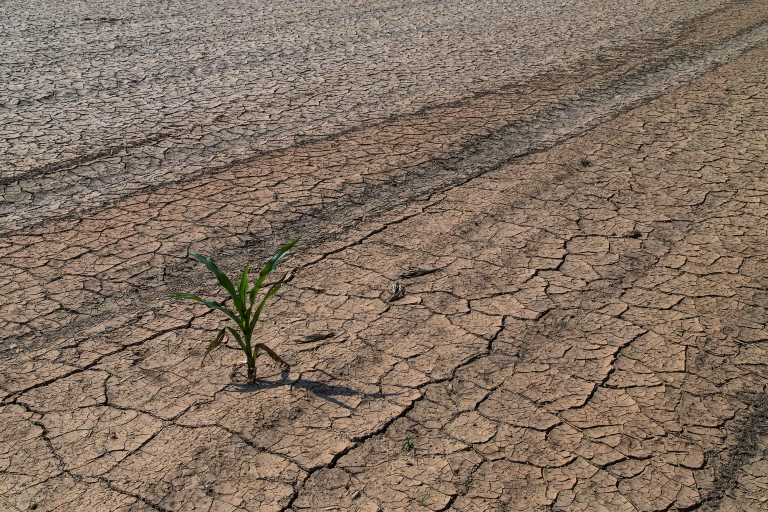
Drought is a prolonged period of reduced water availability, often leading to an imbalance between water supply and demand. It manifests as a progressive process, beginning with a lack of precipitation (meteorological drought) and extending to reduced water availability in rivers or reservoirs (hydrological drought) and soils (agricultural drought). Each type of drought has distinct effects on water availability for natural systems and human uses, including domestic, agricultural, industrial, and energy sectors.
Due to the climate crisis and current practices in water resource use and land management, droughts are increasing globally in frequency, intensity, spatial extent, and duration. Climate change exacerbates this issue by raising global temperatures and amplifying climate variability. Recently, Italy experienced exceptionally severe drought conditions between 2022 and 2024, and similar events have occurred in other vulnerable regions such as California, Australia, South America, the Asia-Pacific, and parts of Africa. These cases demonstrate the growing complexity of managing droughts worldwide.
Drought is inherently a slow-onset phenomenon. It does not represent a sudden crisis but rather a systemic risk that evolves over time, requiring proactive management. Addressing drought necessitates monitoring, early warning systems based on robust scientific data, and shared strategies for anticipatory actions and adaptation plans aimed at mitigating impacts. CIMA Research Foundation employs a comprehensive approach combining multi-scale monitoring, satellite analysis, and hydrological models to assess and forecast water scarcity in a changing climate across national, European, and global contexts.
Drought in Italy
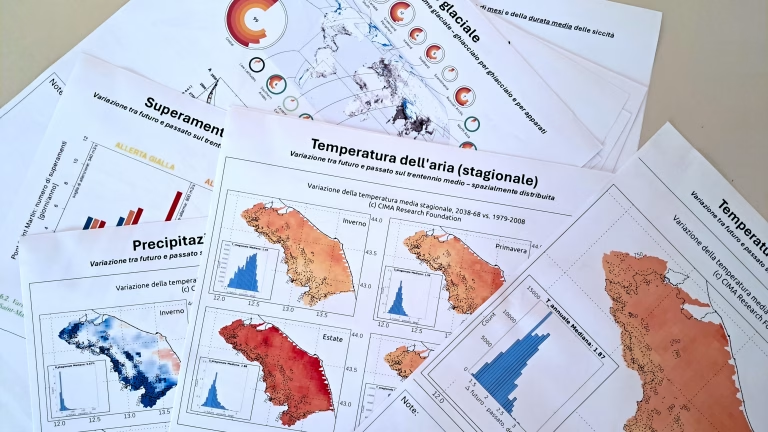
CIMA Research Foundation’s activities in Italy focus on continuous drought monitoring by integrating climatic, hydrological, and satellite data to provide spatially distributed indicators of various drought types. We use a broad range of variables, including precipitation anomalies, temperature, soil moisture, snowpack levels, evapotranspiration, and streamflows, to analyze drought risk from all relevant hydrological perspectives. This approach helps identify critical water availability issues and supports adaptation strategies, particularly during prolonged dry spells.
An important component of this work involves monitoring artificial reservoirs using Sentinel-2 satellite data. These data enable near-real-time calculations of water surface coverage percentages, comparing current levels with historical basin extents and detecting monthly anomalies in water availability. This monitoring system, currently in an experimental phase (Cenci et al., 2024), is instrumental for sustainable water resource management, crisis prevention, and mitigating the impacts of severe drought periods.
The video animation shows the evolution of the water surface extent of the Fanaco Lake (a reservoir located in Sicily, Southern Italy) by means of a series of images acquired by the Sentine-2 (S2) constellation between November 2022 and November 2024.
Beyond hydrological analysis, CIMA Research Foundation also examines the social and legal dimensions of drought. This includes analyzing municipal ordinances and court rulings related to water crises to understand conflicts that may arise between citizens, institutions, and businesses, especially concerning the emerging issue of snow drought impacts in mountain areas. This multidisciplinary approach enables us to provide technical and scientific support to local authorities, fostering constructive dialogue and shared solutions for critical periods.
By combining technological innovation, multidisciplinary analysis, and institutional dialogue, CIMA Research Foundation enhances the resilience of Italian territories to drought-related risks.
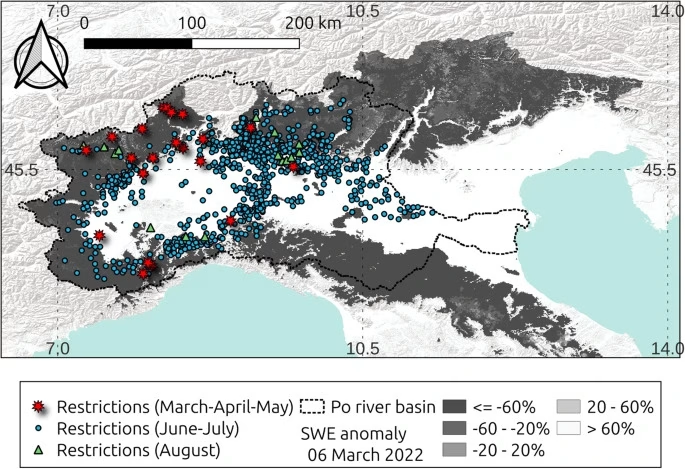
Avanzi, F., Munerol, F., Milelli, M. et al. Winter snow deficit was a harbinger of summer 2022 socio-hydrologic drought in the Po Basin, Italy. Commun Earth Environ 5, 64 (2024). https://doi.org/10.1038/s43247-024-01222-z
Drought in Europe
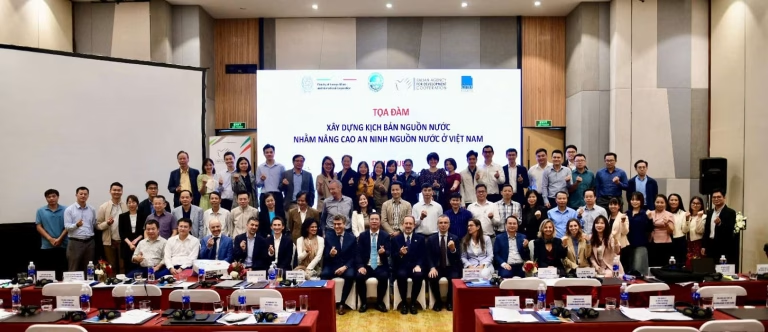
The need for coordinated and centralized early warning systems (EWS) at the European level for drought management led to the development of the European Drought Observatory (EDO) and the Global Drought Observatory (GDO) by the Copernicus Emergency Management Service. In this context, CIMA Research Foundation collaborates with the European Commission’s Joint Research Centre (JRC) to enhance drought monitoring by strengthening the infrastructure of EDO and GDO, developing new predictive methodologies, and refining procedures for calculating and visualizing the indicators that form the core of these observatories’ informational content. As a result, EDO and GDO have become reference tools for European governments, policymakers, and stakeholders in the water, energy, and agricultural sectors.
A concrete example within this framework is EDORA – the European Drought Observatory for Resilience and Adaptation. This initiative integrates drought monitoring with vulnerability and adaptation capacity analysis, combining climatic and socio-economic aspects to support adaptation policies that explicitly account for all components of drought risk. Notably, we coordinated the development of the European Drought Risk Atlas, created by an international consortium under the JRC’s guidance. The atlas provides a detailed overview of current and future drought risk scenarios and their potential impacts on key socio-economic sectors (agriculture, potable water, energy, river transport) and terrestrial and aquatic ecosystems. This tool supports water resource planning and management, identifies the most vulnerable areas and sectors at a continental scale, and serves as a foundational resource for developing and implementing strategic adaptation actions.
Drought in Africa
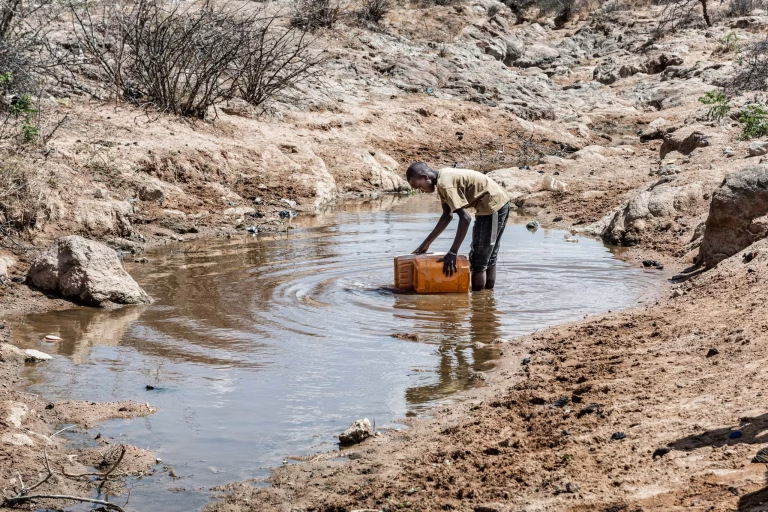
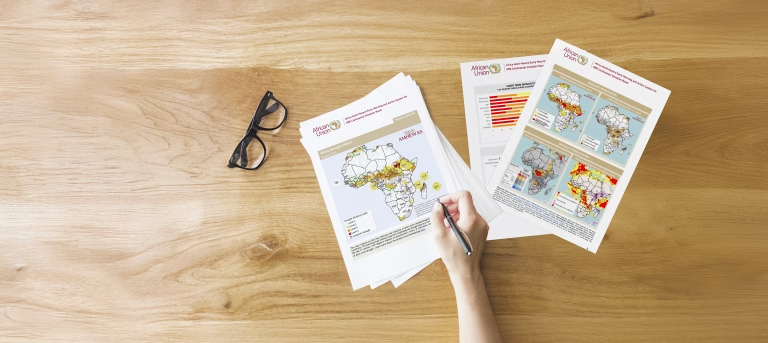
In Africa, drought is one of the most pressing climate risks, with direct impacts on food security, access to water, and socio-economic systems. To address this challenge, Africa Drought Watch (ADW) was created, a new continental monitoring and early warning system developed as part of the AMHEWAS (Africa Multi-Hazard Early Warning and Early Action System) program. Through monthly bulletins that integrate satellite data, climate indices, and local knowledge, ADW makes it possible to distinguish between short-term droughts and prolonged water crises, transforming scientific information into operational decisions for governments and institutions. CIMA Research Foundationcontributed substantially to the co-design and co-production processes of the system, working alongside the African Union Commission, ACMAD, regional climate centers (RCCs), regional economic communities (RECs), national meteorological and hydrological services, and international partners including the Ministry of Foreign Affairs and International Cooperation (MAECI) and the Italian Agency for Development Cooperation (AICS), the United Nations Office for Disaster Risk Reduction (UNDRR), and NORCAP. The common goal is to strengthen the resilience of the African continent by transforming climate intelligence into concrete action.
Drought in the world
Drought is a global challenge amplified by climate change, requiring coordinated and inclusive international actions. The World Drought Atlas, presented at COP16 of the United Nations Convention to Combat Desertification (UNCCD), exemplifies tools designed to understand drought risks and promote adaptation and mitigation interventions.
Developed through a collaboration among the UNCCD, the European Commission’s JRC, CIMA Research Foundation, Vrije Universiteit Amsterdam, and United Nations University, the atlas provides a comprehensive overview of drought impacts on key sectors such as agriculture, hydropower, river transport, and ecosystems. Through maps, data, and case studies, it highlights how cascading drought effects threaten food security, public health, and economies while exacerbating social inequalities and conflicts. The atlas showcases examples of proactive approaches and preventive measures adopted by communities, regions, and countries, demonstrating how they can reduce vulnerability to drought impacts. It serves as a valuable resource for fostering cooperation and inspiring action to enhance drought resilience.
Globally, special attention is given to mountain areas, which are vital for water resource management and particularly vulnerable to climate change. Global warming accelerates glacier retreat and alters snow accumulation dynamics, disrupting hydrological cycles and exposing these regions to unprecedented risks. CIMA Research Foundation works to strengthen the resilience of mountain communities by promoting practical adaptation strategies and sustainable resource management. Projects like A-DROP (an INTERREG Alpine Space initiative led by EURAC Research) and the global Drought in Mountain Regions Working Group (co-coordinated by CIMA within the International Association of Hydrological Sciences’ research decade) exemplify this commitment.
Insights
Women and drought
Who are the first to suffer the consequences of the global water crisis? Data show that drought exacerbates existing inequalities, disproportionately affecting women. Time spent collecting water increases, access to education decreases, and often-overlooked dynamics of vulnerability are reinforced. An analysis that explores drought through a gender-sensitive lens.
Glaciers and drought
Glaciers are retreating at an accelerating pace, signaling a water crisis that threatens environmental and social balance. As sentinels of change, they reveal the impact of global drought and provide crucial data to address it. A journey through science, monitoring, technology and future scenarios.

Biodiversity and drought
Drought transforms ecosystems: it disrupts balances, reduces ecological functions, and puts biodiversity resilience at risk. An analysis to understand why species loss is just the beginning, and how to observe these impacts through a systemic lens.
Heat waves and drought
Heat waves can trigger or aggravate droughts, but sometimes soil moisture mitigates their effects. A sonification of climate data makes this intertwining perceptible, transforming extreme heat into sound to convey the fragility of water balances.
Challenges and future goals
- Tracking drought propagation across sectors and water cycles: Strengthening tools to monitor interactions between drought impacts on agriculture, hydropower, and water supply to mitigate economic and social effects.
- Focusing on impacts alongside natural processes: While understanding drought as a natural and anthropogenic process remains critical, there is an increasing need to emphasize its effects on people, economies, and ecosystems to adapt policies and management tools.
- Drought as a continuous process, not a crisis/event: Treating drought as an evolving phenomenon to encourage long-term management strategies for building resilience and reducing risk.
Projects
News
Munerol, F., Molini, L., Altamura, M., Andreaggi, M., Bernini, L., Dalla forensic investigation alla mitigazione delle responsabilità: i sistemi tecnico-scientifici e politici di supporto alle decisioni in protezione civile, Federalismi, Resilienza e calamità naturali, n. 6 (2026) http://bit.ly/46lOGGC
Bruno, G., F. Avanzi, S. Gabellani, L. Ferraris, and M. I. Brunner, Short to Long Streamflow Droughts: A Process-Oriented Review, Wiley Interdisciplinary Reviews: Water 13, no. 1: e70060 (2026) https://doi.org/10.1002/wat2.70060
Borroni, A., Schick, R.S., Sechi, A.D. et al. From signal to location: using goniometer-derived Argos UHF power to enhance movement data for cryptic whales, Anim Biotelemetry 14, 6 (2026) https://doi.org/10.1186/s40317-025-00443-z