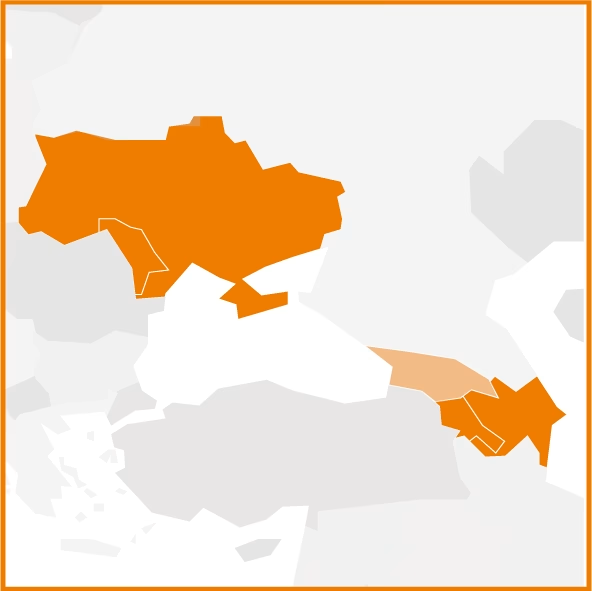
PPRD East 4 represents the final phase of the European Union program dedicated to strengthening disaster risk management in the Eastern Partnership countries. The project consolidates and expands the results achieved in previous phases, supporting the alignment of national systems with the Union Civil Protection Mechanism (UCPM), in line with the Sendai Framework and the EU Disaster Resilience Goals.
The program combines technical assistance and training addressed to institutions, communities and volunteers at different territorial levels, promoting an inclusive approach that engages the whole of society. Through hands-on support, backed by national and regional exercises, PPRD East 4 aims to ensure ownership, autonomy and continuity of results. The project also integrates EU cross-cutting priorities — gender equality, social inclusion, environmental sustainability and conflict sensitivity — thereby contributing to enhanced resilience, interoperability and cross-border cooperation.
GOALS AND EXPECTED RESULTS
The objective of PPRD East 4 is to increase countries’ capacity to prevent, prepare for, respond to and recover from disasters, while strengthening risk governance and at the same time facilitating integration into the Union Civil Protection Mechanism and participation in its initiatives. The program seeks to consolidate and update national risk assessments, integrate multi-hazard analysis into emergency planning, make early warning systems more operational and institutionalised, modernise training and curricula, strengthen procedures for requesting and receiving international assistance, and structure networks among authorities and civil society. Expected results include more coherent and interoperable systems, increased use of UCPM tools, more effective cross-border cooperation, and improved integration between prevention, preparedness, response and recovery.
CIMA RESEARCH FOUNDATION’S CONTRIBUTION
CIMA Research Foundation coordinates the overall aspects of the program and leads the technical and scientific pillars on risk management. It provides technical assistance and training to countries in the development of national risk assessments, the production of data and maps to support planning, and the strengthening of early warning systems linked to timely action. CIMA conducts the planned technical missions, facilitating dialogue among different services and the integration of scientific expertise, methodologies and specialised knowledge into decision-making processes. It also contributes to updating plans and operational procedures, developing exercises, and carrying out communication, inclusion and monitoring activities, ensuring continuity and coherence with the results of previous phases of the program.
Photograph: Di Menna Paolo/UIF