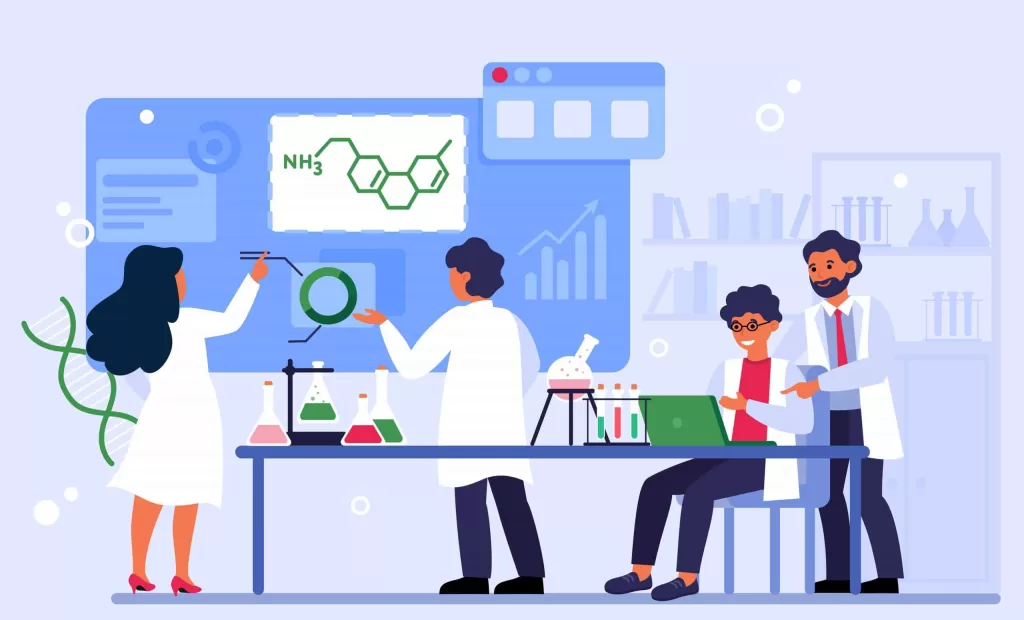
Two relatively close day are dedicated to women, February 11th and March 8th. We decided to take the opportunity to gather female colleagues and hear directly from their voices what they think about women’s work in a scientific environment. The text presented here is not intended as a statistical survey and has no pretension of reaching positions or pointing univocal strategies for gender equality. This is just the result of an “open mic” meeting, that hopes to contribute, with some very personal reflections, to the debate on gender equality in a scientific environment
Two international days dedicated to women fall relatively close together, February 11th and March 8th: the World Day of Women and Girls in Science, established by the UN to promote gender equality in scientific careers, and the International Women’s Day, in 2022 entitled Gender equality today for a sustainable tomorrow. To highlight how, on the one hand, women remain more vulnerable to the climate change’s impacts and how, on the other, only equal opportunities for men and women can be an effective basis for sustainable development strategies.
We took the opportunity of these important dates to do some reflections on women in science. Therefore, we decided to directly address “our women”, not only the researchers but also who work in administration, communication or other areas that are an integral and necessary part of the CIMA Research Foundation’ activities. In this way, we were able to broaden the discussion not to strictly research careers but to all those who find themselves working and dealing with a scientific environment.
The result was an “open mic” discussion with some of the women of the Foundation. A discussion that does not claim for identifying unambiguous problems and solutions, but rather to act as a sharing moment, for experiences and reflections that (we hope) could contribute, albeit in their personal character, to enrich the debate on the subject. We share here some of the considerations and experiences reported during the meeting.
Work and family
“Like many other colleagues, I have been here for years and this is the first opportunity to discuss this issue that has been proposed to me… I am very pleased!”; “When I told my partner about the meeting, he commented that it would never have been organized in his company”. These are two of the first comments worth reporting: the opportunity for a moment of discussion on meaning, limits and perspectives of being a woman in a scientific environment is not so obvious but it is appreciated.
“It happened to me, yes, to feel the difference in being a woman when many years ago, while I was working in another place, I was asked to sign a document related to future pregnancies”; “I started my career in an engineering company where the difference between men and women was very strong, especially related to motherhood – it was one of the things that made me leave. In the international context, on the other hand, I have found that the voice of women in our field is much more considered”; “The burden of family work remains much more on women, and this represents a self-limit that we impose on ourselves, because it leaves less time and availability, for example with regard to business travel”; “As an administrator, I had the opportunity to observe couples who ‘left together’, with the same position. Then the woman would choose to leave this environment in order to have a more flexible schedule and greater protections in case of maternity, or to care for the elderly (because the care is always a women responsibility). In short, women had to make different choices while starting from the same perspectives.” Motherhood, domestic and family care, seem to be a limit shared by all – and independently from the scientific field, but, as some colleagues pointed out, “a limit of role and life choices”, linked to “society and cultural context”.
This side brings into play another one, quite relevant in a context (such as ours) in which the job can easily lead researchers to travel abroad and to a certain flexibility in hours. “Not having children means that I can give more availability than other people, and I am sure that it is an added value of my work, from an external point of view. I don’t perceive it as discrimination, but it seems clear to me that the working condition leads to perpetuate this logic”; “Yet, if a woman can’t leave for family reasons… the same should happen with a man who has a family and children! Instead, we rarely observe it: that’s why this is an aspect that seems to recall a difference linked more to culture and society than to the scientific environment”. Perhaps, as someone pointed out, the issue can be reversed: it would not be so much the idea that a woman cannot deal with science as “I think it is more present in our society the idea that a man cannot deal with the family and relational aspect alone”.
There is also an important point that we feel we should report on in this regard, brought up by one of our colleagues: “I think there is still a somewhat backward view that, for career advancement, availability is one of the most important elements. However, in my opinion, being available 24 hours a day is not the most important element for a good director, good project manager, or any other role!”
Would you advise a girl to pursue a career in science?
Today, the focus on avoiding gender differences in the scientific field is high, with many research also dedicated to understanding which issues may be holding girls back from beginning studies and a career in STEM. How has it been for our female colleagues? Personal memories emerged spontaneously during the meeting. “In high school, the professor told me not to do engineering, because it was a male environment: it was better for a woman to study in physics”; “Similar experience: in the late 1990s, when I finished high school, I attended a presentation of the mechanical engineering course… and the professor felt the need to specify that the facility also had bathrooms for women!”
And now? Would we advise a girl to pursue this path? “I felt the sense of discrimination several times when, for example, at a discussion table I found myself having to energetically repeat, several times, a proposal or an opinion that, if expressed by a male colleague, had no problem being accepted. And this is one of the reasons why, when some girl – for example, one of the Ph students I supervised – asked me for an opinion, I suggest she thinks about it. At a certain point in our careers, we are called upon to make a choice. Parenting, relocation, status must be put on the scale. And maybe, at some point in life, you’ll feel frustrated in realizing that you’ve sacrificed more than others to achieve the same goals.”
Discrimination and considerations for overcoming it in everyday life
Of course, discrimination in its diverse forms is one of the most heartfelt topics. Not all the colleagues who participated in the meeting reported having experienced it, and in any case the experiences were diverse: in the difficulty of having an opinion taken into due consideration, in discovering an unjustified salary gap, as a perception of acting as a “secretary” to a colleague… But what strategies come to mind overcoming it, when present, in daily life? That is, beyond institutional strategies – on which CIMA Research Foundation has already started working, recently publishing its Gender Equality Plan – how do our colleagues think it is fair to deal with these situations?
“As trivial as it may seem, I think the first fundamental element is to point out the biases and problems – that is, not to be afraid to expose yourself, because recognizing them is the first necessary step in addressing them.” And again, “Participation and action, even if in small steps: it’s important that there be confrontation with men as well, since we’re talking about a subconscious mentality shared by the sexes. My invitation is therefore to participate in the working groups on the subject and in general to take part in the actions that may be proposed”.
As anticipated from the beginning, we did not want to present ourselves here as a place of choices as much as of free sharing of experiences and reflections, hoping that these can still enrich the reflections on the subject. This text is the result of about two hours of meeting with the colleagues who gave their availability, and of which we have collected and reorganized the ideas that emerged; to this, we have added a short questionnaire (32 of our 53 colleagues responded): while not being a statistical tool, has allowed us to consider perceptions and experiences of those who did not have the opportunity to participate in the meeting.