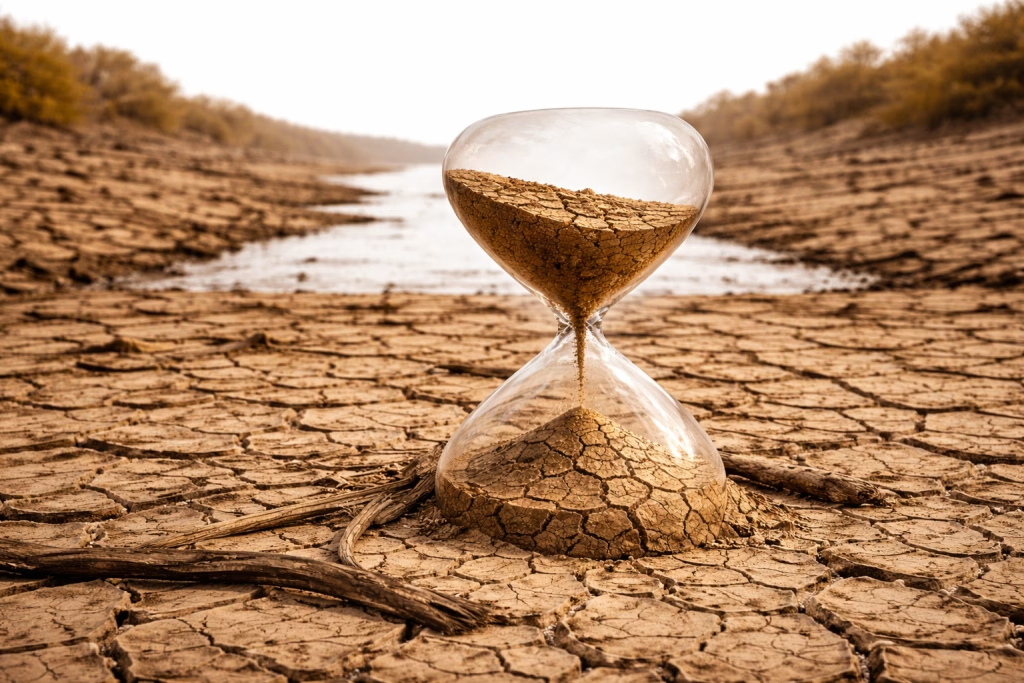
Streamflow droughts represent a growing challenge for territories, ecosystems, and socio-economic systems. In recent years, events such as the European drought of 2018 or the 2022 drought in the Po River basin have shown how these phenomena can become more frequent, intense, and difficult to manage.
A new scientific review published in WIREs Water, to which researchers from CIMA Research Foundation also contributed, proposes an integrated perspective on streamflow droughts, analysing them as events that may last from a few weeks to several years and that arise from the interaction between climate, hydrological processes, and human activities.
Different droughts, different causes
Not all streamflow droughts are the same. Defined as periods when river discharge drops to exceptionally low levels, some develop rapidly and last only a few weeks or months, while others persist for years, with impacts that accumulate over time.
For this reason, the study distinguishes between short- and long-duration droughts. The former are often associated with sudden atmospheric anomalies, such as prolonged periods of high pressure. The latter involve deeper changes in the functioning of river basins, such as the progressive depletion of groundwater reserves.
This distinction is far from theoretical: the duration of an event is a crucial piece of information that determines how monitoring and management strategies should evolve.
Why time is a key factor
The review adopts a process-oriented approach, placing at the centre the different factors that contribute to triggering, intensifying, or mitigating a streamflow drought.
Often everything begins in the atmosphere, where precipitation deficits and temperature anomalies can create the initial conditions for drought development. In many mountain basins, however, snow and glacier melt can temporarily mitigate its effects. When these reserves decline, for example due to climate change, the impacts become more severe.
Soil and groundwater also play an equally important role. Subsurface water storage acts as a form of “memory” within the hydrological system: it accumulates water during wet periods and releases it slowly during dry periods, sustaining river discharge during drought phases.
Natural processes are then compounded by human activities. Water withdrawals, reservoir management, land-use changes, and irrigation practices can significantly influence the evolution of a drought, either reducing or amplifying its effects, especially when the phenomenon persists over time.
One of the central messages of the study is that the importance of these processes changes with drought duration. During short events, atmospheric factors tend to dominate. In multi-year droughts, however, interactions between evaporation, vegetation, subsurface storage, and water management become increasingly important. In these cases, the hydrological system may enter a phase of persistent stress, making the recovery of river flows slower and more uncertain.
Toward more effective water management
Hydrological models are a fundamental tool for monitoring, forecasting, and planning systems. However, the review highlights that many current models still struggle to correctly represent key processes, such as the accumulation and release of water in the subsurface, the simulation of very long and severe droughts, and the realistic inclusion of human activities. Continuing research to improve these tools is therefore essential to support effective decision-making in a context of ongoing climate change.
The authors of the study also emphasize that addressing streamflow drought risk requires an integrated approach. This means analysing these phenomena across different temporal and spatial scales, paying greater attention to the specific, often compound, drivers of each event, and investing both in improved observational data and in the development of more advanced modelling frameworks.
These directions are particularly relevant for improving water-resource planning, strengthening early warning systems, and designing effective adaptation strategies to climate change.