
By January, the overall picture of Italy’s snow water equivalent (SWE) reveals a persistent, significant national deficit. What does this mean? Snow accumulation remains far below seasonal averages, with direct repercussions on water availability in river basins.
A snow-covered landscape is not just a picturesque image; it is a vital reservoir of water resources for the country. Yet, this new year is not bringing “new life” to Snow Water Equivalent (SWE). Our monitoring confirms a national deficit of -63% 1. reflecting the critical situation across the Alpine arc and the Apennines after December’s initial assessment.
“The causes of this deficit are not uniform across the territory,” explains Francesco Avanzi, researcher at CIMA Research Foundation. “In the Alps, the lack of precipitation is slowing snowpack formation, despite relatively cool temperatures. In the Apennines, however, more abundant rainfall has been offset by above-average temperatures, leading to rapid snowmelt.”


Let’s take a closer look at what’s happening.
The Alps: a season stuck in neutral (so far)
In the heart of the Alps, December saw persistently low snowfall, with key river basins, such as the Po and Adige, significantly below average.
This “season stuck in neutral” stems from a late-starting winter, with snow accumulation remaining below average since November. This trend reflects the lack of significant snowfall events, even though temperatures have been somewhat cooler than in recent years.
The role of the Alps as “natural water towers” for Italy cannot be overstated. Reduced water contributions from Alpine basins directly affect water availability for agricultural, domestic, and industrial use, especially in spring and summer. Historical data show that a snow-poor winter often leads to lower river flows in summer, exacerbating drought risks.
The Apennines: between surges and sudden stops
If the Alps are struggling, the Apennines are no better off, though the dynamics differ. Heavy rainfall, instead of translating into durable snow accumulation, has often been accompanied by above-average temperatures, leading to rapid snowmelt. A striking example is the Tiber River basin, which shifted from near-average conditions to an -88% 2deficit in just a few weeks. This is classic “ephemeral snow” behavior.
“Ephemeral snow is a typical phenomenon in milder snow regions,” Avanzi explains. “It occurs when abundant precipitation combines with elevated temperatures, preventing snow from consolidating and persisting on the ground. This results in almost immediate melting, with significant implications for local water resource management. This type of snow, which melts just days or weeks after falling, is historically more frequent in the Apennines than in the Alps. However, future scenarios marked by climate change suggest that these conditions will increasingly affect the Alpine region as well. The rapid shifts from intense but episodic accumulations to extended melting periods can create significant imbalances in river basins, negatively impacting local ecosystems and communities’ ability to manage water resources effectively.”
December forecasts indicated an unstable start to winter, and current data confirm this trend. In some areas, the snow season began nearly a month late, amplifying the contrast between accelerated accumulation periods and subsequent steep declines. This volatile pattern reflects the ongoing impacts of a warming climate, which is altering traditional snow accumulation dynamics.
Between past and future: analysis and forecasts
For many Italian regions, this winter’s start ranks among the poorest for snow on the ground since 2011. Data reveal striking similarities to critical years such as 2016, 2022, and 2023. This comparison underscores the persistent impact of climatic variations on snow regimes, highlighting the need for constant monitoring of the situation and its repercussions on water availability and ecosystems.
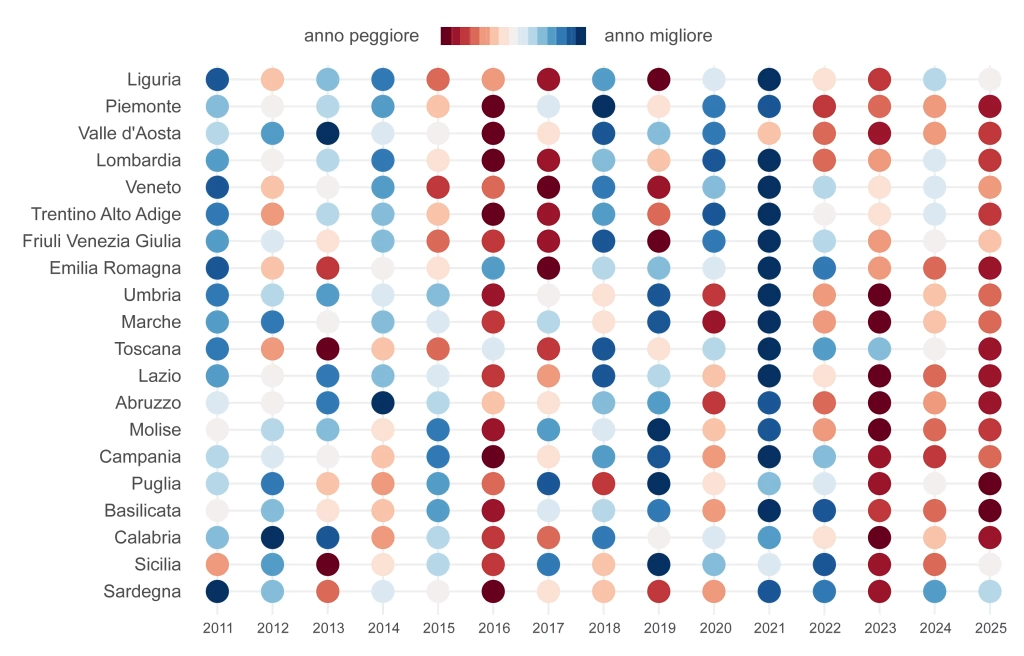
Despite the current outlook, it is too early to draw definitive conclusions for this season. Seasonal forecasts from ECMWF3 suggest a warmer-than-average winter across Europe, with particularly high temperatures over the Alpine arc and central Apennines.

Regarding precipitation, forecasts indicate average conditions in the Alps and slightly below average for the Apennines.

Recent snowfall in the southern Apennines, however, offers a glimmer of hope for partial recovery in the coming months. Avanzi concludes: “The peak snow accumulation is expected between February and March, giving us time to observe significant developments.”
- Updated data as at 10/01/2025. ↩︎
- We would point out, however, that in the Apennines there is some snowfall in progress in these very days, which makes our estimates a little more uncertain in these areas. ↩︎
- The European Centre for Medium-Range Weather Forecasts is concerned with providing operational forecasts that aim to show how the weather is most likely to evolve. To this end, the Centre produces a set of forecasts. Individually, they are comprehensive descriptions of weather evolution. Taken together, they indicate the probability of a range of future weather scenarios. See https://www.ecmwf.int/en/forecasts . ↩︎