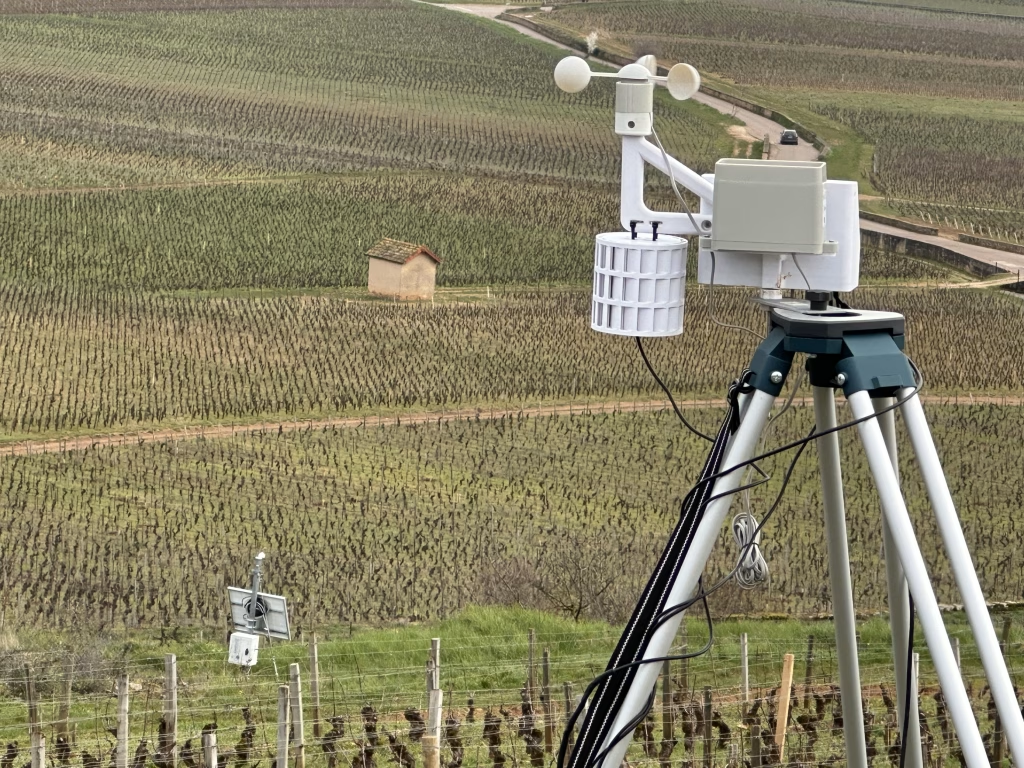
CIMA Research Foundation is a partner of the MAGDA project, which aims to develop a system that provides forecasts and warnings for adverse events for those in the agricultural sector. Our researchers have developed a forecasting system that assimilates observational data, optimized for specific applications.
Less than a year ago, we dedicated an article to the work done by our Meteorology and Climate Department for the EU MAGDA project. The goal is to develop a suite of tools for meteorological and hydrological applications that provide support in the agricultural field by offering forecasts and warnings in case of adverse events, through a Farm Management System dashboard.
At the time, CIMA Research Foundation was conducting preliminary runs of the meteorological forecasting model. These are essentially simulations that allow for a statistical estimation of model errors and the optimization of observational data assimilation—a procedure that makes forecasts more accurate and reliable by integrating real-time observations with parameters and variables representing initial conditions.
And now? How is the activity progressing, and what is planned for the coming months?
Developing the Forecasting System
One of the complexities of the MAGDA project is that it involves the assimilation of observational data from various sources (ground measurement stations, including those installed as part of the project, weather radars, meteodrones, and GNSS, the global navigation satellite system), which must be integrated into the WRF forecasting model. “Each of these data categories has different characteristics, and therefore requires processing to be assimilated into WRF,” explains Martina Lagasio, a researcher at CIMA Research Foundation.
For example, GNSS measures the columnar amount of vapor (the amount of vapor in the air column above the measurement station) through the delay acting on a signal (between satellite and station); the radar estimates rainfall. These are essentially different sets of observations that are needed to obtain the most complete possible picture of the state of the atmosphere at the time of assimilation, but they must be integrated together within the model.
The research team first had to process each of these data categories to make them compatible with the forecasting model and allow for their coherent and effective assimilation.
Even before that, the model itself was configured to adequately cover the study fields, located in Italy, France, and Romania. The choice of the three sites is not coincidental. Each of them represents different needs of the agricultural world, as they are areas characterized by different crops (orchards in Italy, vineyards in France, and summer crops such as corn and sunflowers in Romania), each with its own requirements.
“In developing the forecasting system, we took specific needs into account. Thus, for hydrological and irrigation purposes, the simulations will be a 120-hour forecast and will integrate observations during initialization to improve accuracy,” says Dr. Lagasio. “For thunderstorms, however, we have adopted a different approach. We run the model more frequently, assimilating observational data as we approach the event: this way, we can increase forecast accuracy throughout the day. This is particularly important, especially in summer, when there are greater temperature differences between surface and upper air, which, if associated with water-rich clouds developing vertically (cumulonimbus), can give rise to very localized and intense phenomena with hailstorms.”
Moving toward evaluation
To ensure reliability and accuracy, the performance of the developed forecasting system must undergo careful analysis. “The complete results will be presented only at the end of the project, but we are already conducting the first validations,” explains Dr. Lagasio. “So far, they are confirming the system’s reliability in various scenarios, highlighting how observational data assimilation improves weather forecasting.”
Specifically, the researcher explains, the results of the initial case studies used to set up the forecasting system showed that “from an operational point of view, the solution is to run the model frequently throughout the day, to have always updated information. This also tells us that the approach we chose, where forecasts and assimilations have different times depending on what we want to see (the amount of water needed for irrigation, an intense wind event or hailstorm, or even just a more accurate rainfall forecast to better manage treatment timing for the plants), is suitable for the purposes.”
As we previously wrote, this system will be more than just a service test for the agricultural sector: the intent is more than just reduce economic losses by providing forecasts for crop protection and irrigation optimization. In fact, all these phenomena, as well as water availability, are heavily influenced by the climate crisis: responding effectively and timely means implementing adaptation strategies, tailored to the context. The work within the MAGDA project, therefore, goes in this direction, seeking to limit food losses and water waste.
“We are currently halfway through the project: the results on data assimilation in test cases are good, and we have presented the forecasting system adapted to different needs, which has passed the review of the European Commission,” concludes Dr. Lagasio. “From now on, we enter a so-called demonstration phase where, if an event of interest to agriculture occurs, we will try to conduct simulations (also assimilating GNSS sensors and meteodrones installed ad hoc in crops) for communication aimed at farmers, with the developed system and through a dashboard that allows easy visualization and interpretation of information.”