What happened?
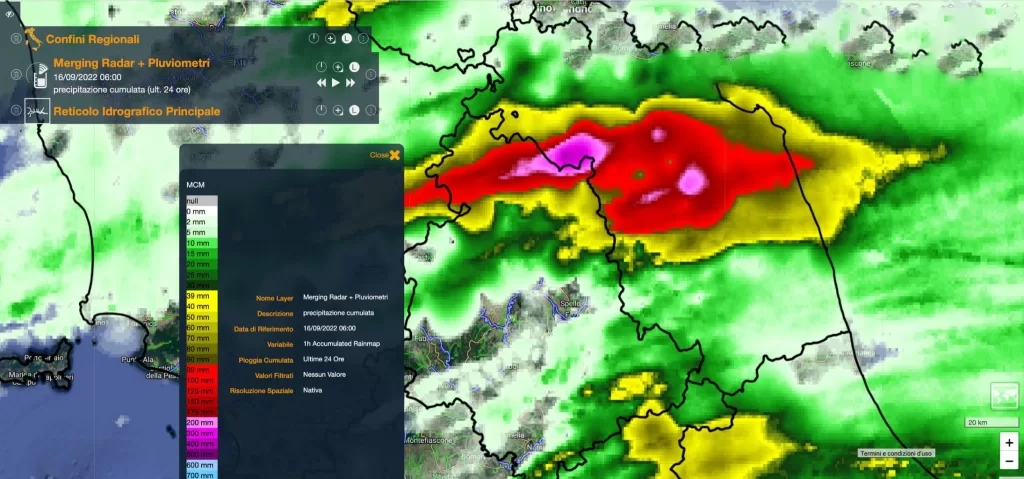
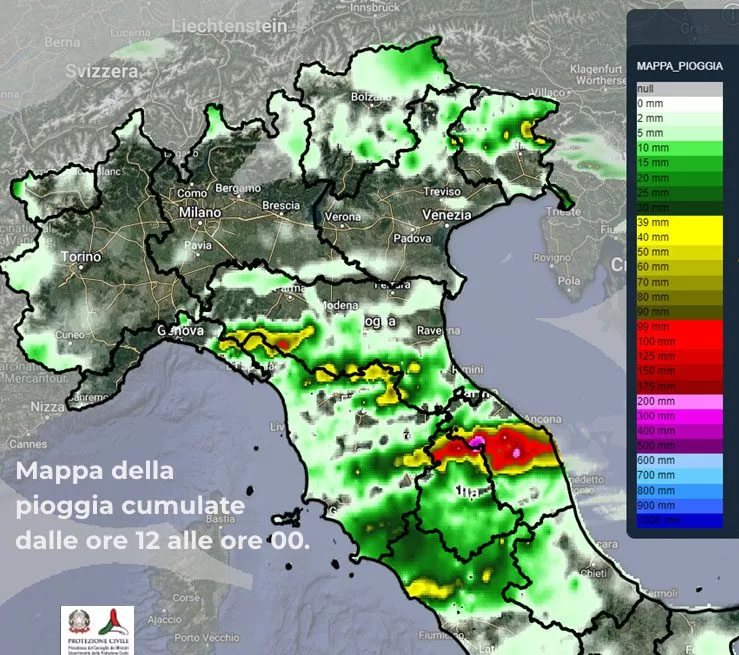
Between the late evening and the early hours of the night between 15 and 16 September 2022, the provinces of Ancona and Pesaro-Urbino were affected by a ‘self-regenerating’ thunderstorm structure. This is a thunderstorm phenomenon that is self-regenerating thanks to the clash between two air masses with different characteristics, one warm-humid, rich in water vapour, the other cooler and drier, whose convergence keeps the updraft, or convection, active. The clash resulted in precipitation of considerable intensity (a cloudburst), lasting over six hours with devastating consequences for the area.
Why was it so devastating?
Because of the ‘stationarity’ of the structure. The thunderstorm cells of which it is composed persist for several hours in the same area and then move very quickly only when the disturbance passes. Self-generating structures are not new in Italy, just remember the events in Genoa (2011 and 2014), the Cinque Terre (2011), Livorno (2017) and Val Bormida (2021), with consequences that we all still remember today.
Could the extreme event and its disastrous impact have been foreseen?
Unfortunately not. As LaMMA Consortium researcher Guido Betti also emphasized in an interview with la Repubblica, the predictability of these events, i.e. accurately predicting structure and intensity in advance, is still very low.
Moreover, hydrological models that use the quantitative precipitation forecasts provided by weather models did not show any particular hydraulic criticalities. No high flow values were forecast in any of the rivers in the Marche region, much less exceedances of the alert thresholds/let alone a passing of the alert levels.
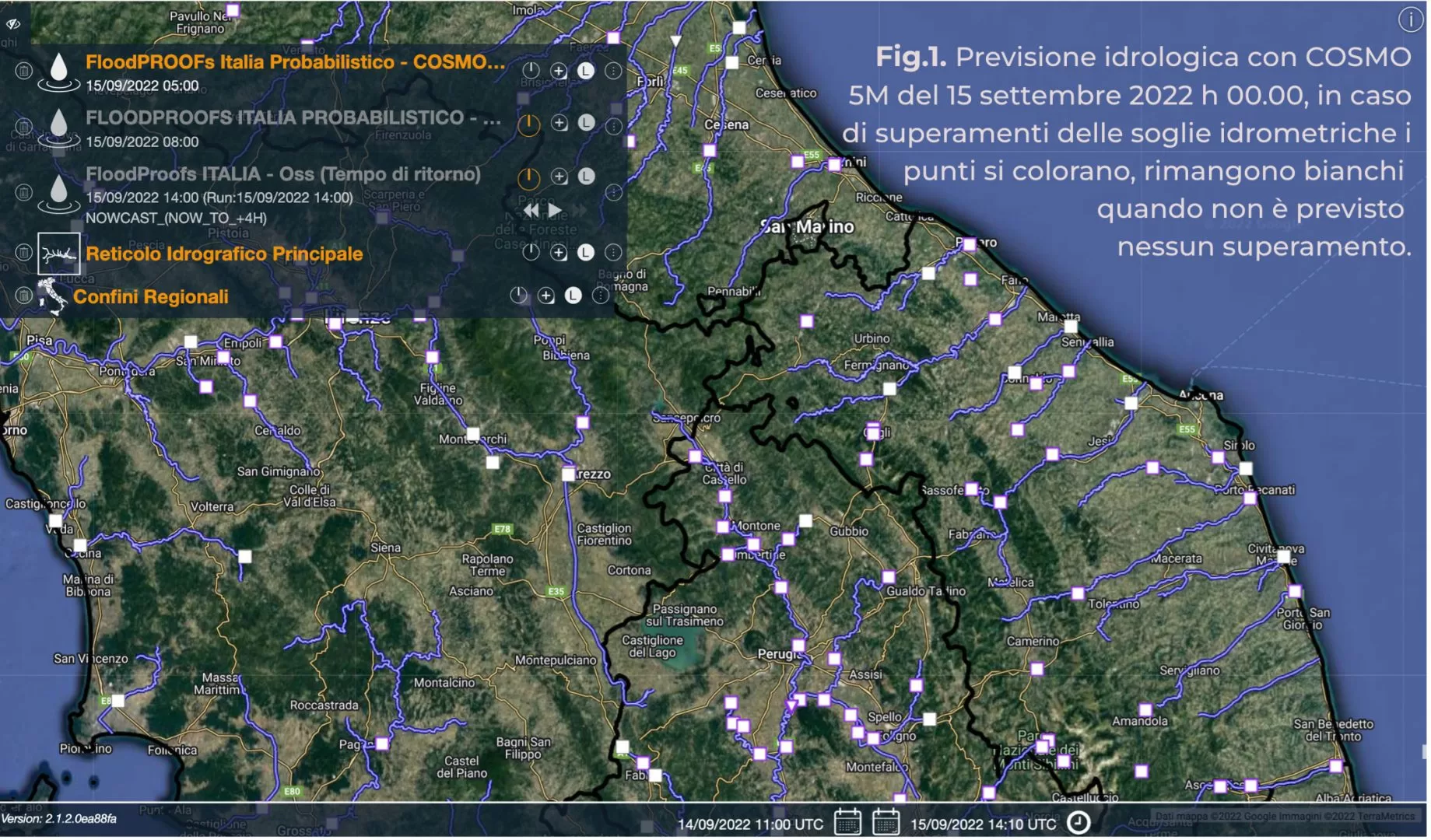
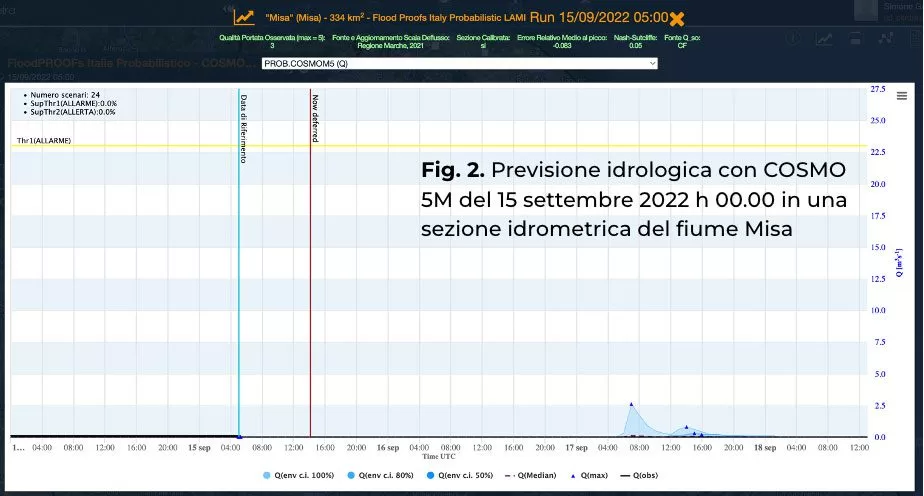
The amount of precipitation was expected to be low and, coming from a particularly hot and dry period, the soils were in a dry condition (Figure 3).
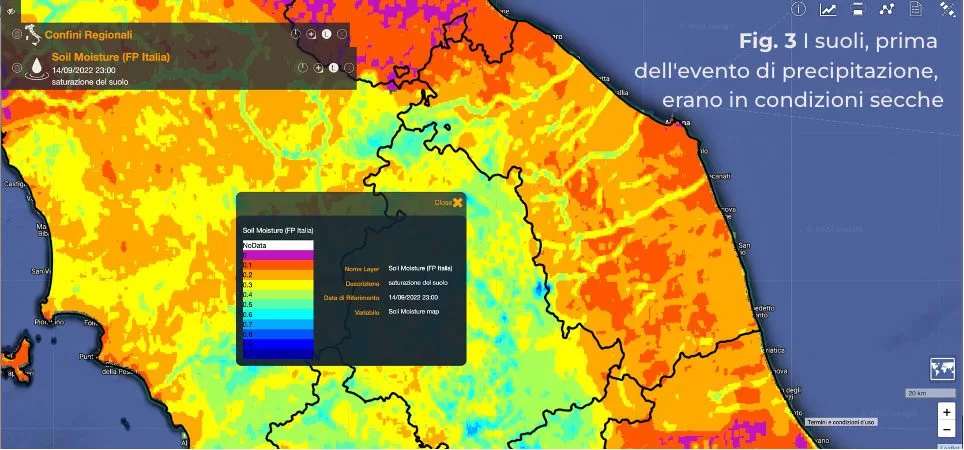
The event especially affected the basins of the Misa (approximately 350 km2), Esino (approximately 1000 km2), Cesano (approximately 400 km2) and Musone (approximately 640 km2).
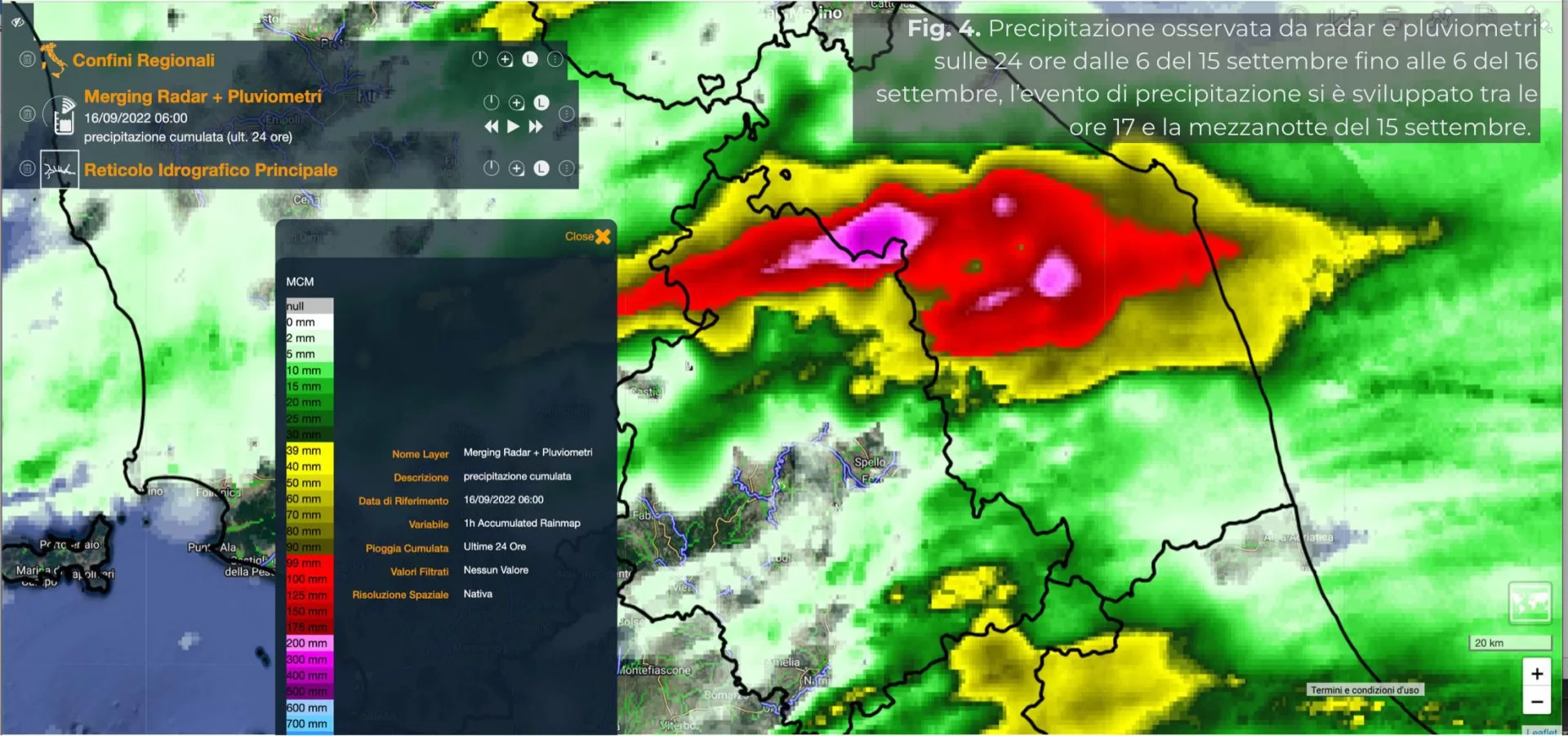
Figure 4 shows the precipitation that fell during the entire event between approximately 17.00 (5:00 pm) and midnight on 15 September.
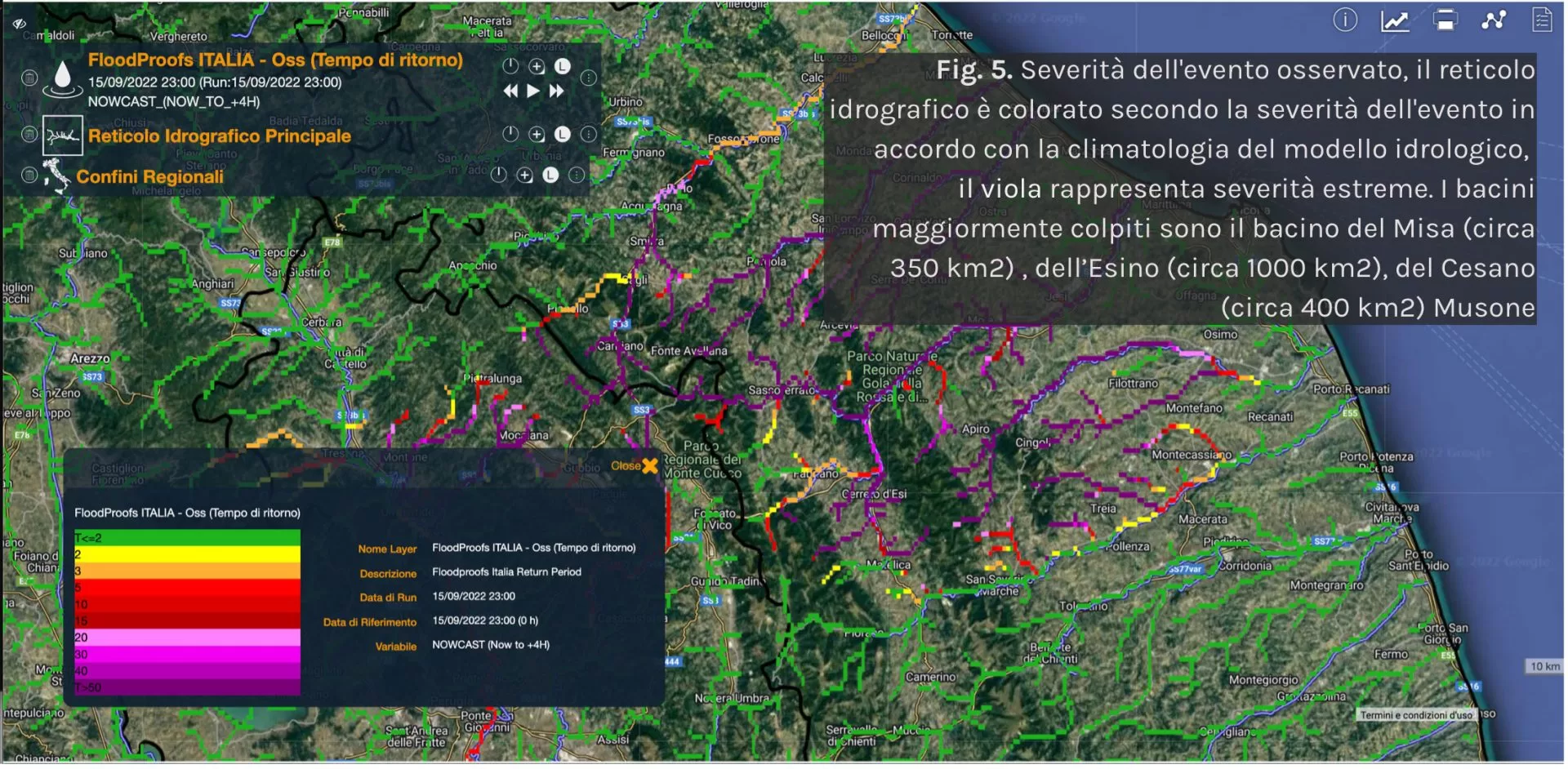
Figure 5 shows the severity of the event; the purple river stretches are those where modelled flows were the highest and most rarely observed by the model’s ten-year climatology.
Is climate change involved?
Yes, very much. The occurrence of these sudden and extreme events is closely linked to ongoing climate change, the consequences of which we have seen both in the lack of water and in its excessive abundance and violence, as in the Marche region.
For years, as researchers at CIMA Research Foundation, we have been dealing with these events by means of increasingly advanced computational models and data assimilation techniques (i.e. using information acquired from meteorological radars, to lightning strikes in order to improve their localization, albeit in the very short term). In addition, we study climate change and spread correct information and awareness through citizen science projects such as I-CHANGE or the national communication campaign Io non rischio promoted by the Italian Civil Protection Department.
(Images are processed by CIMA Research Foundation with DPC data)