Researchers of Wildfires Risk Management and Forest Conservation Department of CIMA Foundation analyze the causes that originated the devastating wild fires of the last days in Sicily
The devastating wildfires in July 2023 in Italy are due to the extreme weather conditions that affected the southern Mediterranean. During the period from July 18 to 26, in fact, the southern Mediterranean regions were subjected to extreme weather conditions that caused severe wildfires in Spain, Greece, Algeria, and the southern regions of Italy – in the worst cases leading to numerous casualties and tens of thousands of people evacuated. These conditions, which had already persisted for some time on the Iberian Peninsula, were established in the central-southern Mediterranean area at a later point compared to the typical fire seasonality in the region.
The early summer’s situation
After a long period of drought that characterized the fire seasons of 2021 and 2022, the entire area experienced heavy and frequent rainfall from April to June. In particular, in May, rainfall up to 4 times higher than the 1961-1990 climatological value was observed in Sicily (Figure 1).

Figure 1: Maps of cumulative precipitation anomaly in Italy for the past 4 months, compared with the 1961-1990 climatological value. Source: ISPRA. The analysis shows how, starting from a condition of monthly cumulative precipitation below the 1961-1990 average recorded in March, there has been a progressive change, with precipitation up to four times higher than the reference period for the months of May and June.
While southern Europe went through June with concern about the possible impacts of heavy rainfall, which unfortunately led to the floods in Emilia Romagna Region in Italy, northern Europe was characterized by particularly anomalous conditions for the period. Air temperatures were 10°C higher than the average for the period, and this resulted in an increase in forest fires. During the same period, the wildfires burned tens of thousands of square kilometers in Canada for weeks, under fire prone conditions similar to those in northern Europe.
This situation has been rapidly changing since the end of June, with an apparent return to normalcy in the northern belt of the Northern Hemisphere, accompanied by a significant increase in temperatures in the southern Mediterranean. In particular, air temperature and humidity conditions determine the so called fine fuel moisture content.. Fine fuel includes dry grass and shrubs we usually find at the roadsides, leaves, needles, and fallen branches on the ground that characterize forest litter. Such fuel acts like a sponge, capable of absorbing or releasing moisture depending on the surrounding weather conditions. In Fig.2 it can be seen that from mid-May to mid-June northern Europe and particularly the Scandinavian peninsula were characterized by fine fuel moisture content of less than 15 percent, with local drops even below 10 percent. These conditions facilitate the ignition and subsequent spread of fire. In the middle panel, corresponding to the period from mid-June to mid-July, a general increase in moisture content is observed, evident in the Scandinavian peninsula, and a decrease in it in the southern Mediterranean, in line with the summer season. Finally, persistent moisture patterns of less than 5 percent are observed during the period characterized by the catastrophic fires, particularly in the North African regions, Sicily, and the south-central part of the Iberian Peninsula.
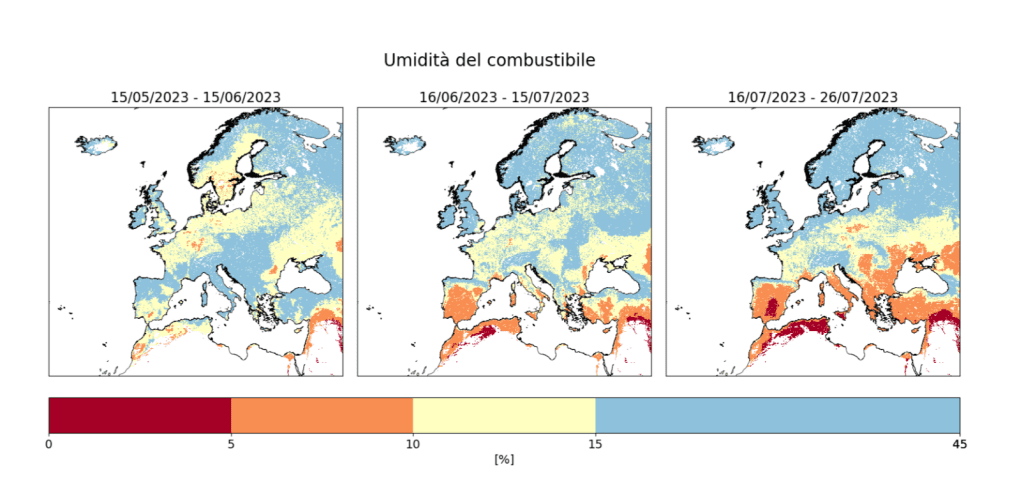
Figure 2: Fine fuel moisture (FFMC) maps averaged over the periods (left to right) 15 May – 15 June, 16 June -15Jjuly, and close to the peak of fires in Sicily (16Jjuly – 26 July). Source: RISICO model, CIMA Research Foundation processing. The figure shows that, in May, fuel moisture values locally around 10 percent were recorded in northern Europe, corresponding to conditions of high susceptibility to fire ignition and spread. During the same period, the Mediterranean, excluding the Iberian Peninsula, experienced conditions of higher fuel moisture. This condition was then reversed in July, with the establishment of particularly dry conditions and large areas of extremely low fuel moisture, with vast areas below 5 percent in the Mediterranean basin.
The anomalies described above are clearly visible in the Canadian FWI anomaly map produced by EFFIS for the day of June 15. Anomalies that tend to fade in the weeks to follow.
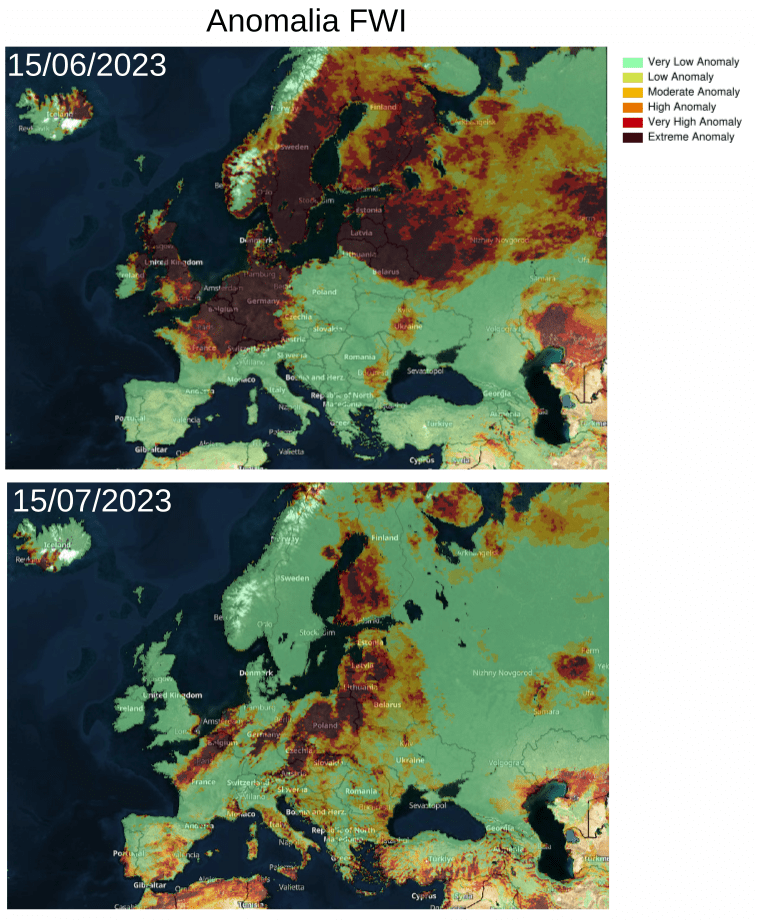
Figure 3: Fire Weather Index (FWI) anomaly compared to the 30-year average on June 15 and July 15. Source: EFFIS – European Forest Fire Information System. In the figure, it can be seen how northern Europe experienced anomalous conditions of FWI values. The FWI index is developed based on weather conditions to provide an indicator of forest fire danger. Those conditions changed in July, where locally anomalous FWI conditions were experienced in the Mediterranean.
Mid-July 2023: the “Perfect Storm” hits Sicily
Beginning in the second week of July, observations from the Palermo’s SIAS weather station show the establishment of a persistent heat wave that brought maximum temperatures above 30°C in the central hours of the day and minimum nighttime temperatures above 25°C (Figure 4). Beginning July 16, there was a steady intensification of the heat wave, which led to the rapid rise in temperatures, which reached highs above 45°C on July 24 with nighttime minimum temperatures around 35°C, a full 10°C higher than the previous night.
It is interesting to note that the heat wave was accompanied by air humidity conditions that fluctuated between 30 percent, observed in the central hours of the day, and 75 percent at night, except for a few sporadic and temporary events that brought the air humidity to values below 20 percent in the daytime hours always accompanied by an increase in the nighttime hours above 50 percent.
Beginning in the early morning of July 24, the relative air humidity reduced from 85 percent to 7 percent in less than three hours (second panel of Figure 4). These conditions remain quasi-persistent throughout July 24 and 25, returning to values above 75% during the night of July 26. The air humidity anomaly is associated with increased ventilation with a prevailing southerly direction and values between 5 and 12 m/s.
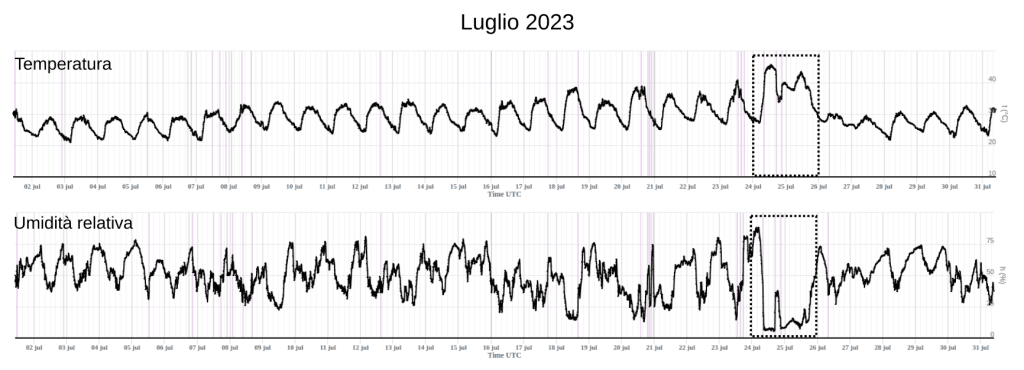
Figure 4: Temperature and relative humidity data from July 1, 2023 to July 31, 2023 recorded by the Palermo SIAS station. Source: RISICO Live network. The dashed boxes indicate the period from July 24 to July 26, 2023 (concurrent with the major fires in the Palermo area), where temperatures increase dramatically and relative humidity has a significant drop. Particularly noticeable is how relative humidity remains at very low values for at least two consecutive days.
This situation highlights how, even in the absence of prolonged drought conditions, localized extreme weather conditions, correctly predicted by weather models, can lead in a matter of hours to the disasters. This makes increasingly necessary to adjust the prevention and countermeasure system with respect to the weather conditions predicted and subsequently observed without necessarily associating the start of the fire season with a fixed calendar date.
Indeed, during the summer not every day, fortunately, leads to the ignition and subsequent spread of extreme fires, i.e., fires that far exceed our coping capacity. Such extreme events can generally occur only with the concomitance of several factors: 1) widespread presence of desiccated herbaceous vegetation or other fine fuels; 2) continuity of dense, particularly flammable plant fuel; 3) persistent air humidity of less than 30 percent, resulting in decreased moisture content of fine fuels. High temperatures further contribute to the reduction in the moisture content of fine dead fuels, but they are not necessary for the occurrence of extreme fires since the same moisture conditions are those that also characterize large fires in the winter season; 4) wind, like temperature, contributes to accelerating the dehydration of fuels and especially to increasing the rate of fire spread, making wildfires particularly difficult to control and limiting the use of aerial means. However, under conditions of extreme dryness, fire energy is able to fuel convective phenomena capable of creating local conditions favorable for fire propagation and extreme behavior. This occurs in the presence of high and particularly flammable masses of fuels.
The conditions listed above are those found in the case of the fires that affected Sicily between July 24 and 26.
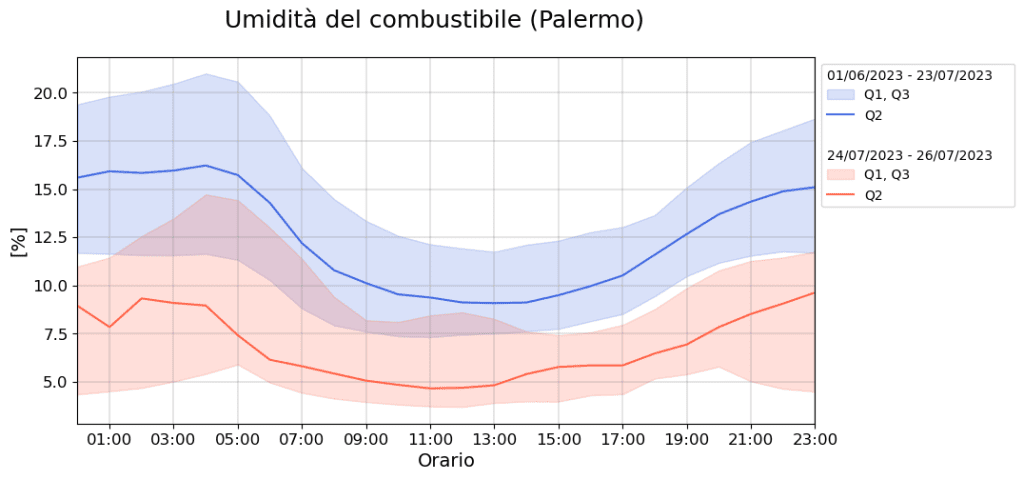
Figure 5: Hourly averages of fine fuel moisture obtained from all RISICO Live network stations located within 20 km of Palermo from June to July 26. The blue graph represents an average from June 1 to July 23, while the red graph represents the average of days 24-26. It is evident from the graph how days 24-26 constitute a major deviation from the trends of the previous days.
These conditions can be observed objectively using the available data. The transformation of meteorological information into the parameters that can describe potential fire behavior, integrating information on vegetation and slope and exposure, allows for objective analysis of what happened, both “in forecast,” i.e., using forecasts from weather models, and “in real time,” using weather data available from sensor network, which are processed by the RISICO model developed by CIMA Research Foundation.
The fine dead fuel moisture map, predicted from the July 23 run (Figure 6), shows a drastic drop in the fine fuel moisture content. This is particularly evident on the day of the 24th, in an already alarming overall picture which saw the entire island below the 10 percent threshold.
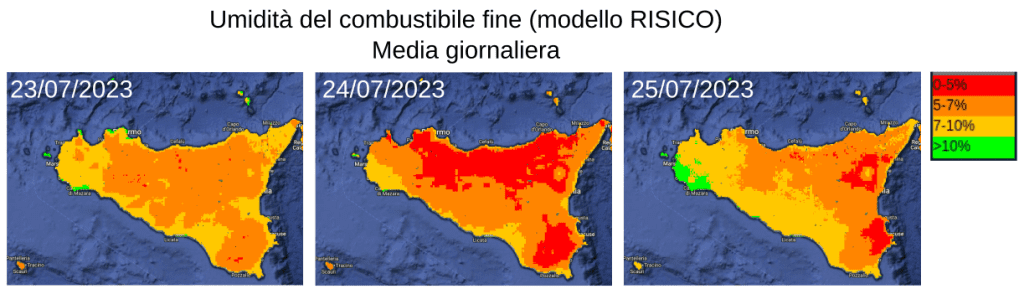
Figure 6: Daily average fuel moisture from RISICO model in Sicily, on the days of July 23-25.
Turning to real-time monitoring, Figure 7 shows that on the day of July 24, for data obtained from the “Rete Fiduciaria Nazionale” weather stations network, almost all stations in Sicily witnessed moisture conditions below the critical threshold of 12 percent, with many of them dropping below the 5 percent threshold. Similar conditions also affected the region of Sardinia and other southern regions.
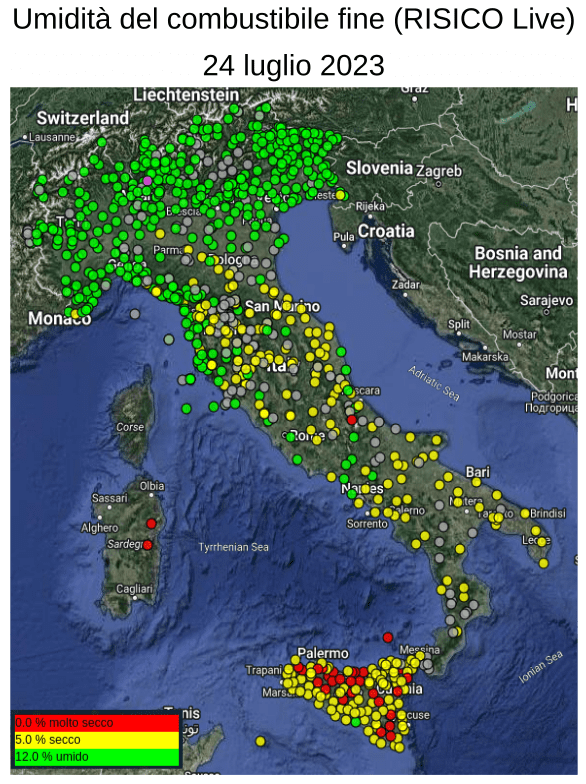
Figure 7: Hazard levels processed by the RISICO Live model. Each weather station is colored according to its modeled fuel moisture value (daily average) on the day of July 24. It can be seen that for that day Sicily is characterized by extremely dry fuel conditions.
Focusing on a single weather station, Figure 8 shows instead how, using data from the Palermo SIAS station, the days from July 24 to July 26 are characterized by extreme values of potential rate of spread (that is, potential speed of the fire front).
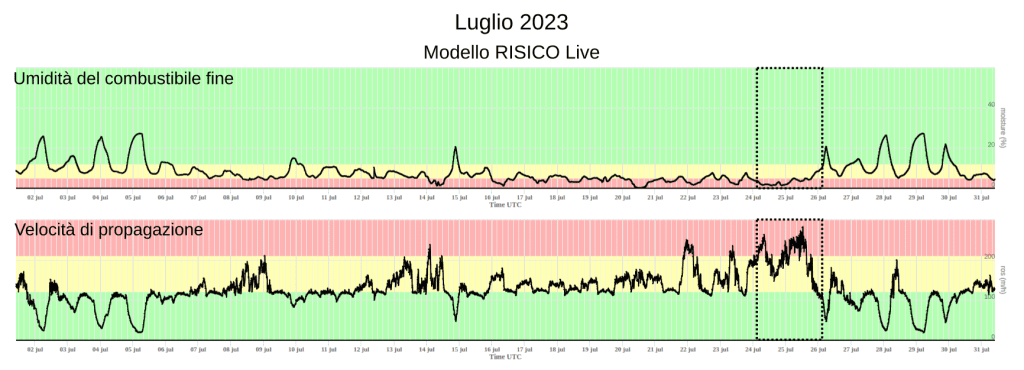
Figure 8: RISICO Live model outputs, obtained by processing “live” data from the Palermo SIAS weather station from July 2023 to July 31, 2023. The two outputs of the RISICO model, in the RISICO Live approach, are not obtained from weather forecasts, but rather using the real time data collected from the weather station. The two outputs represented are: fine fuel moisture (top panel, [%]), and potential rate of spread (bottom panel, [m/[m/h]h]). The dashed boxes indicate the period from July 24 to July 26, 2023 (concurrent with the major fires in the Palermo area). In this time window, fine fuel moisture remains below the critical threshold of 5 percent, and wind conditions result in two peaks in the potential rate of spread of the flame front, which remains above the critical threshold for almost all of the days examined. The time window analyzed thus presents very favorable conditions for both ignition (top panel) and rapid propagation of already ignited fires (bottom panel).
Regarding the status of vegetation fuels, the use of vegetation indices obtained from the Sentinel 2 satellite allows us to observe how the rainfall that affected Sicily in the April-June period favored the accumulation of herbaceous vegetation. This underwent a process of desiccation following the establishment in July of weather conditions typical of the summer season. Such herbaceous vegetation became soon fine fuel available for fire ignition and propagation (Figure 9).
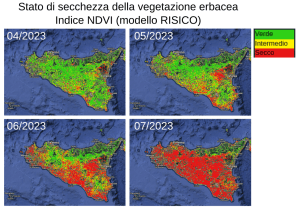
Figure 9: NDVI index from RISICO model (obtained by processing the Normalized Difference Vegetation Index provided by Sentinel II) using the last available survey at the end of April, May, June and July, respectively. This index allows monitoring the status of live herbaceous vegetation. It is observed that much of the herbaceous vegetation in Sicily, flourishing in April and May, is now dry by late July.
The prevalence of dry fine fuel, which naturally adjusts its moisture content to match the relative humidity of the air, results in a widespread rise in the likelihood of ignition, whether it occurs intentionally or due to carelessness and a lack of awareness in fire use.
Under the conditions described above, even the smallest ignition can trigger a fire that spreads rapidly and devours any patch of vegetation fuel, reaching intensities so high as to exceed extinguishing capacity.
The need to prevent, in the short and long term
To prevent the extreme fires we have recently observed, it is essential to increase awareness of the associated risks and take appropriate prevention measures. We must learn to recognize the days in which any source of energy in the presence of fine and particularly flammable fuels can quickly trigger a fire capable of reaching the canopies of Mediterranean pines and other particularly flammable tree species. For example, we favored eucalyptus as the species best adapted to the hot and arid environments of the Mediterranean, disfavoring instead the forests of oaks and other broadleaf trees that in the absence of external disturbances would cover almost the entire territory. The immediately feasible solution is to establish protocols capable, when necessary, of enhancing all communication and monitoring activities, limiting the ignitions causes as much as possible, and preparing the fire response system, reducing the response time in case of newly reported fires thanks also to a clever pre-positioning of resources.
However, addressing the long-term issue, given the evident impacts of climate change, necessitates landscape planning. We need to encourage the development of more resilient forests and design our urban fabric in such a way that it can be harmoniously integrated with the surrounding rural and natural environment. This would not only reduce the negative impacts of wildfires but would generally increase the quality of life in our settlements that are often exposed to solar radiation resulting in higher temperatures.
Furthermore, it is of utmost importance to give priority to planning in the so-called wild land-urban interfaces, as they are especially susceptible to fires, and where fire outbreaks can result in loss of lives. We cannot wait for more tragedies to occur; it is urgent to act now to prevent future disasters.