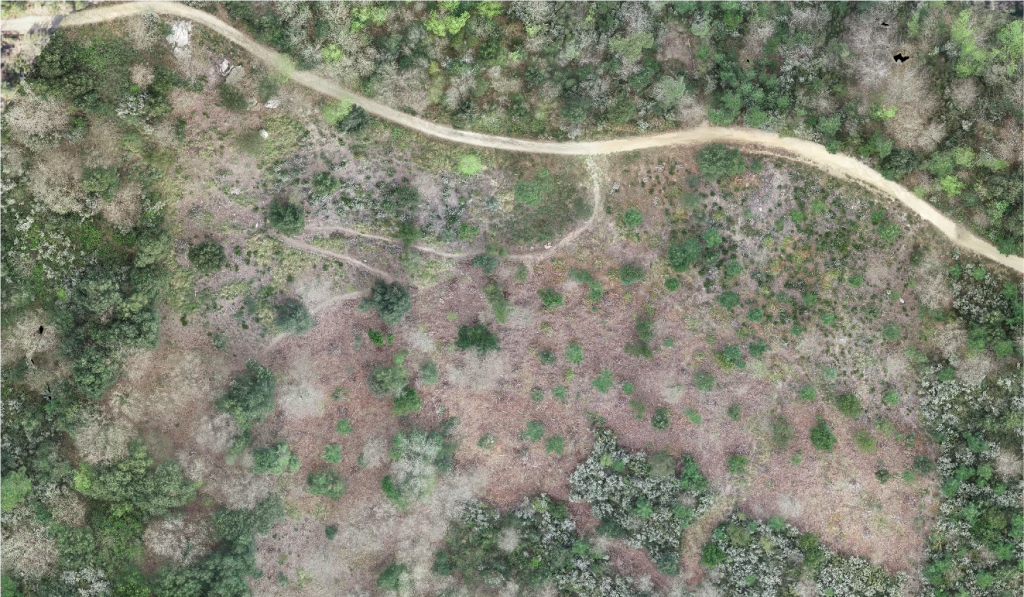
Resilience to natural disasters requires not only limiting immediate damage but also building long-term strategies. This process involves various elements. Taking as an example our work on wildfires in Liguria, we discuss it with Paolo Fiorucci, Associate Director at CIMA Research Foundation
Withstanding, adapting, and recovering from adverse events such as floods, wildfires, and droughts—this is, in a nutshell, the concept of resilience to natural disasters. On the International Day for Disaster Risk Reduction, we want to delve into this concept.
The term resilience is now very popular, almost omnipresent when discussing climate crises, disasters, and environmental damage. Still, understanding what it concretely requires can be more challenging. Resilience has a peculiar feature: it takes time to build. The actions that foster its development (in a given area or community, large or small) often have deep roots that may not be immediately visible. It requires not only limiting the immediate damage of a disaster but also constructing long-term strategies through interventions on various levels—from the technological and physical, such as land management, to the social, which involves informing and enhancing the response capacities of a population.
In short, resilience is not (only) a goal but also a process. A process that should be developed as much as possible during “peace times,” rather than during an emergency phase. Unfortunately, this clashes with the urgency posed by climate change, whose effects are not only imminent but already present.
Wildfires in Liguria: history and science
For CIMA Research Foundation, contributing to the development and strengthening of resilience in the areas where we work is a continuous commitment that permeates many of our national and international projects. It is an ongoing effort, though in some cases, it has yielded significant results. One example comes from the work on wildfires in Liguria, the Region that hosts our headquarters and is among our founding members. Until around the 1960s, forests and mountain areas were populated and active: livestock farming, crop cultivation (especially chestnuts), and wood harvesting were common. When the population moved to urban areas, many small villages in the hinterland became “ghost towns,” and the forests were left untended; vegetation began to thrive.
“Liguria has become one of the most forested regions in Italy. But more forests also mean more fuel: starting in the 1970s, wildfires became more frequent and widespread. It’s no coincidence that Liguria was one of the first Italian regions to adopt a wildfire management plan—the first one dates back to 1975,” explains Paolo Fiorucci, Associate Director of the Emergent Nexus: Risk Resilience, Biodiversity and Ecosystem Functioning program at CIMA Research Foundation. “In the late 1990s, the Region also asked the University of Genoa to develop a model for predicting wildfires; a few years later, this led to the research activities of CIMA Research Foundation (which was then an inter-university center affiliated with the University of Genoa).”
From a technological standpoint, the research has led to the development of two different models over the years: RISICO, which assesses the likelihood of a wildfire ignition based on environmental conditions, and PROPAGATOR, which simulates fire spread in both space and time. Operationally, the research has led to the daily publication of the SPIRL bulletin (Wildfire Prediction Service for Liguria Region), which provides a fire danger index based on meteorological, topographical, and vegetation conditions. “Based on this information, institutions have been able to implement a series of prevention and preparedness actions, primarily patrolling high-risk areas,” says Fiorucci. “For the operational structures responsible for managing wildfire risk, which in Liguria is delegated to the Vigili del Fuoco (National Fire Brigade), a synthetic and easy-to-interpret index (the percentage of municipalities within a province that exceed the danger threshold) has been developed. This index determines whether to activate the preparedness phase, meaning to have equipment and personnel ready to intervene in case of a reported ignition on a particularly critical day. This is crucial because if the territory is prepared to intervene, the fire spread can be managed efficiently. Failing to act immediately could result in one or more fire fronts spreading for hundreds of meters, complicating firefighting efforts.”
The contribution of these research and operational activities is evident in the data collected over the years, which clearly show a significant reduction in the burned areas from the late 1990s to today, especially in the last decade. Scientific advancements have also made risk models increasingly reliable: satellite images, better-quality ground observations, richer and more complete data, and the recent use of artificial intelligence techniques have all contributed to improving their reliability.
A success but also a process
However, as mentioned, resilience is a process, and even in Liguria, it cannot be considered complete. “The research results and their use in decision-making processes by the relevant institutions have had a significant effect on reducing the impacts of wildfires. However, they have not yet reduced their danger,” comments Fiorucci. What does this mean? The danger of wildfires is still a constant in the area, and the reason is simple: the vegetation that burns is restored with the same species as before, some of which are highly vulnerable to fire. This is the case with pine forests, largely of anthropogenic origin, planted in the last century to increase forest cover for various reasons, including reducing hydrogeological risk. Whenever human intervention interferes with natural processes, which occur over long timeframes, it is essential to understand the long-term effects, including any disturbances—in this case, fire ignition. Pine forests’ resilience to wildfires, allowing them to regenerate abundantly after a fire, guarantees forest cover restoration but also maintains a high risk of fire. It is also important to consider that if fires occur frequently in the same area, they can greatly reduce the ability of the forest to regenerate, significantly impacting hydrogeological risk. On the other hand, the vast majority of broad-leaved trees, both evergreen and deciduous, which could occupy much of the regional territory (with the exception of some particularly selective soils), would, over time, lead to a reduction in fire susceptibility and create a more resilient territory.
“For this reason, the process of building wildfire resilience must now also focus on a careful analysis of the territory, identifying priority areas for intervention, and planning, with the support of research, the correct evolution of vegetation cover, without neglecting the impacts of ongoing climate change. A first pilot project carried out in the Municipality of Spotorno starting in 2019 is already demonstrating the effectiveness of this type of intervention and can provide all the necessary information to make it replicable and extendable to other areas. Moreover, it is important to strengthen risk communication to the population because increasing societal engagement and information is another crucial element for building real resilience. Some research projects that will be launched in the coming months will include actions aimed at achieving this goal,” concludes Fiorucci. “This process, to which scientific research can make a significant contribution, cannot be built overnight. What is certain is that our commitment must be constant and concrete in order to tackle today’s risks and mitigate those of tomorrow.”