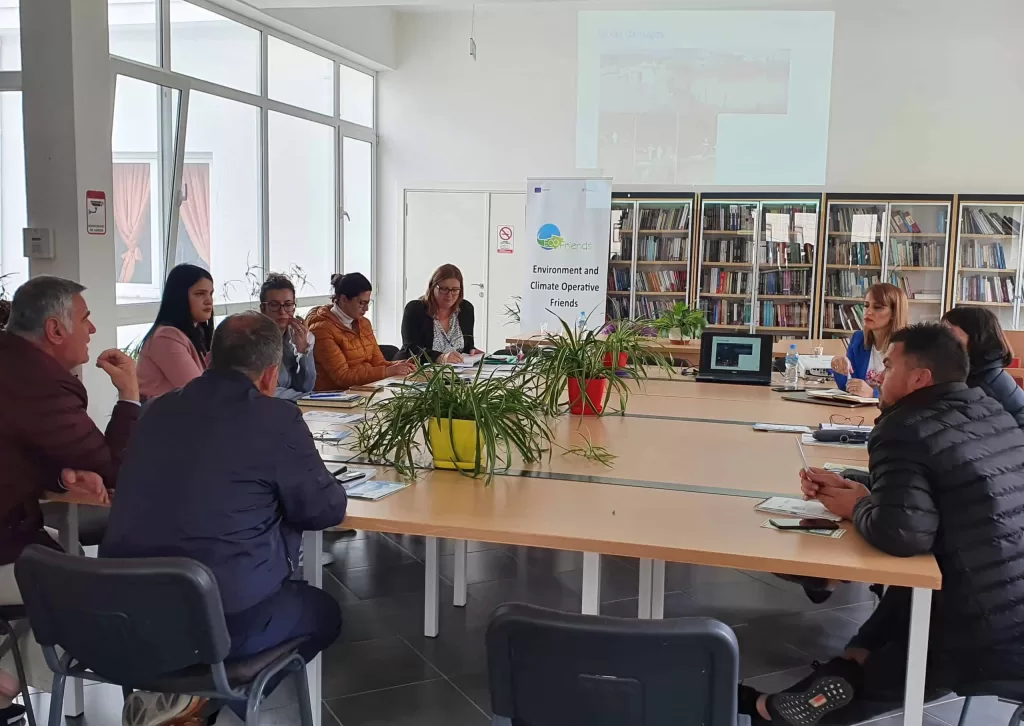
We interviewed Rozeta Gradeci, Country Representative for COSPE Albania, to tell us about some of the most important aspects of the ECO FRIENDS project, which aims to build the country’s resilience by working on dialogue between institutions and civil society organizations
An inclusive dialogue on climate change, allowing a direct confrontation and mutual enrichment between civil society organizations, citizens and institutions: this is the aim of ECO FRIENDS, a project carried out in Albania by NGO Cooperation for the Development of Emerging Countries (Cooperazione per lo Sviluppo dei Paesi Emergenti, COSPE) and which sees among its partners CIMA Research Foundation. Funded by the program IPA II – European Union Integration Facility 2017 and started in March last year, ECO FRIENDS provides training and consultation tables that allow both the transmission of knowledge and the possibility of comparison and direct exchange between the various actors involved.
Recently, the first consultation tables have been held in the municipalities of Skrapar, Berat, Kucove and Dimal. We took the opportunity to ask a few questions to Rozeta Gradeci, Country Representative for COSPE Albania, and with whom we collaborate in the activities of the project.
What is the origin of the ECO FRIENDS project?
In Albania, the issue of climate change has been addressed only relatively recently. In fact, although the country has had a number of international conventions since the mid-1990s, the Climate Change National Strategy only arrived in 2019 – and only since 2020 has it been law. This means that there is a great need to deepen the issue, raise awareness among citizens and carry out training activities for operators in the sector; this is also because the country is vulnerable to many risks that are influenced by climate change, such as floods and fires.
ECO FRIENDS has among its primary objectives to create a network between civil and social organizations, and to encourage dialogue with institutions: why was it chosen to focus the project on this objective? And what activities are planned to achieve it?
The basic idea is that citizen participation is fundamental to make the policies implemented by a country effective, because the citizens themselves can encourage and implement them. In the same way, trust between civil society organizations and institutions is fundamental, allowing for the creation of the necessary conditions to cooperate towards a goal – in this case, that of creating resilience to the effects of climate change.
It is for this reason that “dialogue and confrontation” are the two key words of the project, and it is also for this reason that we have chosen to work by creating moments that favor them: this is the case of the consultation tables, which bring together representatives of different realities for a direct confrontation on issues related to climate change. The results of these tables, which have been and will be held with the collaboration of CIMA Foundation, will be brought, at the end of the project, to a national table attended by all major Albanian institutions.
To these moments are added training courses, not only addressed to institutions and civil society but also specific for technicians. During these meetings, various themes are explored, from those related to scientific knowledge on the effects of climate change to those of participatory democracy. Moreover, as far as the training for technicians is concerned, the trainings will allow them to learn more about the standards adopted by the European Union, in order to strengthen their knowledge in this field and allow Albania to move in this direction.
Why did you choose to involve CIMA Research Foundation in the project?
Collaboration is always the most important element for the success of projects: in the case of CIMA Research Foundation, the expertise in risk reduction and the experience gained during the projects already carried out in the country (such as PRO NEWS and FLORIS) represent an important contribution both in terms of scientific knowledge and for the possibility to broaden the dialogue, involving the institutions with which CIMA has already dealt in the past. This represents a double enrichment: for COSPE, more accustomed to working with society, it is a support in the involvement of institutions; for CIMA, that in international projects has worked mainly with the latter, it is a way to work also at the level of civil society organizations.
What are the most interesting aspects that are emerging from the moments of confrontation and dialogue?
Working at the level of the municipalities allows us to deal with smaller realities, and thus have a more “detailed” vision than if we worked at the level of the prefecture. It has thus become evident that each reality feels certain problems more than others, from the risk of fire in some areas to the problems linked to financing in others, from training to the problems linked to deforestation. And it’s very important for us to be able to give back to the national table a complete panorama. In general, moreover, we have observed with great pleasure that these moments are welcomed with great interest and participation: it means that the reality of climate change, which in Albania is often perceived as unrelated to everyday life, is instead a source of great interest and need for deepening – and we hope that, with ECO FRIENDS, we can meet this need.