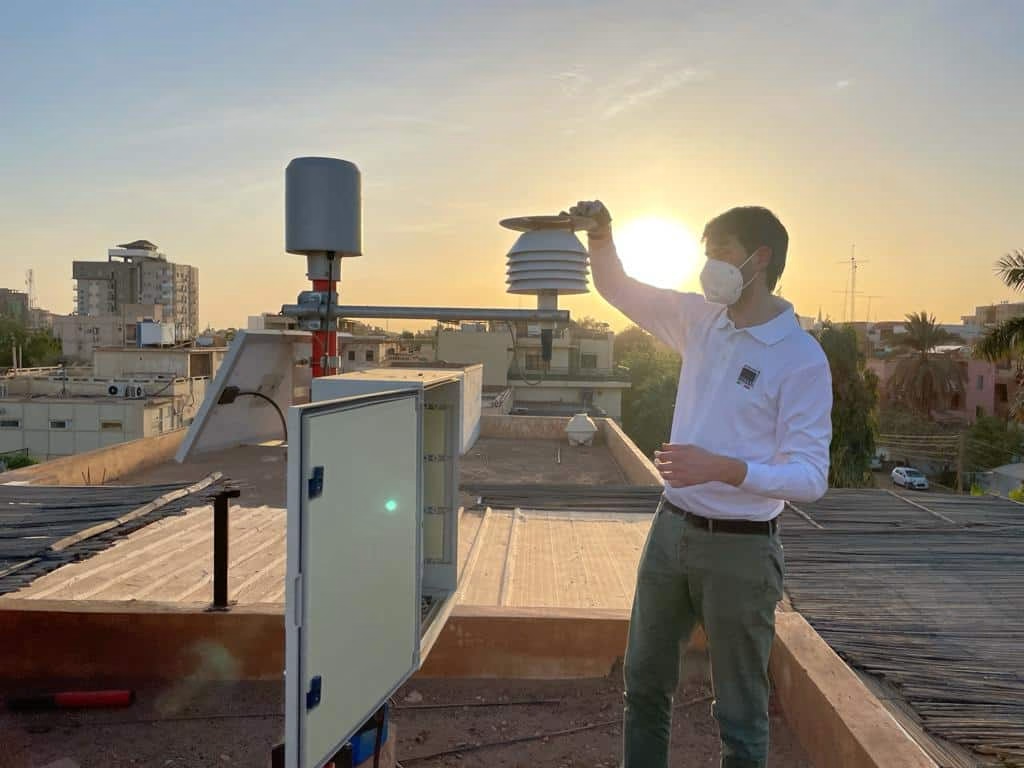
Environmental monitoring is undergoing a significant evolution, driven by increasingly advanced technologies capable of collecting, processing, and transmitting real-time data. However, access to adequate instrumentation that meets professional standards is often beyond reach for small local administrations and the National Civil Protection Systems of emerging economies. In this context, Fondazione CIMA has been developing the ACRONET paradigm for years—a project designed to create and globally disseminate open-hardware environmental monitoring and control systems. By eliminating copyright restrictions, this approach enables real-time data collection with high reliability and precision at reduced costs.
Thanks to its modular and scalable architecture, ACRONET offers a range of specialized configurations tailored to address specific challenges and meet the most common needs. From rainfall height to hydrometric levels, wind speed to air temperature: ACRONET monitoring stations collect and transmit real-time data, providing crucial information for understanding natural phenomena and managing risk.
A recent scientific paper, co-authored by our Program Director Cosimo Versace, has reassessed the history of environmental parameter observation, analyzing the availability and quality of global-scale rainfall measurements. The challenges and opportunities outlined in the study confirm the importance of advanced technological solutions in addressing the complexities associated with hydrometeorological data collection and analysis.
Rainfall analysis and resilience in environmental monitoring
The paper A reassessment of the history of the temporal resolution of rainfall data at the global scale, recently published in the Journal of Hydrology, provides an overview of the historical and technical evolution of rainfall data temporal resolution, highlighting the crucial role of measurement quality in effective hydrogeological risk management. Within this framework, ACRONET represents a concrete example of how open-hardware systems can meet these needs through an advanced and adaptable infrastructure. Key aspects explored include data collection optimization, integration with predictive models, and the reliability of sensor networks. These themes are also central to ACRONET’s evolution, positioning it as a highly specialized infrastructure for hydrometeorological monitoring.
The quality of rainfall records is particularly relevant for improving forecasting and early warning systems. The ACRONET monitoring network, for instance, includes 174 rain gauges distributed across the national territory, with data series ranging from a minimum of 2 years to a maximum of 13 years, covering the period from 2012 to 2024 and offering a time resolution as fine as one minute. This level of detail has enhanced the analysis of extreme meteorological phenomena, improving forecasting capacity and emergency management.
One of the most significant findings from recent analyses is the spatial and temporal variability of precipitation, a critical factor for calibrating hydrological models. High-resolution data availability reduces uncertainties in river flow estimates and hydrogeological risk assessments. In this context, ACRONET does not merely collect data but also integrates advanced algorithms for quality control and measurement validation, ensuring scientifically robust and reliable information. “Scientific research continuously enhances environmental monitoring systems,” says Cosimo Versace. “ACRONET was created to translate these advancements into concrete applications, supporting those who manage risk in the field.”
An advanced infrastructure for prevention
While the innovations discussed in the study represent a step forward in defining new observational models, ACRONET embodies their practical application. This modular and scalable architecture has been developed to collect and transmit real-time hydrometeorological data, significantly improving emergency response capabilities.
Thanks to continuous technological advancements, ACRONET ensures stable data transmission even in complex scenarios. The stations are designed to provide reliable operational continuity through integrated battery and solar panel power supply, while data transmission occurs via GPRS or LTE mobile networks. “One of our main objectives is to reduce uncertainty in environmental measurements,” emphasizes Versace. “With ACRONET, we work to ensure accurate and timely data, essential for decision-making in emergency situations.”
A global paradigm for monitoring and risk management
The ACRONET paradigm is not limited to the Italian context but is an integral part of numerous Fondazione CIMA projects worldwide. Thanks to its flexibility and scalability, ACRONET’s architecture has been adapted to diverse territorial contexts to support monitoring and risk management strategies on an international scale, contributing to the global initiative Early Warnings for All (EW4ALL). Through its advanced infrastructure, ACRONET enhances early warning and disaster response capabilities by integrating hydrometeorological monitoring data with predictive models. This approach strengthens the ability to anticipate extreme events and improve mitigation strategies on a global level.
ACRONET has already been successfully implemented in several international projects by Fondazione CIMA. Among these is the Contribution to the improvement of the Integrated Water Resources Management (IWRM) for the Webi Shebele, Awash, and Danakil Hydrographic Basins in Ethiopia, where Fondazione CIMA supports a range of interventions integrated across the entire hydrological cycle. This includes modernizing the hydro-meteorological observation network through the installation of ACRONET stations and training personnel responsible for maintenance, alongside the development of a hydrological modeling and forecasting system to enhance water resource planning.
Similarly, in Sudan, within the APIS – Combating Climate Change: Flood and Drought Early Warning and Civil Protection in Sudan project, funded by the Italian Agency for Development Cooperation, an ACRONET network has been implemented. Meteorological stations shipped to Port Sudan and installed in collaboration with the National Civil Protection Council (NCCD) and the Sudan Meteorological Authority are positioned at the Port Sudan civil airport and in the towns of Tokar and Shendi. Thanks to these installations, the national early warning system can now monitor critical environmental variables such as rainfall, temperature, and relative humidity in real time, strengthening the country’s response capacity to climate-related emergencies.
These projects demonstrate how ACRONET’s architecture can be adapted to diverse geographic and climatic contexts, ensuring reliable and timely data for risk management. “Innovation is a continuous process, and our goal is to make ACRONET increasingly effective in supporting risk management,” concludes Versace. “We are exploring new solutions to further optimize the architecture and ensure that every collected data point is used as efficiently as possible.”