Italy Snow Updates
CIMA Research Foundation carries out constant monitoring of snowfall data on Italian mountains.
On this page, we collect key data, which provide a picture of snowfall in Italy during the winter, crucial for an estimate of the water resources that will be available in the spring and summer months.
SWE - Snow Water Volume
The Snow Water Equivalent (SWE) is a measure that represents the amount of water that could be obtained from snow if it was completely melted. It is calculated by multiplying the snow depth by its density and is expressed in millimeters of water equivalent, or in kg/m2. For example, an SWE of 100 mm indicates that melting that amount of snow would result in 100 kg (or 100 l) of water per m2. Monitoring SWE allows for predicting the snow’s contribution to spring runoff, estimating available water reserves for the warmer months, and preventing potential flooding in rivers. It is also an essential tool for the sustainable management of water in mountainous regions, where snow represents a key storage.
SWE - mean anomaly by elevation
< -50%
-50% / -5%
-5% / +5%
+5% / +50%
> +50%
These data indicate the percentage deviation of SWE compared to the average from 2011, analyzed as a function of elevation. In other words, this data allows for comparing the amount of water contained in the snowpack across different altitude ranges with historical average values, highlighting specific anomalous variations at certain altitudes. A positive anomaly indicates that the snowpack at a particular elevation contains more water than usual, while a negative anomaly signals less water. Italian mountains have long shown negative anomalies at lower elevations, a phenomenon correlated with rising temperatures due to climate change.
Temperature anomaly
The temperature anomaly represents the deviation of the observed temperature over a certain period from a reference value or long-term climate average. In our case, a positive anomaly indicates that temperature for a given month was higher than the historical average for that month, while a negative anomaly signifies a lower-than-normal temperature. This is a parameter used to monitor and quantify climate changes over time, particularly relevant today to understand global warming and its effects on both regional and global scales.
Precipitation anomaly
Similarly, a precipitation anomaly is the difference between the amount of precipitation recorded over a specific period and the long-term climatic average. It is a key parameter for analyzing phenomena such as drought and provides essential information for water resource management and agricultural planning. It is also crucial for studying climate change and its impact on natural and human systems.
SWE - Rivers
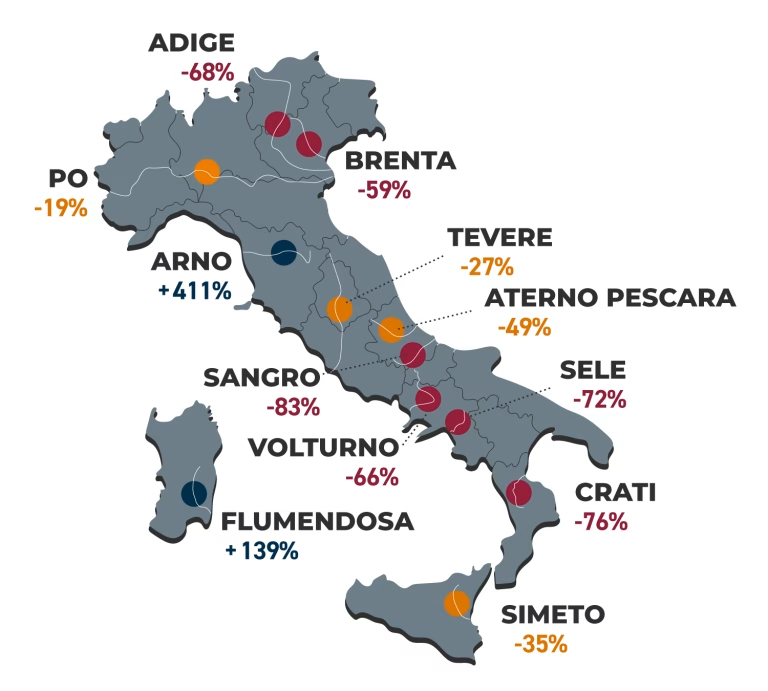
< -50%
-50% / -5%
-5% / +5%
+5% / +50%
> +50%
Focusing on watersheds, SWE is an excellent measure of the amount of water potentially available in the basin from accumulated snow. The Po, Adige, Tiber, and Aterno-Pescara rivers flow through regions characterized by different climates and specific hydrological dynamics, although they share a dependence on glaciers and mountain basins that release crucial water in the spring for agricultural irrigation, water supply, and hydroelectric power generation. Monitoring the SWE of the Po is particularly important, as its basin is the largest in Italy and plays a crucial role in sustaining vast agricultural and urban areas.