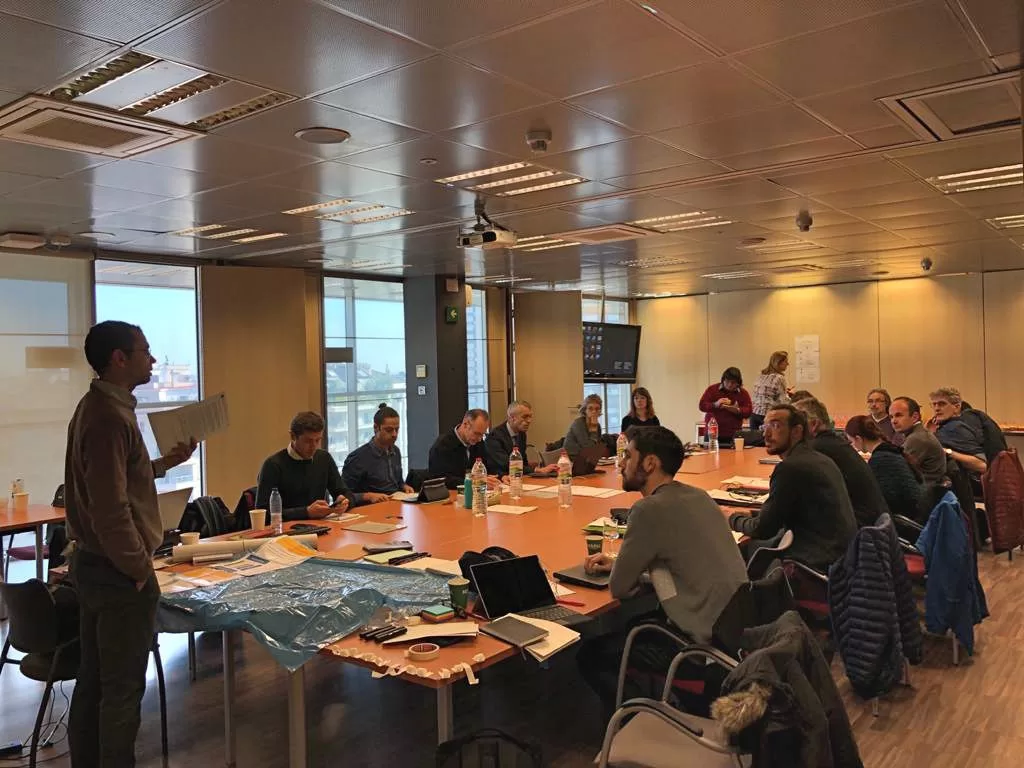
International experts and researchers met at the end of February to establish the necessary steps to address the challenge of the impact of climate change on natural hazards
At the end of February the opening meeting of the RECIPE project and its first technical workshop took place in Barcelona. The latter, the first of the three foreseen by the project, looked to define, within the partnership, a common methodological basis to analyze and frame the problems that the project will need to face in a shared and coherent way, in order to strengthen the tools of the civil protection system while taking into account the potential impacts of climate change.
In fact, risk management becomes particularly complex when the possible effects of climate change are considered, since they can lead to more uncertain and more impactful scenarios. In order to establish a more effective management of risk, an integrated approach is therefore necessary that brings together scientific and operational experts who are able to deal with a common vocabulary and methodology of analysis. For this reason, the two days of workshops have seen together technicians and researchers from the project partner institutions, but also international experts, invited to address the issue of how climate change can affect the risk arising from different natural phenomena (fires, floods, avalanches, storms and landslides).
The workshop wanted in a first phase to analyze some ad hoc selected case studies, methodologies, and operational tools allowing to work for an integrated prevention-preparedness-response approach in disaster risk reduction strategies. In this context, the RISKPLAN , a planning tool developed by the Forest Research Institute Baden-Wuerttemberg, one of the project partners, was presented for integrated risk management.
The following session was about the discussion related to the approach to be used within the project, also through the contribution of external experts.
During the last session of this first workshop, the operational tools to be developed at pilot site level were presented and discussed in order to highlight the synergies between the different tools, working from the beginning in a coordinated and inter-disciplinary way, a particularly important aspect to working in a multi-risk perspective.
The workshop marked an important moment for the start of the work that will be carried out by the partners in the coming months (the end of the project is scheduled for November 2021). CIMA Research Foundation, in particular, will be in charge of building the guidelines for civil protection planning on fire and flood risk, through the realization of a participatory civil protection-planning path. Moreover, CIMA Research Foundation will analyze some events considered extraordinary and multi-risk to, together with national, regional and local stakeholders, identify civil protection needs.
During the months of project work it will then be necessary to understand how integrated approaches can fit into risk reduction strategies, and to identify the requirements for civil protection to address the effects of climate change on different natural hazards.
To learn more: https://recipe.ctfc.cat/1st-workshop-a-common-understanding-of-risk/