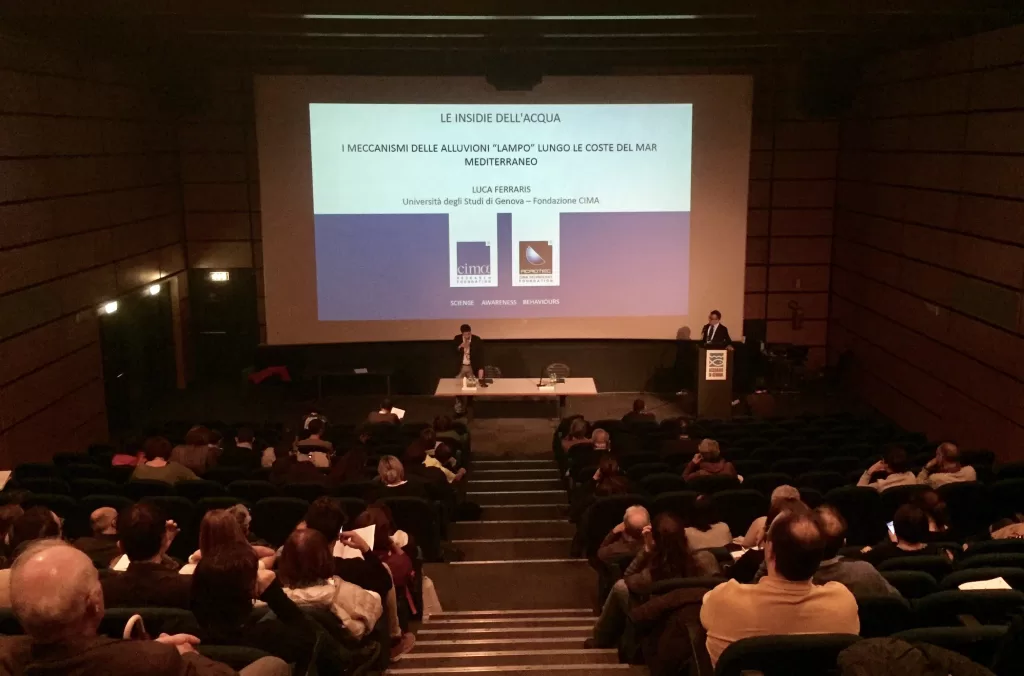
On Saturday, November 2nd, Luca Ferraris, CIMA Research Foundation’s president, gave a talk about storms and floods hitting the coasts of the Mediterranean Sea
What is the origin of the violent storms hitting the coasts of the Mediterranean Sea? Is it possible to forecast them, and to forecast what will the effects on the ground be? Have they always occurred? And how can they be influenced by climate change? On Saturday, November 2nd, within Genoa’s Science Festival, Luce Ferraris, professor at the University of Genoa and president of CIMA Research Foundation, answered to these and other questions in a conference entitled “The traps of the water”. Giancarlo Sturloni, science communicator and expert in risk communication, moderated the conference.
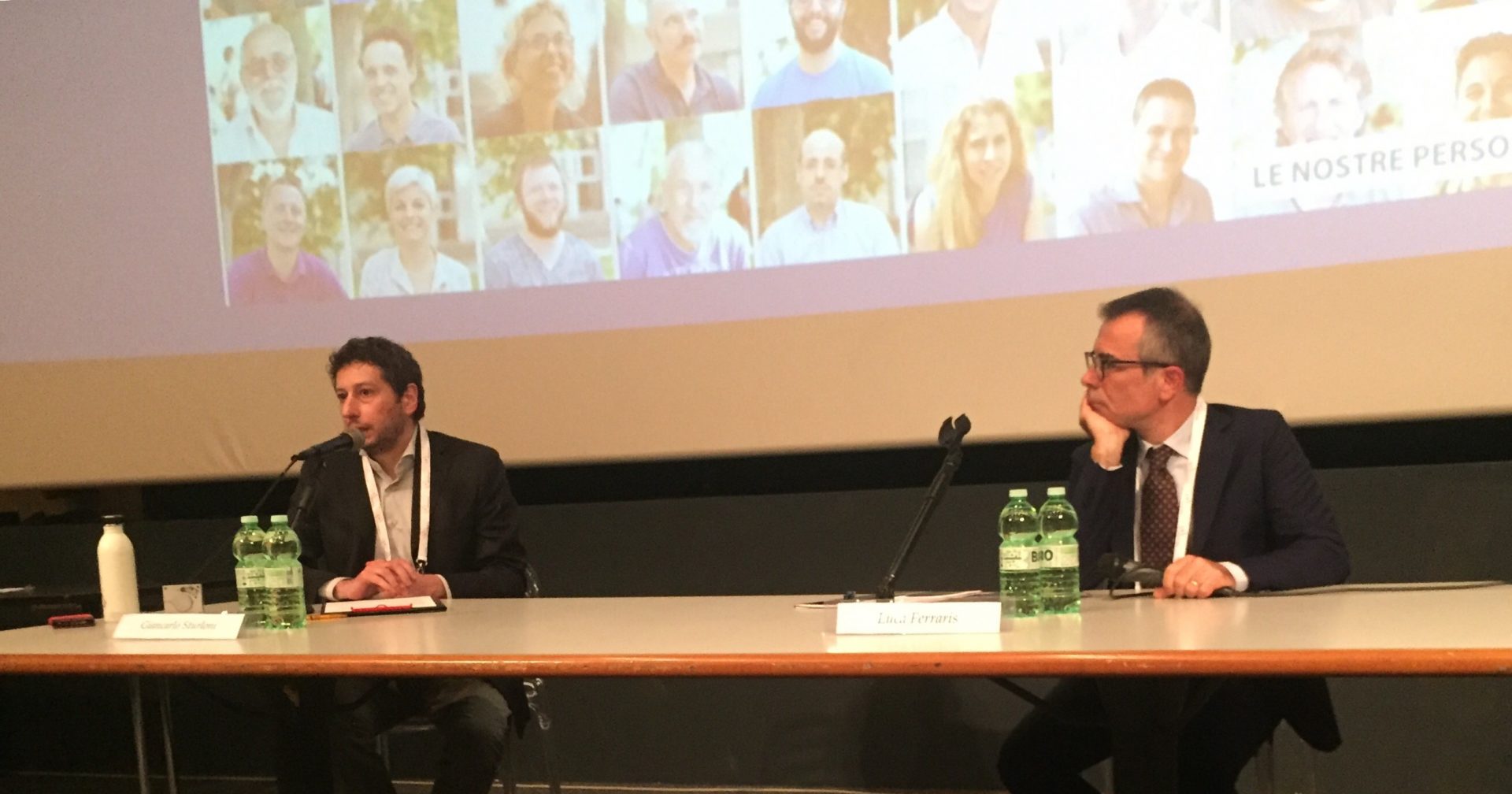
A moment of the conference. On the left, Giancarlo Sturloni, science communicator; on the right, Luca Ferraris, CIMA Research Foundation’s president
The atmospheric processes underlying storms and floods
Now in its 17th edition, the Genoa’s Science Festival was this year dedicated to the subject “Elements”. Water, in the ancient times, was one of the most important elements, source of life as well as of danger. Genoa, as other cities on the Mediterranean Sea, knows this very well. The strong storms during the fall, as the ones occurred in the last weeks, caused and are still causing victims and extensive damage. It is the water that the Geoan songwriter Fabrizio De André, in a song dedicated to the 1970’s flood, defined as “black hitting strong, kicking the doors down”.
This water has a very particular origin. It comes from an encounter between the cold air coming from the Po valley and the hot air taken by winds as the scirocco. The storms deriving from this encounter, when observed from the satellites, are characterized by a V-shape – a highly localized structure, which discharges huge amount of water on a restricted area.
Let’s imagine discharging the same amount of water in the same area of a swimming-pool or of a bathtub. In the swimming-pool, the effects would be scarcely visible, while the bathtub would be quickly full. This is the mechanism explaining why the strong and localized storms have particularly pronounced effects on small basins as the Ligurian ones, often hit by floods.
Past history and future prospective of storms
It is commonly thought that these are relatively recent phenomena. Ferraris explained that a research in the literature of the ‘800 Century allows us to see that this is not completely correct. In the prints and in the texts of the time is in fact possible to recognize the same storms as today, with the same effects on the ground. What has changed over time is, instead, the urbanization of our cities. This is particularly evident in Genoa. Until the half of the ‘800 Century, the city was mainly developed around the harbour, and torrents like Bisagno and Ferreggiano, now sadly famous for their floods, were surrounded by the countryside.
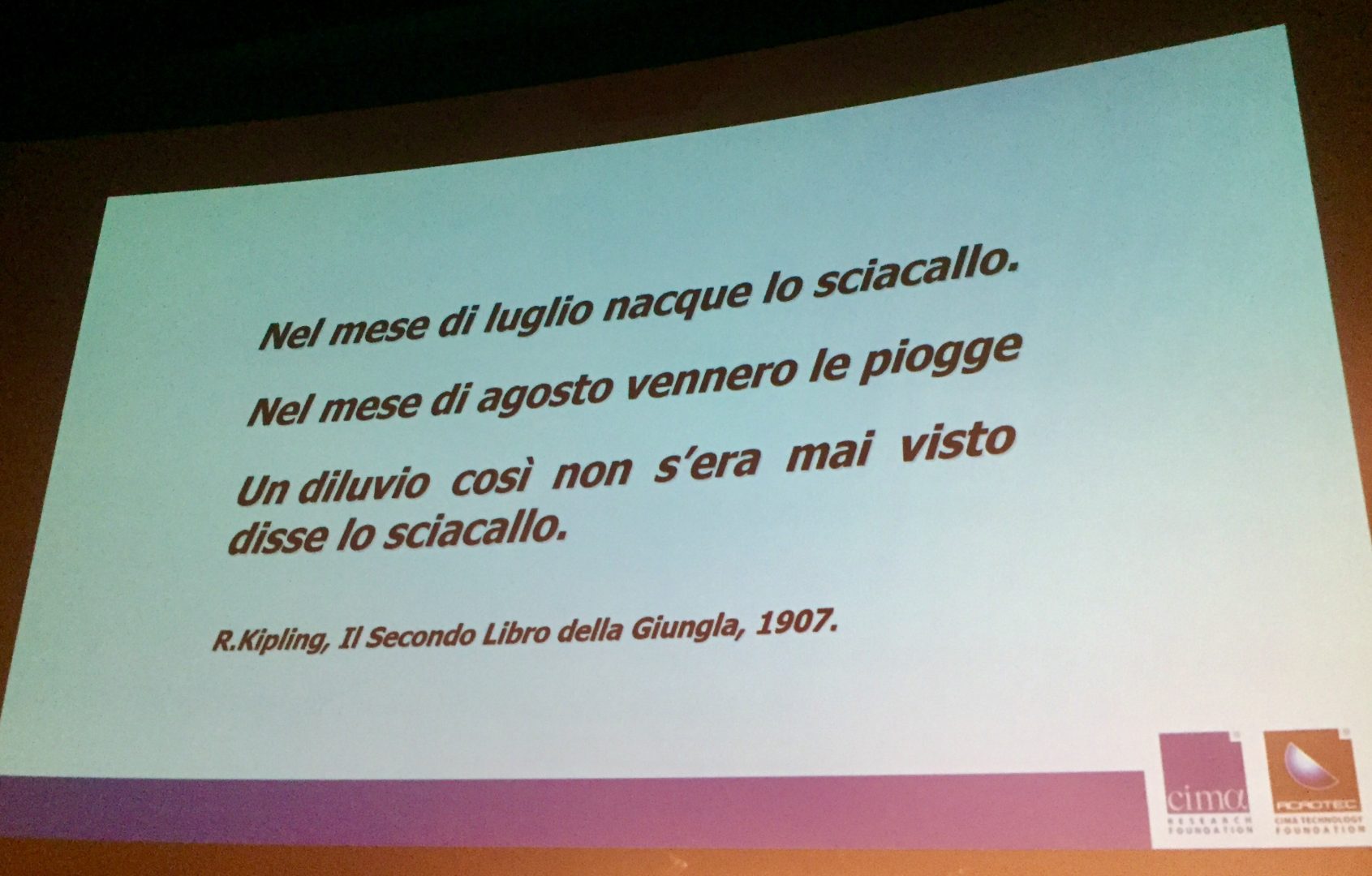
Have the strong storms hitting the Mediterranean coasts always existed? Our perception makes us think that they are a quite recent phenomenon, also because in the past the instruments were not sophisticated enough to record them as precisely as today. A research in the literature and the graphic production of the mid ‘800 suggests that strong storms and floods have always accompanied the history of the region
Already in the 1940 the city was completely changed. The urbanization grew, and the Bisagno torrent was hidden underground, surrounded by public and private buildings. Within this context, the effects of a flood become more relevant, putting at risk people, houses, shops cars in the streets and in the underground parking.
The climate change has a role, too, in influencing storms and associated floods. As suggested by a study conducted by CIMA researchers in 2017, it is possible that the frequency of storms will increase in the next 30 years, with their intensity remaining the same.
Civil protection and active participation of citizens
This is the knowledge that science has today, on storms and their possible affects on the ground. How to use this knowledge for a more efficient civil protection? How to avoid other deaths and damage? It is around this questions that the dialogue between Sturloni, Ferraris and, not least, the public evolved. One of the most important aspects emerged in the discussion was the role of the active involvement of the citizens in civil protection strategies. Since the introduction of the meteorological alert, alerts are considered not only a tool for technicians but also a fundamental communication instrument for warning the population about a possible risk. Possible, not sure, because despite the development of the modelling used for the forecasts, we still can’t have the total certainty that there will be a storm, how strong it will be and in which that exact area.
To face uncertainty is not simple but it’s a fundamental aspect to be understood by technicians in charge for the risk management, administrations and by citizens which must be an active part of the risk management. To know (and to take seriously) the alerts, to put in place auto-protection behaviours, to know which are the zones at risk: these are all actions required from all of us in order to avoid the disasters of the past and to grow as risk resilient communities.
The conference was a moment to think about these themes. It was also an important moment of exchange, thanks to the moderation by a communication expert and the interaction with the public, which allowed to combine strictly scientific knowledge with the needs and the perspectives of whom is not from the sector but still has to deal with it every time that, for example, there is an alert. These are the type of exchanges that CIMA Research Foundation looks forward for its research in civil protection.